
Free Safe Operating Procedure (Boat Refuelling) Template
Download our free Safe Operating Procedure (Boat Refuelling) Template. This DOCX and PDF resource helps you outline safe refuelling steps. Customise it today.
Free Safe Operating Procedure (Boat Refuelling) Template
DOCX • 126 KB + PDF
Updated Oct 2026
No signup required
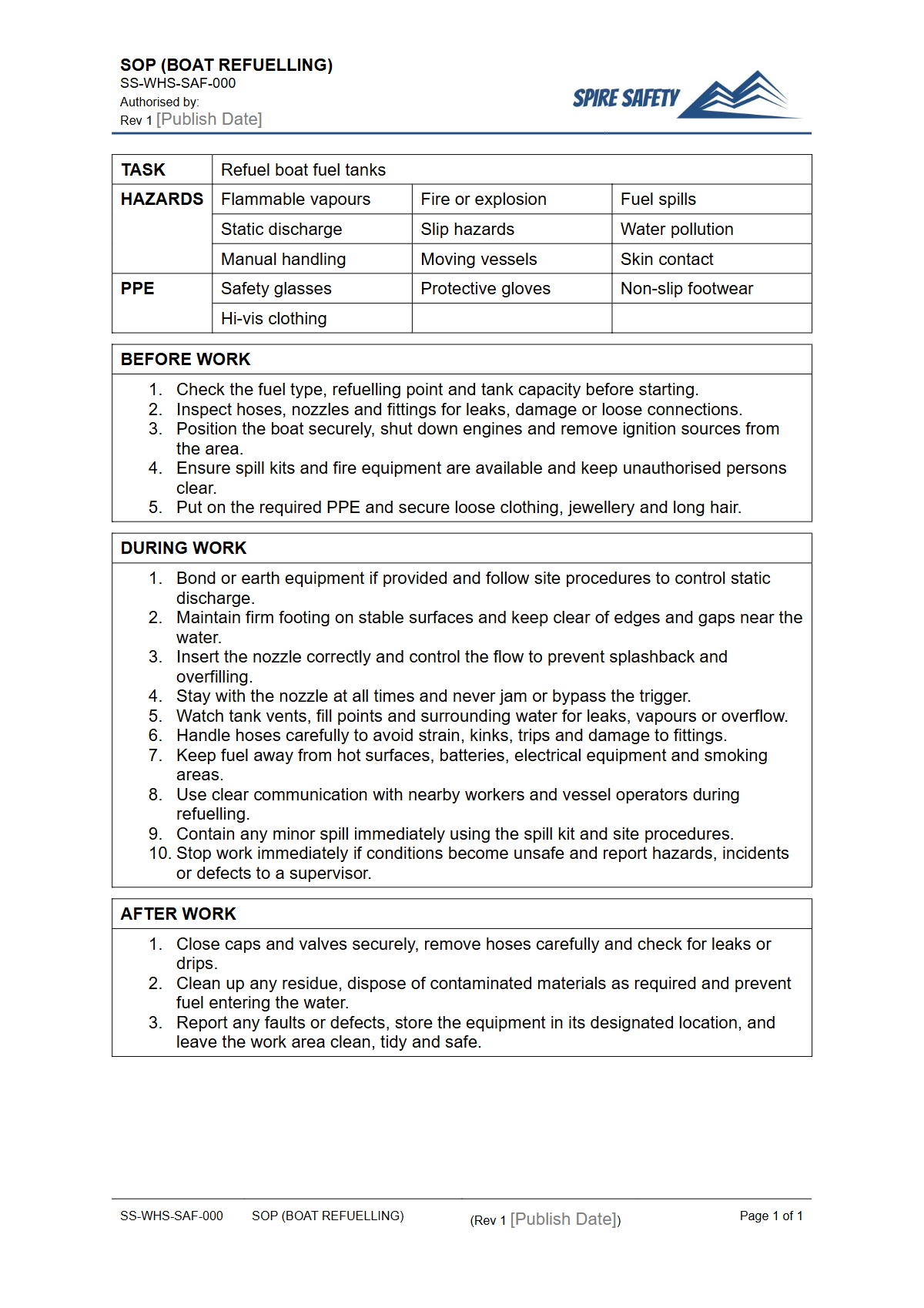
Purpose of the Free Safe Operating Procedure (Boat Refuelling) Template
This Free Safe Operating Procedure (Boat Refuelling) Template provides a structured framework for documenting the risks and control measures associated with refuelling marine vessels. Handling flammable liquids like petrol or diesel presents significant hazards, including fire, explosion, chemical spills, and vapour inhalation.
This SOP template is a crucial starting point for any Person Conducting a Business or Undertaking (PCBU) in the maritime, commercial fishing, or tourism sectors to establish and communicate a safe system of work. It is designed to be adapted to your specific operational needs, ensuring all personnel understand their responsibilities for preventing incidents.
A documented SOP helps standardise safety-critical tasks, reducing the likelihood of human error. By clearly outlining steps for preparation, refuelling, and post-task cleanup, you create a repeatable and auditable process.
Integrating this procedure into your broader WHS management systems ensures a consistent approach to safety across all your operations.
Video walkthrough
How to use the Free Safe Operating Procedure (Boat Refuelling) Template
To get the most value from the Free Safe Operating Procedure (Boat Refuelling) Template, you must adapt its contents to your unique work environment. A generic document is not sufficient for managing specific risks; customisation is essential for effective WHS management.
Download the template in your preferred format (DOCX for easy editing or PDF) and begin the customisation process by consulting with the workers who will actually perform the task. Their direct experience is invaluable for identifying practical hazards and effective controls.
Key Sections to Customise
- PPE: Specify the exact personal protective equipment required, such as solvent-resistant gloves, safety glasses, and appropriate footwear.
- Equipment: List the specific vessels, fuel types (petrol/diesel), and refuelling equipment (e.g., fixed bowser, portable fuel containers, funnels) used in your operations.
- Procedure Steps: Detail the step-by-step process, from mooring the vessel and shutting down engines to grounding nozzles and monitoring fuel levels.
- Emergency Response: Outline clear, site-specific actions for fuel spills, fires, or medical emergencies. Include the location of fire extinguishers and spill kits.
Note: We have provided a comprehensive template aligned with Australian WHS practice. However, it is essential that you customise it to reflect the specific equipment, substances, and environmental conditions at your workplace.
If you need expert assistance tailoring this document to your specific maritime operations, our WHS consulting services can provide tailored support.
When to use a Safe Operating Procedure
A Safe Operating Procedure for boat refuelling should be used as a primary reference document for all refuelling activities. It serves multiple functions within your safety system.
It is an essential training tool for inducting new skippers, deckhands, or marina staff, ensuring they learn the correct, safe method from the outset. It also acts as a ready-reference for experienced personnel, reinforcing best practices and preventing complacency.
The SOP should also be reviewed and used during the planning of non-routine refuelling tasks or when conducting a risk assessment for a new vessel or refuelling location.
The principles of documenting procedural safety are universal, whether for marine vessels or for land-based equipment. Just as you would for high-risk machinery like that covered in a Dozer SOP, formalising the process for handling flammable liquids is a critical control measure.
Regular checks and verification that the SOP is being followed correctly can be incorporated into a formal WHS compliance auditing program.
Who should use it
This SOP is intended for a range of personnel within an organisation to ensure a comprehensive approach to safety. The responsibility for health and safety is shared, and this document supports various roles in fulfilling their duties.
- PCBUs and Directors: Use the SOP to demonstrate due diligence and ensure a safe system of work is in place, as required by WHS legislation.
- Managers and Supervisors: Use it to train, supervise, and monitor workers, ensuring the procedure is understood and followed correctly.
- Workers (Skippers, Deckhands, Marina Staff): Refer to the SOP to understand and follow the mandated safety steps required to perform their job without risk to themselves, others, or the environment.
- WHS Officers and Advisors: Integrate the procedure into the organisation's overall safety management system, using it as a basis for risk assessments, incident investigations, and continuous improvement activities.
The procedural logic in this document extends to other equipment where energy sources and pre-checks are critical, as seen in our Air Compressor SOP template. This SOP template is one of many documents available to help you build a robust safety system; you can explore more in our free WHS resources library.
Common mistakes
Common mistakes to avoid
- Refuelling while engines are running, electrical equipment is active, or passengers are aboard.
- Failing to ensure good natural ventilation to disperse flammable vapours before and during refuelling.
- Not having a dedicated spill kit and fire extinguisher immediately accessible at the refuelling point.
- Overfilling the tank, which can lead to spills into the waterway via overflows and vents.
Legal references
Legal considerations
The following legal requirements may be relevant to this type of work.
- Work Health and Safety Act (Harmonised) — Provides the primary duties for protecting workers and other people from work health and safety risks.
- Work Health and Safety Regulations (Harmonised) — Sets out requirements supporting the management of workplace hazards and risks.
The following codes may be relevant to this type of work.
- Managing WHS Risks Code of Practice — Provides practical guidance on identifying hazards, assessing risks and applying effective controls.
- Work Health and Safety Consultation, Cooperation and Coordination Code of Practice — Provides practical guidance on consulting workers and coordinating with other duty holders.
- Managing the Work Environment and Facilities Code of Practice — Provides practical guidance on safe work environments, workplace facilities and related controls.
Did you know
Static Spark
A static spark from a plastic fuel container or an ungrounded nozzle can have enough energy to ignite petrol vapours, which are heavier than air and can accumulate in a boat's bilge.
Fuel Expansion
Petrol can expand by nearly 10% when it warms up. Overfilling a tank on a cool morning can lead to a dangerous spill from the vents as the day's heat causes the fuel to expand.
FAQ
Frequently asked questions
01What key information should be in a boat refuelling SOP?
02Why is a specific SOP for boat refuelling necessary?
03Who is responsible for developing a boat refuelling procedure?
04How often should a boat refuelling SOP be reviewed?
Share this resource
Free Safe Operating Procedure (Boat Refuelling) Template
Browse Categories
How To Use It
- 1Download and open in Word or PDF.
- 2Replace the placeholders with your business details.
- 3Get it reviewed by a WHS specialist before rollout.
Need it customised?
Our WHS consultants can adapt this template to your site, run a gap analysis, or audit what you already have in place.
Book a Free Consultation WHS consulting servicesor call 1300 156 382
Related templates
- Free Safe Operating Procedure (Boat Retrieval) Template
- Free Safe Operating Procedure (Boat Trailer) Template
- Free Safe Operating Procedure (Boat Waste Removal) Template
- Free Safe Operating Procedure (Bocce Court Grooming) Template
- Free Safe Operating Procedure (Body Bag Handling) Template
- Free Safe Operating Procedure (Body Filler Sanding) Template