
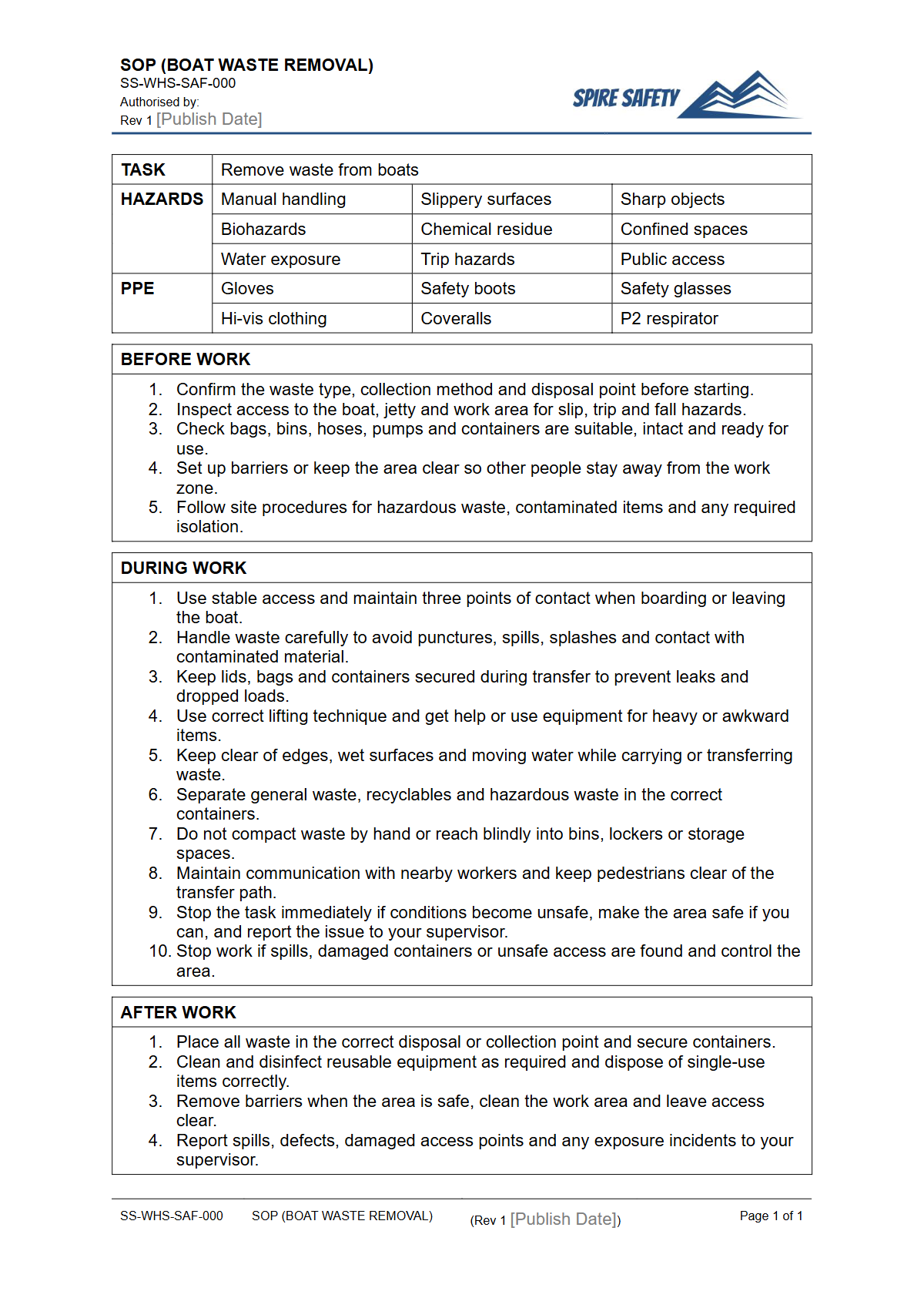
Free Safe Operating Procedure (Boat Waste Removal) Template
Develop a safe system of work for removing waste from vessels with our structured template. Aligned with Australian WHS practice. Download your free SOP now.
Free Safe Operating Procedure (Boat Waste Removal) Template
DOCX • 126 KB + PDF
Updated Oct 2026
No signup required
Purpose of the Free Safe Operating Procedure (Boat Waste Removal) Template
Managing waste on marine vessels is a critical task with significant health, safety, and environmental implications. This Free Safe Operating Procedure (Boat Waste Removal) Template provides a structured framework for documenting a safe and repeatable process.
Using an SOP helps to identify potential hazards, such as exposure to biological or chemical contaminants, manual handling risks, and environmental spillages. It formalises the control measures required to mitigate these risks, ensuring that all workers understand their responsibilities and follow a consistent, safe method for every job.
A well-defined SOP is a fundamental component of a safe system of work. It serves as a vital training tool for new employees and a reference for experienced operators, reinforcing safe behaviour and procedural compliance.
Integrating this procedure is a practical step towards building robust WHS management systems, demonstrating a commitment to protecting your people and the marine environment.
Video walkthrough
How to use the Free Safe Operating Procedure (Boat Waste Removal) Template
This document is a starting point designed to be adapted to your specific operational context. Before implementation, a Person Conducting a Business or Undertaking (PCBU) must conduct a site-specific risk assessment for the boat waste removal tasks performed.
You must customise this template to reflect your unique vessels, equipment (e.g., pumps, containers, dollies), waste types (sewage, greywater, oily waste, general rubbish), and onshore disposal facilities.
Important: We have created this template as a guide. You are responsible for ensuring it aligns with your specific machinery, tasks, control measures, and legal obligations.
Consultation with your workers is a crucial part of this customisation process. If you are unsure how to conduct the necessary risk assessments or tailor this document effectively, seeking specialist WHS consulting is recommended to ensure your procedures are robust and effective.
When to use it
A Safe Operating Procedure for boat waste removal should be consulted before the task is performed every single time. Its primary purpose is to guide the pre-operational checks, the step-by-step execution of the job, and the post-task cleanup and documentation. It is particularly important in several key situations:
- Training and Induction: When onboarding new crew members or contractors who will be involved in waste management activities.
- Refresher Training: For periodic training sessions to ensure all workers remain familiar with the established safe procedures.
- After an Incident: The SOP should be a key document for review during an incident investigation to determine if procedural gaps contributed to the event.
- During Audits and Inspections: To demonstrate to regulators or clients that a formalised, safe system of work is in place.
- Procedural Changes: Whenever new equipment is introduced or the process for removing waste is modified.
Who should use it
This SOP is intended for use across various roles within the maritime and associated industries. It provides essential guidance for anyone involved in or responsible for the management of waste on vessels. Key users include:
- PCBUs and Business Owners: In marinas, shipyards, and commercial vessel operations, who hold the primary duty of care to ensure worker safety.
- Managers and Supervisors: To direct work, conduct training, and verify that procedures are being followed correctly.
- Workers and Crew Members: The operators who physically perform the waste removal tasks must understand and follow the SOP to protect themselves and others.
- WHS Professionals: Safety officers and advisors can use this template as a foundation for developing comprehensive safety documentation.
The procedure is also useful for those involved in transporting the waste after it is removed from the vessel. For example, if waste is decanted into a larger vehicle for transport, operators must follow safe work procedures for a body truck to manage road safety and spill risks. Similarly, the process may involve working at heights or in awkward positions, making it essential that workers understand protocols for using equipment like a step ladder safely. If the process involves pumping liquids, workers may also need to reference a specific safe operating procedure for boom pumps.
For more templates and safety documents covering a wide range of tasks and equipment, browse our complete free WHS resources library.
Common mistakes
Common mistakes to avoid
- Failing to correctly segregate different waste streams (e.g., general, oily, sewage).
- Using inadequate manual handling techniques for heavy or awkward containers.
- Neglecting to maintain or inspect waste removal equipment like pumps and hoses.
- Poor record-keeping for waste disposal, which is often a regulatory requirement.
Legal references
Legal considerations
The following legal requirements may be relevant to this type of work.
- Work Health and Safety Act (Harmonised) — Provides the primary duties for protecting workers and other people from work health and safety risks.
- Work Health and Safety Regulations (Harmonised) — Sets out requirements supporting the management of workplace hazards and risks.
The following codes may be relevant to this type of work.
- Managing WHS Risks Code of Practice — Provides practical guidance on identifying hazards, assessing risks and applying effective controls.
- Work Health and Safety Consultation, Cooperation and Coordination Code of Practice — Provides practical guidance on consulting workers and coordinating with other duty holders.
- Managing the Work Environment and Facilities Code of Practice — Provides practical guidance on safe work environments, workplace facilities and related controls.
Did you know
Marine Pollution Rules
Under international MARPOL regulations, it is illegal to discharge untreated sewage from vessels within 3 nautical miles of the Australian coast, with specific rules applying to treated sewage and discharge further offshore.
FAQ
Frequently asked questions
01What are the main hazards in boat waste removal?
02What PPE should be worn for boat waste removal?
03Is an SOP a legal requirement for removing boat waste?
04How often should a boat waste removal SOP be reviewed?
Share this resource
Free Safe Operating Procedure (Boat Waste Removal) Template
Browse Categories
How To Use It
- 1Download and open in Word or PDF.
- 2Replace the placeholders with your business details.
- 3Get it reviewed by a WHS specialist before rollout.
Need it customised?
Our WHS consultants can adapt this template to your site, run a gap analysis, or audit what you already have in place.
Book a Free Consultation WHS consulting servicesor call 1300 156 382
Related templates
- Free Safe Operating Procedure (Bocce Court Grooming) Template
- Free Safe Operating Procedure (Body Bag Handling) Template
- Free Safe Operating Procedure (Body Filler Sanding) Template
- Free Safe Operating Procedure (Bollard Cleaning) Template
- Free Safe Operating Procedure (Bollard Maintenance) Template
- Free Safe Operating Procedure (Bolt Cutter) Template