
Free Safe Operating Procedure (Body Bag Handling) Template
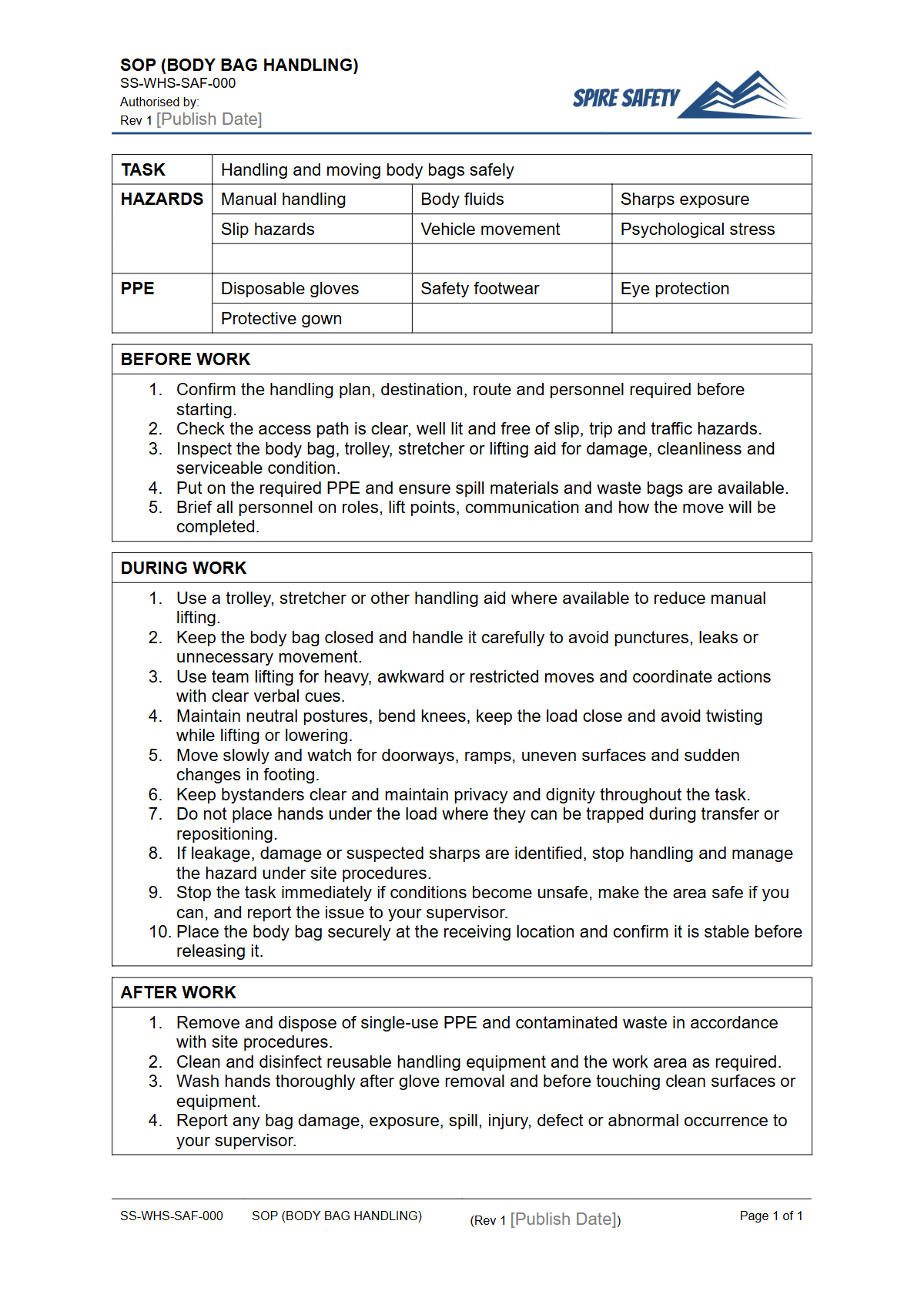
Download our free Safe Operating Procedure (Body Bag Handling) Template. This DOCX and PDF resource helps outline safe work practices for a sensitive task.
Free Safe Operating Procedure (Body Bag Handling) Template
DOCX • 126 KB + PDF
Updated Oct 2026
No signup required
Purpose of the Free Safe Operating Procedure (Body Bag Handling) Template
Handling deceased persons requires the utmost respect, dignity, and a stringent focus on worker safety. This free Safe Operating Procedure (Body Bag Handling) Template provides a structured starting point for organisations to document the required safety measures for this sensitive task.
The purpose of an SOP is to standardise procedures, ensuring that every worker understands the risks and follows the same safe steps every time. It outlines key considerations, including manual handling techniques, required Personal Protective Equipment (PPE), infection control protocols, and steps for managing potential biological hazards.
A well-defined SOP is a critical component in managing workplace health and safety. It demonstrates a commitment to protecting workers from physical and psychological harm.
Implementing this procedure helps create a safer work environment and forms a foundational part of broader WHS management systems, integrating safety into your organisation's daily operations.
Video walkthrough
How to use the Free Safe Operating Procedure (Body Bag Handling) Template
This document is a template, not a finished procedure. To use it effectively, you must customise it to reflect the specific circumstances of your workplace.
Download the DOCX file and adapt the contents to align with your unique equipment, environment, staffing, and the specific types of tasks your workers perform. This customisation is essential for ensuring the procedure is practical and relevant.
Once customised, the SOP should be used as a key training resource for all relevant personnel. It serves as a clear reference for correct procedure and a benchmark for workplace inspections and observations.
Regularly reviewing its effectiveness is crucial, and this process can be supported through formal WHS compliance auditing to verify that the documented procedures are being consistently followed in practice.
Customisation is required
Important: This is a template document. You must consult with your workers and adapt the content to the specific hazards, risks, and equipment in your workplace.
We are not liable for any incidents that may arise from the use of this document.
When to use it
A Safe Operating Procedure for body bag handling should be implemented and followed whenever a worker is required to prepare, lift, move, or transport a deceased person using a body bag. This task is common in a variety of sectors and scenarios.
These include funeral homes and mortuaries during preparation and transport, hospitals and aged care facilities when moving a deceased patient, and by first responders like paramedics and police at incident scenes.
The SOP is also critical for coronial and forensic services where evidence preservation may be an additional factor. The procedure should cover all phases of the task, from the initial approach and assessment of the scene to the final handover.
For tasks involving vehicle transport, this SOP should be used in conjunction with other relevant procedures, such as our FREE Body Truck SOP (Safe Operating Procedure) Template, to ensure end-to-end safety.
Who should use it
This Safe Operating Procedure is intended for any person conducting a business or undertaking (PCBU) whose workers perform tasks involving body bag handling. The finalised SOP should be used by all workers who are directly involved in or supervise the task. This includes, but is not limited to:
- Funeral directors and mortuary assistants
- Paramedics and ambulance officers
- Police officers and forensic investigators
- Hospital porters and patient care assistants
- Aged care facility staff
- Emergency services personnel
Supervisors and managers must ensure that workers are thoroughly trained on the customised SOP before they undertake the task. For organisations requiring specialised guidance on developing procedures for such unique and sensitive tasks, engaging external expertise through WHS consulting can provide valuable support and ensure all risks are adequately addressed. For more templates and safety documents, browse our complete free WHS resources library.
Common mistakes
Common mistakes to avoid
- Using poor manual handling techniques, such as twisting the back while lifting.
- Failing to wear appropriate Personal Protective Equipment (PPE) or not following correct donning and doffing procedures.
- Not providing adequate psychological support or debriefing opportunities for workers after performing the task.
- Assuming a single generic procedure is sufficient, without customising it for specific scenarios or environments.
Legal references
Legal considerations
The following legal requirements may be relevant to this type of work.
- Work Health and Safety Act (Harmonised) — Provides the primary duties for protecting workers and other people from work health and safety risks.
- Work Health and Safety Regulations (Harmonised) — Sets out requirements supporting the management of workplace hazards and risks.
The following codes may be relevant to this type of work.
- Managing WHS Risks Code of Practice — Provides practical guidance on identifying hazards, assessing risks and applying effective controls.
- Work Health and Safety Consultation, Cooperation and Coordination Code of Practice — Provides practical guidance on consulting workers and coordinating with other duty holders.
- Managing the Work Environment and Facilities Code of Practice — Provides practical guidance on safe work environments, workplace facilities and related controls.
Did you know
Psychosocial Hazards
Work involving exposure to traumatic events is a significant psychosocial hazard. Australian WHS regulations now require PCBUs to manage risks to psychological health with the same diligence as physical health.
Manual Tasks
Manual handling injuries are one of the most common types of workplace injuries in Australia. A single serious injury claim can cost an employer tens of thousands of dollars in direct costs and lost productivity.
FAQ
Frequently asked questions
01What are the main hazards involved in body bag handling?
02Does this SOP template cover infection control procedures?
03Is specific training required to handle body bags safely?
04How often should a Safe Operating Procedure for body bag handling be reviewed?
Share this resource
Free Safe Operating Procedure (Body Bag Handling) Template
Browse Categories
How To Use It
- 1Download and open in Word or PDF.
- 2Replace the placeholders with your business details.
- 3Get it reviewed by a WHS specialist before rollout.
Need it customised?
Our WHS consultants can adapt this template to your site, run a gap analysis, or audit what you already have in place.
Book a Free Consultation WHS consulting servicesor call 1300 156 382
Related templates
- Free Safe Operating Procedure (Body Filler Sanding) Template
- Free Safe Operating Procedure (Bollard Cleaning) Template
- Free Safe Operating Procedure (Bollard Maintenance) Template
- Free Safe Operating Procedure (Bolt Cutter) Template
- Free Safe Operating Procedure (Bolt Tensioner) Template
- Free Safe Operating Procedure (Boom Deployment) Template