
Free Safe Operating Procedure (Bollard Cleaning) Template
Download our free Safe Operating Procedure (SOP) for bollard cleaning. This customisable template helps you document safe work steps. Get your DOCX and PDF now.
Free Safe Operating Procedure (Bollard Cleaning) Template
DOCX • 126 KB + PDF
Updated Oct 2026
No signup required
Purpose of the Free Safe Operating Procedure (Bollard Cleaning) Template
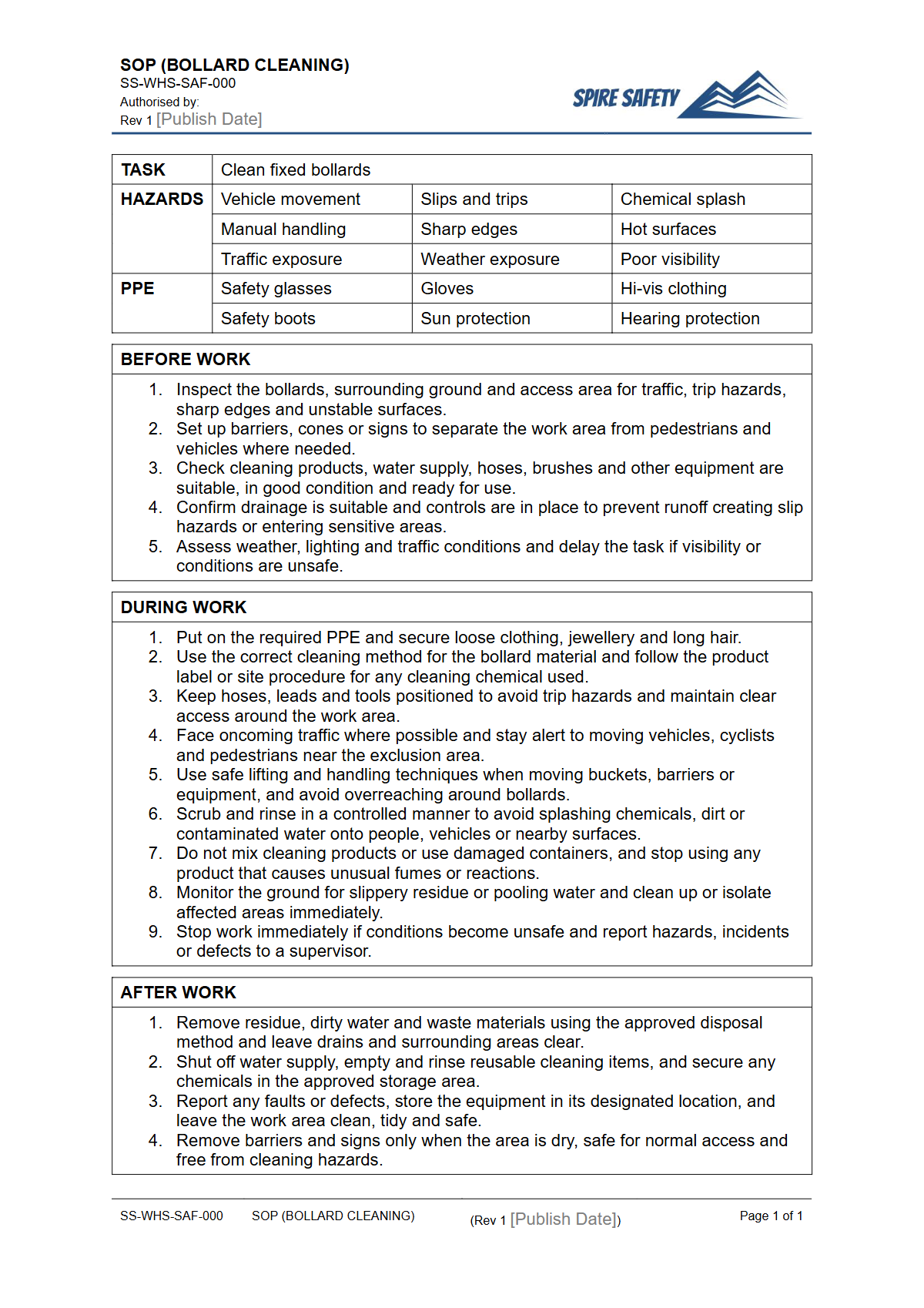
Our Free Safe Operating Procedure (Bollard Cleaning) Template provides a structured framework for documenting the safe and correct way to clean bollards in any workplace. This task, while seemingly simple, involves potential hazards such as traffic interaction, manual handling, chemical exposure, and slips or trips.
This SOP helps you formally identify these risks and specify the control measures required to protect your workers.
By implementing a clear SOP, you establish a consistent, safe method for the task, which is a fundamental part of a robust safety system. It serves as a vital tool for training, supervision, and risk management.
This document is a solid starting point, aligned with Australian WHS principles, helping you fulfil your duty of care. An effective SOP is a cornerstone of a complete safety framework, which is why many organisations choose to develop comprehensive WHS management systems.
Video walkthrough
How to use the Free Safe Operating Procedure (Bollard Cleaning) Template
Using the Free Safe Operating Procedure (Bollard Cleaning) Template correctly involves adapting it to the unique conditions of your site. It is not a complete, out-of-the-box solution.
A generic document cannot account for all site-specific variables, from traffic flow to the types of cleaning agents used.
IMPORTANT: This is a template only. We provide this resource as a starting point.
You must consult with your workers and adapt this document to the specific equipment, chemicals, environment, and risks at your workplace. You are responsible for ensuring it is suitable and sufficient for your needs.
Follow these steps to implement it effectively:
- Download: Choose the DOCX format for easy editing or the PDF for immediate use.
- Customise: Fill in the details specific to your organisation, including site locations, designated personnel, and the specific types of bollards (e.g., steel, concrete, plastic).
- Consult: Involve the workers who will be performing the cleaning. Their practical experience is invaluable for identifying all the real-world hazards and practical controls.
- Detail the Process: Document the step-by-step cleaning procedure, required personal protective equipment (PPE), pre-start checks, and emergency responses.
- Train: Formally train all relevant employees on the finalised SOP and keep records of this training.
- Review: Schedule regular reviews of the SOP, especially after an incident or when a process changes. If you need expert assistance in tailoring safety documents, our WHS consulting services can provide tailored support.
When to use a Bollard Cleaning SOP
A Safe Operating Procedure for bollard cleaning should be used consistently to guide behaviour and manage risk. It is particularly important in several situations:
- Training and Induction: Use it to train new employees or contractors on the established safe method for the task.
- Pre-Start Tool: Workers can use the SOP as a pre-task checklist to ensure all safety controls are in place before they begin.
- Refresher Training: It is a useful document for periodic refresher training to prevent complacency.
- Incident Investigation: If an incident or near-miss occurs during cleaning, the SOP is a key document to review to identify what went wrong.
- Workplace Audits: Supervisors can use the SOP as a benchmark when conducting safety observations or formal inspections of work practices.
Given that bollards are often located in or near vehicle operating areas, it's crucial to consider traffic management. The procedures must align with any broader site rules, similar to how a body truck SOP would detail interactions with pedestrians and infrastructure.
Who should use this Safe Operating Procedure
This SOP template is designed for anyone responsible for overseeing or performing facility maintenance and cleaning tasks. This includes:
- WHS Managers and Advisors: To standardise procedures and ensure a documented system of work is in place.
- Facility Managers and Supervisors: To manage their teams, assign work, and ensure it is completed safely.
- Team Leaders and Leading Hands: To conduct pre-start talks and supervise the task on the ground.
- Cleaning and Maintenance Workers: As the end-users, they rely on the SOP for clear, step-by-step instructions on how to perform their job without harm.
If cleaning requires working at a slight height, for example on taller architectural bollards, additional controls for preventing falls are necessary. A specific step ladder SOP should be referenced or integrated into your procedure. The same applies if heavy equipment operates nearby; controls must be in place to manage interactions with machinery, which would be covered in documents like a FREE Telehandler SOP (Safe Operating Procedure) Template. For more templates covering a wide range of tasks and equipment, you can explore our free WHS resources library.
Common mistakes
Common mistakes to avoid
- Failing to set up an adequate exclusion zone to protect workers from vehicle traffic.
- Using incorrect or poorly diluted cleaning chemicals, leading to surface damage or health risks.
- Neglecting proper manual handling techniques when carrying water buckets and equipment.
- Forgetting to display 'wet floor' or 'cleaning in progress' signs to warn pedestrians.
Legal references
Legal considerations
The following legal requirements may be relevant to this type of work.
- Work Health and Safety Act (Harmonised) — Provides the primary duties for protecting workers and other people from work health and safety risks.
- Work Health and Safety Regulations (Harmonised) — Sets out requirements supporting the management of workplace hazards and risks.
The following codes may be relevant to this type of work.
- Managing WHS Risks Code of Practice — Provides practical guidance on identifying hazards, assessing risks and applying effective controls.
- Work Health and Safety Consultation, Cooperation and Coordination Code of Practice — Provides practical guidance on consulting workers and coordinating with other duty holders.
- Managing the Work Environment and Facilities Code of Practice — Provides practical guidance on safe work environments, workplace facilities and related controls.
Did you know
Origin of the Bollard
The term 'bollard' originally referred to a post on a ship or quay used for mooring. Their use on land for directing traffic only became common with the rise of the automobile.
Slips, Trips, and Falls
Slips, trips and falls are a leading cause of workplace injury in Australia, making controls like 'wet floor' signs and non-slip footwear critical for tasks involving water or cleaning fluids.
FAQ
Frequently asked questions
01What are the main hazards involved in cleaning bollards?
02Why is an SOP needed for a simple task like cleaning bollards?
03What PPE is typically required for cleaning bollards?
04How often should a Safe Operating Procedure for bollard cleaning be reviewed?
Share this resource
Free Safe Operating Procedure (Bollard Cleaning) Template
Browse Categories
How To Use It
- 1Download and open in Word or PDF.
- 2Replace the placeholders with your business details.
- 3Get it reviewed by a WHS specialist before rollout.
Need it customised?
Our WHS consultants can adapt this template to your site, run a gap analysis, or audit what you already have in place.
Book a Free Consultation WHS consulting servicesor call 1300 156 382
Related templates
- Free Safe Operating Procedure (Bollard Maintenance) Template
- Free Safe Operating Procedure (Bolt Cutter) Template
- Free Safe Operating Procedure (Bolt Tensioner) Template
- Free Safe Operating Procedure (Boom Deployment) Template
- Free Safe Operating Procedure (Boom Gate Operation) Template
- Free Safe Operating Procedure (Boom Spray Operation) Template