
Free Safe Operating Procedure (Bollard Maintenance) Template
Download our free Safe Operating Procedure for bollard maintenance. This customisable DOCX & PDF helps you create clear WHS instructions for your site.
Free Safe Operating Procedure (Bollard Maintenance) Template
DOCX • 126 KB + PDF
Updated Oct 2026
No signup required
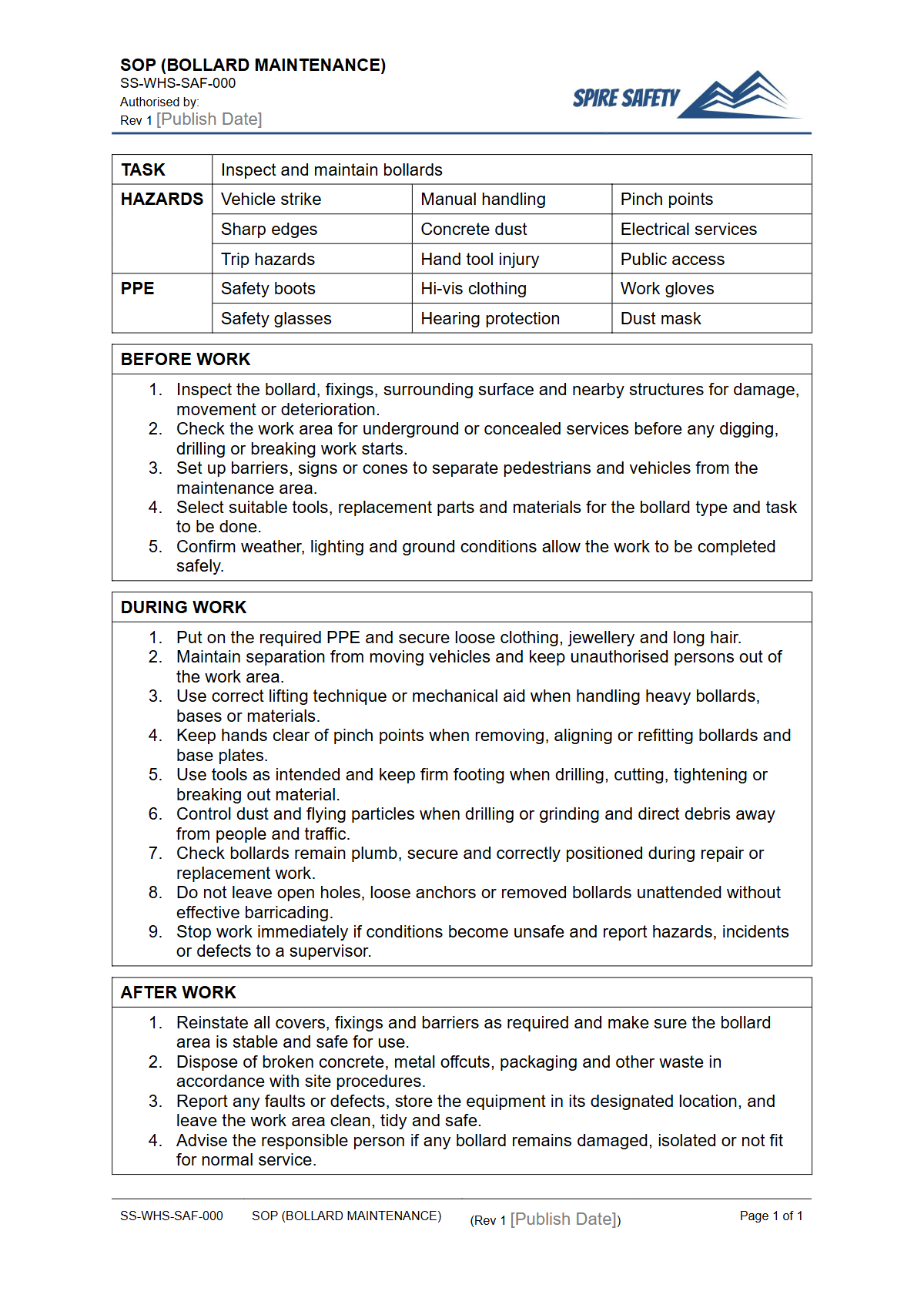
Purpose of the Free Safe Operating Procedure (Bollard Maintenance) Template
Bollards are critical safety and security assets, protecting pedestrians, buildings, and sensitive areas from vehicle impact. However, their effectiveness relies on correct installation and regular maintenance.
This Free Safe Operating Procedure (Bollard Maintenance) Template provides a structured framework for documenting the required steps to inspect, clean, and repair bollards safely and consistently. Using a formal SOP helps standardise the task across all personnel, ensuring key safety checks are never missed.
It formalises hazard identification—such as manual handling, pinch points, trip hazards, and exposure to live traffic—and outlines specific control measures to mitigate risks.
A well-defined SOP is a fundamental component of a proactive safety culture. It serves as a clear record of your organisation's commitment to maintaining a safe work environment and is a key document within broader WHS management systems. By outlining a clear, repeatable process, you reduce ambiguity for workers and provide a clear benchmark for safety performance, demonstrating due diligence in managing facility safety.
Video walkthrough
How to use the Free Safe Operating Procedure (Bollard Maintenance) Template
This document is a starting point designed for easy customisation. After downloading the DOCX or PDF file, you will need to adapt its contents to suit your specific operational context.
This includes detailing the types of bollards at your site (e.g., steel, concrete, flexible, removable), the specific tools required for maintenance, and the unique environmental conditions of your workplace.
The template includes sections for:
- Required Personal Protective Equipment (PPE)
- Hazard Identification and Risk Controls
- Pre-task Checks and Site Preparation
- Step-by-step Maintenance Procedures (Inspection, Cleaning, Repair)
- Post-task Clean-up and Waste Disposal
- Emergency Procedures
Important: This is a template, not a finished document. We have provided a structured foundation, but you must review and modify it to accurately reflect the specific equipment, chemical products, hazards, and control measures relevant to your workplace.
If you need assistance tailoring this document, our WHS consulting team offers expert guidance.
When to use it
This Safe Operating Procedure should be the primary guidance document for all planned bollard maintenance activities. It is designed to be used by maintenance staff before and during the task to ensure all safety and procedural steps are followed.
It is also an essential training tool for new employees or for refresher training to ensure ongoing competency. The SOP should be reviewed and updated regularly, especially if new types of bollards are installed or if an incident occurs.
It should also be consulted immediately following any incident where a bollard has been impacted by a vehicle or mobile plant, helping guide the assessment and repair process. Preventing these incidents through robust training is also key; for example, using a FREE Body Truck SOP Template can help standardise safe vehicle operation around pedestrian areas and fixed assets.
Who should use it
This SOP is intended for several key roles within an organisation:
- Maintenance Personnel: The primary users who will follow the step-by-step instructions to perform their work safely and effectively.
- Supervisors and Team Leaders: To conduct pre-start briefings, toolbox talks, and to verify that the work is being performed according to the approved procedure.
- Facility and Operations Managers: To ensure a standardised, safe, and efficient process is in place for maintaining critical site infrastructure.
- WHS Managers and Officers: As a key document for risk assessments, training records, and demonstrating compliance with WHS duties.
Maintenance personnel performing the work must be trained on the final, approved SOP. This is especially critical for tasks with elevated risks, such as those requiring work from ladders to service taller, illuminated bollards. In these cases, the procedure must align with other task-specific documents, like a FREE Step Ladder SOP Template.
Supervisors can use the SOP as a checklist for routine inspections and for verifying worker competency. WHS managers will find it an essential piece of evidence during formal WHS compliance auditing, demonstrating that a safe system of work has been established and communicated. Explore our complete free WHS resources library for more templates to support your safety management efforts.
Common mistakes
Common mistakes to avoid
- Failing to implement traffic control measures (barriers, signs) while maintenance is underway.
- Only inspecting the visible post and ignoring the footing, grout, or surrounding pavement for cracks and movement.
- Using incorrect tools or non-compliant fasteners for repairs, which can compromise structural integrity.
- Performing only reactive maintenance after damage instead of conducting scheduled preventative inspections.
Legal references
Legal considerations
The following legal requirements may be relevant to this type of work.
- Work Health and Safety Act (Harmonised) — Provides the primary duties for protecting workers and other people from work health and safety risks.
- Work Health and Safety Regulations (Harmonised) — Sets out requirements supporting the management of workplace hazards and risks.
The following codes may be relevant to this type of work.
- Managing WHS Risks Code of Practice — Provides practical guidance on identifying hazards, assessing risks and applying effective controls.
- Work Health and Safety Consultation, Cooperation and Coordination Code of Practice — Provides practical guidance on consulting workers and coordinating with other duty holders.
- Managing the Work Environment and Facilities Code of Practice — Provides practical guidance on safe work environments, workplace facilities and related controls.
Did you know
More Than Just a Post
A bollard's effectiveness is determined more by its foundation than the visible post. A shallow or poorly installed footing can cause a bollard to fail on impact, regardless of its material strength.
Impact Ratings
High-security bollards are often rated for impact resistance. For example, a PAS 68 rating indicates a bollard has been physically tested to stop a vehicle of a specific mass at a certain speed, providing proven performance.
FAQ
Frequently asked questions
01What should be included in a bollard maintenance SOP?
02How often should bollards be maintained?
03Is a Safe Operating Procedure a legal requirement for bollard maintenance in Australia?
04Can I use this template for hydraulic or automatic bollards?
Share this resource
Free Safe Operating Procedure (Bollard Maintenance) Template
Browse Categories
How To Use It
- 1Download and open in Word or PDF.
- 2Replace the placeholders with your business details.
- 3Get it reviewed by a WHS specialist before rollout.
Need it customised?
Our WHS consultants can adapt this template to your site, run a gap analysis, or audit what you already have in place.
Book a Free Consultation WHS consulting servicesor call 1300 156 382
Related templates
- Free Safe Operating Procedure (Bolt Cutter) Template
- Free Safe Operating Procedure (Bolt Tensioner) Template
- Free Safe Operating Procedure (Boom Deployment) Template
- Free Safe Operating Procedure (Boom Gate Operation) Template
- Free Safe Operating Procedure (Boom Spray Operation) Template
- Free Safe Operating Procedure (Booster Pump Check) Template