
Free Safe Operating Procedure (Booster Pump Check) Template
Streamline your safety processes with our free Safe Operating Procedure (Booster Pump Check) Template. A structured starting point for Australian workplaces.
Free Safe Operating Procedure (Booster Pump Check) Template
DOCX • 126 KB + PDF
Updated Oct 2026
No signup required
Purpose of the Free Safe Operating Procedure (Booster Pump Check) Template
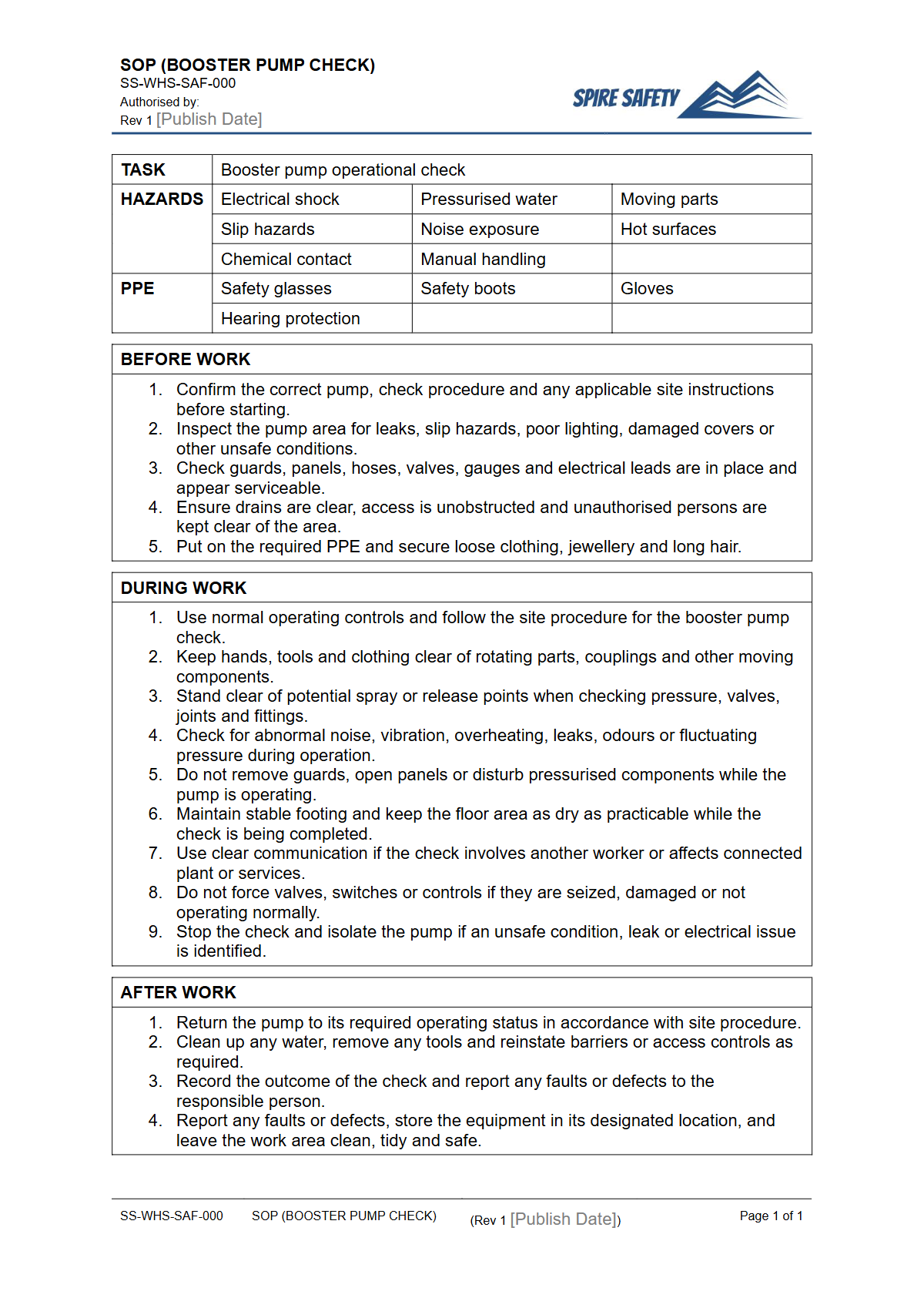
This Safe Operating Procedure (SOP) template provides a structured framework for conducting routine checks on booster pumps, ensuring the task is performed safely and consistently. Using this free Safe Operating Procedure (Booster Pump Check) Template helps organisations meet their duty of care by identifying hazards, assessing risks, and implementing control measures.
It serves as a critical tool for training workers and verifying their understanding of the required safety protocols before they undertake any checks.
A well-documented SOP is a fundamental component of a robust WHS management system. It demonstrates a commitment to proactive risk management and provides a clear, auditable record of the agreed-upon safe work method for maintaining this type of plant. This procedure helps minimise the risk of incidents related to pressure systems, electrical energy, and manual handling.
Video walkthrough
How to use the Free Safe Operating Procedure (Booster Pump Check) Template
This document is available for download in both DOCX and PDF formats. The DOCX file is fully editable, allowing you to tailor the content to the specific requirements of your workplace.
To effectively use this template, you should identify the specific make and model of the booster pumps on your site, review the manufacturer's instructions, and incorporate those details into the procedure.
It is crucial to remember that this document is a template. We have drafted it as a starting point, but you must customise it to reflect the specific booster pump models, site conditions, risk controls, and emergency procedures relevant to your organisation.
Conduct a risk assessment for the task in your environment and ensure the control measures listed are appropriate and sufficient. Similar procedural discipline is required when adapting other templates, such as our free Air Compressor SOP.
Customisation Steps:
- Review and Edit: Open the DOCX file and update the fields for company name, site location, and review dates.
- Specify Equipment: Detail the exact booster pump models used at your facility.
- Incorporate Site-Specific Risks: Add any hazards unique to your operational environment, such as confined space entry, chemical exposure, or noise.
- Consult Workers: Involve operators and maintenance personnel who perform the checks. Their practical input is invaluable for creating a procedure that is both safe and workable.
- Approve and Train: Once finalised, the SOP should be formally approved. All relevant workers must be trained on the procedure, and records of this training should be kept.
When to use a Booster Pump SOP
This SOP should be used every time a scheduled inspection or pre-start check of a booster pump is required. It is designed for routine operational tasks rather than complex maintenance or repair, which may require a separate Safe Work Method Statement (SWMS) or permit-to-work system.
Use this procedure for tasks like checking pressure gauges, inspecting for leaks, monitoring vibration levels, and ensuring guards are in place. High-pressure systems require rigorous procedures, a principle that also applies to equipment covered by our Waterjet Cutter SOP template.
Who should use it
This Safe Operating Procedure should be used by competent workers who have been trained and authorised to inspect and operate booster pumps. This includes maintenance fitters, plant operators, and other personnel tasked with monitoring equipment performance.
Supervisors should also use the SOP to induct new team members, conduct safety observations, and ensure that established procedures are being followed correctly. Competency is not assumed; it must be formally verified for each specific task and piece of equipment.
Key Elements of a Booster Pump Check SOP
A comprehensive SOP for booster pump checks should cover several critical areas to be effective. The template includes sections for Personal Protective Equipment (PPE) requirements, potential hazards and their controls, and a step-by-step operational checklist.
The procedure details pre-start checks, steps for safely starting and stopping the pump, and observations to make during operation. It's also important to document potential access issues and specify safe methods, which might involve equipment detailed in our Step Ladder SOP template if pumps are located at height.
The logical flow guides the user from initial preparation through to completing the task and clean-up. This includes critical safety actions like verifying energy isolation (lockout-tagout) before any hands-on inspection where moving parts or electrical energy present a risk.
If you need help tailoring this document or developing more complex safety procedures, consider engaging specialist WHS consulting services for expert guidance.
By systematically addressing these elements, your customised SOP will become a powerful tool for preventing incidents and promoting a positive safety culture. Feel free to explore our complete library of free WHS resources for more templates to support your safety management system.
Common mistakes
Common mistakes to avoid
- Failing to isolate energy sources (lockout-tagout) before inspecting or cleaning the pump.
- Using a generic SOP without customising it for the specific pump model and site conditions.
- Skipping pre-start checks like inspecting for leaks or verifying gauge readings.
- Not documenting the findings of the check or failing to report required maintenance actions.
Legal references
Legal considerations
The following legal requirements may be relevant to this type of work.
- Work Health and Safety Act (Harmonised) — Provides the primary duties for protecting workers and other people from work health and safety risks.
- Work Health and Safety Regulations (Harmonised) — Sets out requirements supporting the management of workplace hazards and risks.
The following codes may be relevant to this type of work.
- Managing WHS Risks Code of Practice — Provides practical guidance on identifying hazards, assessing risks and applying effective controls.
- Work Health and Safety Consultation, Cooperation and Coordination Code of Practice — Provides practical guidance on consulting workers and coordinating with other duty holders.
- Managing the Work Environment and Facilities Code of Practice — Provides practical guidance on safe work environments, workplace facilities and related controls.
Did you know
The Danger of Cavitation
Pump cavitation occurs when pressure in the pump drops, causing vapour bubbles to form and collapse violently. This process can create noise, vibration, and severe damage to pump components like the impeller.
Energy Consumption
Pumping systems account for nearly 20% of the world's electrical energy demand. Optimising pump performance through regular checks and maintenance can lead to significant energy savings and reduced operational costs.
FAQ
Frequently asked questions
01What is the primary purpose of a Safe Operating Procedure for a booster pump check?
02Does this SOP template supports your compliance efforts with Australian WHS laws?
03Who is qualified to perform a booster pump check using this SOP?
04How often should a booster pump SOP be reviewed and updated?
Share this resource
Free Safe Operating Procedure (Booster Pump Check) Template
Browse Categories
How To Use It
- 1Download and open in Word or PDF.
- 2Replace the placeholders with your business details.
- 3Get it reviewed by a WHS specialist before rollout.
Need it customised?
Our WHS consultants can adapt this template to your site, run a gap analysis, or audit what you already have in place.
Book a Free Consultation WHS consulting servicesor call 1300 156 382
Related templates
- Free Safe Operating Procedure (Border Edging) Template
- Free Safe Operating Procedure (Bore Pump) Template
- Free Safe Operating Procedure (Bored Piling Rig) Template
- Free Safe Operating Procedure (Borescope) Template
- Free Safe Operating Procedure (Bosun Chair) Template
- Free Safe Operating Procedure (Bottle Bin Handling) Template