
Free Safe Operating Procedure (Bosun Chair) Template
Download our free Safe Operating Procedure (Bosun Chair) Template to document safe work methods for industrial rope access.
Free Safe Operating Procedure (Bosun Chair) Template
DOCX • 126 KB + PDF
Updated Oct 2026
No signup required
Purpose of the Free Safe Operating Procedure (Bosun Chair) Template
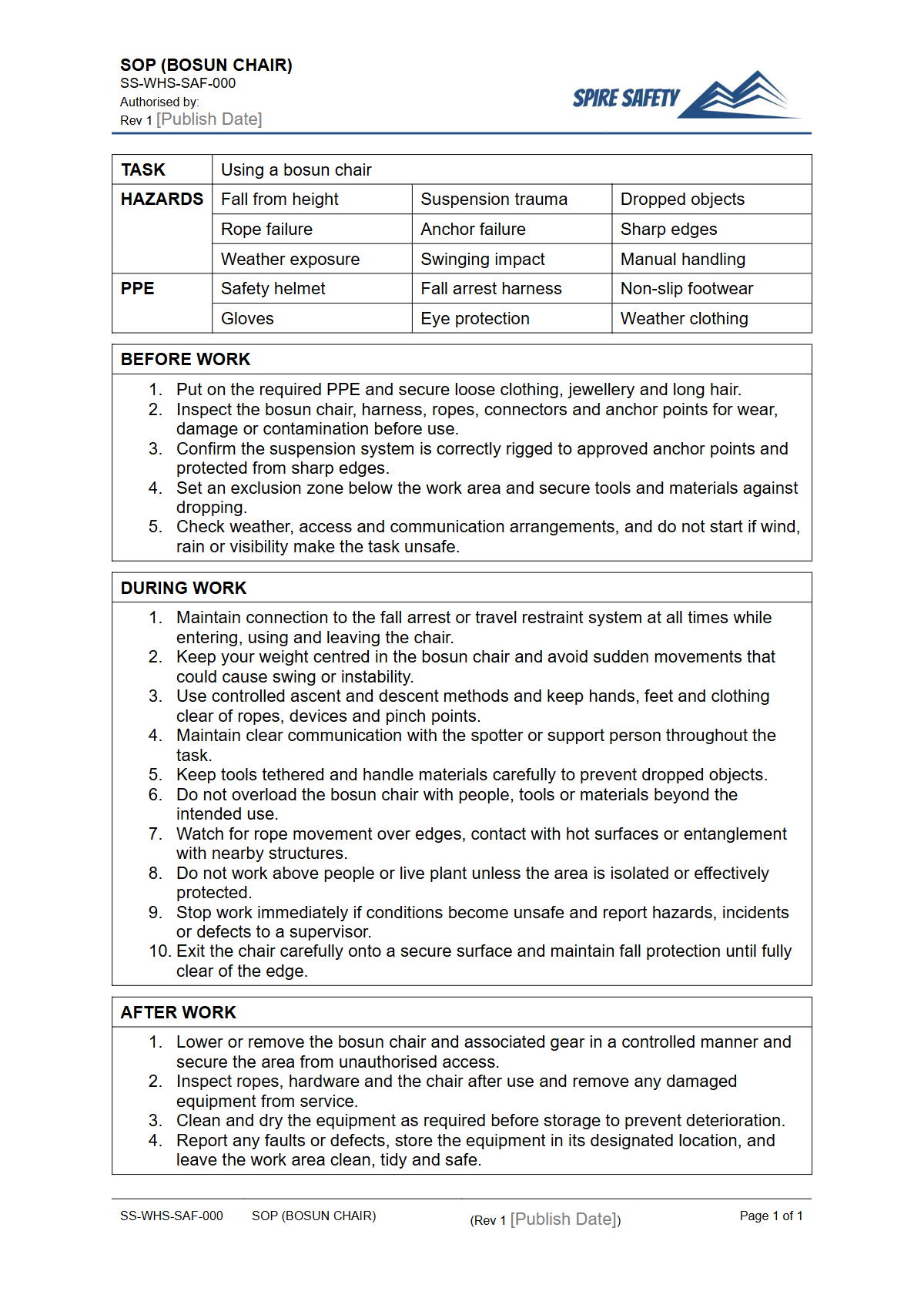
Working at heights using a bosun's chair is a high-risk activity that requires a documented safe system of work. This Free Safe Operating Procedure (Bosun Chair) Template provides a structured framework for outlining the essential steps to perform this task safely.
Using a clear and comprehensive SOP helps your organisation meet its primary duty of care under Australian WHS laws by managing risks and providing clear instruction to workers.
A well-drafted SOP is a critical administrative control that forms part of your overall safety management system. It serves as a vital tool for worker training, site inductions, and ongoing competency verification.
Documenting your process helps demonstrate due diligence and a systematic approach to risk management, which is essential for all high-risk work. It's a foundational element within broader comprehensive WHS management systems that protect both your workers and your business.
Video walkthrough
How to use the Free Safe Operating Procedure (Bosun Chair) Template
This Safe Operating Procedure for a bosun's chair is available for download in both DOCX and PDF formats. The DOCX file is fully editable, allowing you to tailor the content to the specific equipment, personnel, and environmental conditions at your workplace.
It's designed as a starting point, providing a professional layout and key headings based on Australian WHS principles and industry best practice.
Important: This document is a template and must be customised to your specific workplace. We recommend a competent person, such as a qualified rope access technician or safety professional, reviews and adapts the SOP to reflect your unique equipment, site conditions, risk profile, and legal obligations.
If you require assistance in tailoring safety documentation, consider engaging specialist WHS consulting to ensure it is fit for purpose.
Key Elements of a Bosun's Chair SOP
Our template prompts you to detail critical safety information, including:
- Required PPE: Specifies personal protective equipment like helmets, harnesses, and safety footwear.
- Hazard Identification: Lists potential hazards such as falls from height, falling objects, equipment failure, and adverse weather.
- Risk Control Measures: Outlines the controls to mitigate identified risks, following the hierarchy of controls.
- Pre-operational Checks: Includes a checklist for inspecting the bosun's chair, harness, ropes, connectors, and anchor points before use. A similar pre-start inspection process is outlined in our Free Step Ladder SOP Template for other types of work at height.
- Step-by-Step Operating Sequence: Details the safe process for setting up, mounting, operating, and dismounting the chair.
- Emergency Procedures: Defines the response for scenarios like equipment malfunction, medical emergencies, or worker rescue.
When to use this Safe Operating Procedure
A Safe Operating Procedure for a bosun's chair should be developed, implemented, and referenced before and during any task involving this equipment. It is not a document to be filed away; it is an active tool for daily safety management.
Use it for tasks such as building facade inspections, window cleaning, painting, or maintenance in locations that are otherwise inaccessible. This SOP should also be a core document for worker training, inductions for new sites or tasks, and for pre-start toolbox talks to reinforce safe work practices.
Who should use it
This SOP is intended for use by various personnel within an organisation to ensure a coordinated approach to safety:
- Persons Conducting a Business or Undertaking (PCBUs): To ensure a formal, safe system of work is in place for high-risk activities.
- Managers and Supervisors: To train workers, enforce safe work methods, and monitor compliance on site.
- Workers and Operators: As a direct reference guide for performing their tasks safely and correctly.
- WHS/HSE Personnel: To integrate the procedure into the wider safety management system and use it as a basis for regular WHS compliance auditing and site inspections.
By downloading this template, you're taking a proactive step towards formalising your safety processes. For a wider range of safety documentation, explore our complete free WHS resources library, which includes templates for other high-risk equipment and tasks.
Common mistakes
Common mistakes to avoid
- Failing to properly inspect all equipment (ropes, harness, chair, connectors) before each use.
- Using inadequate, uncertified, or untested anchor points for the suspension and backup lines.
- Working in adverse weather conditions such as high winds, heavy rain, or electrical storms.
- Not establishing and maintaining a clear exclusion zone on the ground below the work area.
Legal references
Legal considerations
The following legal requirements may be relevant to this type of work.
- Work Health and Safety Act (Harmonised) — Provides the primary duties for protecting workers and other people from work health and safety risks.
- Work Health and Safety Regulations (Harmonised) — Sets out requirements supporting the management of workplace hazards and risks.
The following codes may be relevant to this type of work.
- Managing WHS Risks Code of Practice — Provides practical guidance on identifying hazards, assessing risks and applying effective controls.
- Work Health and Safety Consultation, Cooperation and Coordination Code of Practice — Provides practical guidance on consulting workers and coordinating with other duty holders.
- Managing the Work Environment and Facilities Code of Practice — Provides practical guidance on safe work environments, workplace facilities and related controls.
Did you know
Rope Access Origins
Modern industrial rope access techniques, which often use bosun's chairs, evolved directly from caving and rock climbing methods. They allow workers to access difficult-to-reach locations without needing cumbersome scaffolding or powered cradles.
Anchor Point Strength
Anchor points for rope access systems must be incredibly strong. Australian Standards generally require that an anchor for a single person's fall arrest system be capable of sustaining a load of at least 15kN.
FAQ
Frequently asked questions
01Is a Safe Operating Procedure legally required for using a bosun's chair in Australia?
02What training is required to use a bosun's chair?
03How often should a bosun's chair SOP be reviewed?
04Can this template be used for a suspended scaffold or swing stage?
Share this resource
Free Safe Operating Procedure (Bosun Chair) Template
Browse Categories
How To Use It
- 1Download and open in Word or PDF.
- 2Replace the placeholders with your business details.
- 3Get it reviewed by a WHS specialist before rollout.
Need it customised?
Our WHS consultants can adapt this template to your site, run a gap analysis, or audit what you already have in place.
Book a Free Consultation WHS consulting servicesor call 1300 156 382
Related templates
- Free Safe Operating Procedure (Bottle Bin Handling) Template
- Free Safe Operating Procedure (Bottle Crusher) Template
- Free Safe Operating Procedure (Bottle Jack) Template
- Free Safe Operating Procedure (Bottling Line) Template
- Free Safe Operating Procedure (Boundary Fence Check) Template
- Free Safe Operating Procedure (Bowling Green Care) Template