
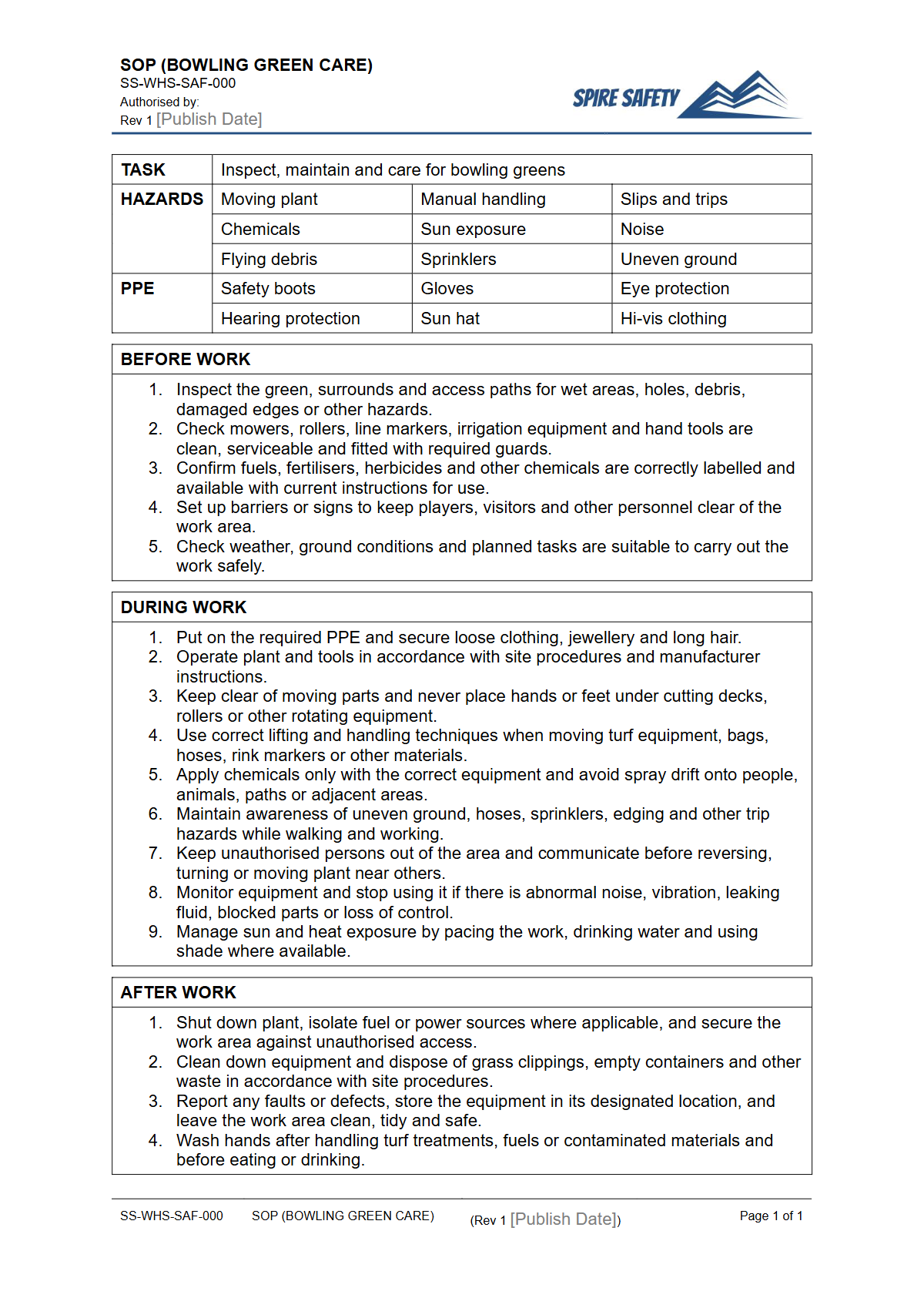
Free Safe Operating Procedure (Bowling Green Care) Template
Download our free Safe Operating Procedure (Bowling Green Care) template.
Free Safe Operating Procedure (Bowling Green Care) Template
DOCX • 126 KB + PDF
Updated Oct 2026
No signup required
Purpose of the Free Safe Operating Procedure (Bowling Green Care) Template
Maintaining a bowling green involves a range of tasks that carry inherent health and safety risks. From operating specialised machinery to handling hazardous chemicals and performing manual tasks, a structured approach to safety is essential.
This Free Safe Operating Procedure (Bowling Green Care) Template provides a clear framework for documenting safe work methods, managing hazards, and ensuring workers understand their obligations. By formally outlining procedures for tasks like mowing, aeration, scarifying, and chemical application, organisations can standardise safe behaviour and create a safer working environment for groundskeepers, greenkeepers, and volunteers.
A documented SOP serves as a critical training tool and a reference point for daily operations. It helps control risks associated with plant and equipment (mowers, rollers, corers), chemical exposure (pesticides, fertilisers), manual handling, and environmental factors like UV radiation and heat stress.
Implementing a robust Safe Operating Procedure is a key step in fulfilling your duty of care under Australian WHS legislation.
Video walkthrough
How to use the Free Safe Operating Procedure (Bowling Green Care) Template
This template is a starting point designed for customisation. After downloading the DOCX file, you must adapt it to reflect the specific circumstances of your club or facility.
Generic procedures are not sufficient for compliance; the document must detail your unique equipment, chemicals, site layout, and environmental conditions. A critical step in this process is consultation with the workers who perform the tasks.
Their direct experience is invaluable for identifying practical hazards and effective controls.
Once customised, the SOP should be integrated into your broader WHS management systems. This involves making it accessible to all relevant personnel, including it in induction and training programs, and scheduling regular reviews. Remember, this document is not a substitute for a comprehensive risk assessment, but a tool to document the controls identified through that process.
A Note on Customisation
This document is a template and is not a substitute for legal advice. We make no claims that this document is 'compliant' as it is the responsibility of the Person Conducting a Business or Undertaking (PCBU) to ensure the procedures are safe and suitable for their specific workplace.
You must consult with your workers and other duty holders and adapt this document to your operational needs.
When to use a Safe Operating Procedure
An SOP for bowling green care should be used consistently as a primary reference for safe work. Key situations include:
- Worker Training: For inducting new groundskeeping staff or volunteers and providing refresher training for existing personnel.
- Pre-Task Planning: As a checklist before commencing specific high-risk tasks, such as large-scale chemical spraying or operating unfamiliar machinery.
- Incident Investigation: To determine if established procedures were followed and to identify areas for improvement after a near miss or injury.
- Safety Audits: During internal or external reviews of your safety practices. An effective SOP provides clear evidence of your documented processes, which is a key part of any WHS compliance auditing program.
Who should use it
This SOP is intended for use by a variety of personnel involved in the management and maintenance of bowling greens, including:
- Groundskeepers and Greenkeepers
- Club Managers and Supervisors
- Work Health and Safety (WHS) Officers and Representatives
- Volunteers involved in green maintenance
- Contractors engaged to perform specific tasks
Key Components of a Bowling Green Care SOP
A comprehensive SOP for this work should cover several key areas to be effective. Ensure your customised document includes detailed steps for the following:
Pre-Operational Checks
Before any work begins, staff must conduct checks on all equipment. This includes inspecting guards on mowers, checking fuel and oil levels, ensuring tyre pressures are correct, and verifying that all safety cut-offs are functional.
This section should also cover assessing the work area for hazards like debris, sprinkler heads, or uneven ground. When tasks require bringing materials to the site, ensure procedures are in place for safe transport, similar to the protocols outlined in a free Body Truck SOP.
Task-Specific Procedures
Detail the step-by-step process for each core task. For mowing, this might include pattern of work, operating on slopes, and safe turning.
For aeration, it should cover connecting and disconnecting implements. For tasks requiring work at minor heights, such as cleaning awnings or high windows near the green, safe practices must be documented, much like in our free Step Ladder SOP template.
Hazardous Chemical Management
This is one of the most critical sections. It must list every chemical used (fertilisers, pesticides, herbicides) and reference the current Safety Data Sheet (SDS) for each.
Specify the required Personal Protective Equipment (PPE) for mixing and application, such as chemical-resistant gloves, respirators, and eye protection. Include procedures for managing spills and first aid requirements, particularly access to eyewash stations.
Manual and Specialist Tasks
Document safe methods for lifting and carrying heavy items like bags of fertiliser or sand. When dealing with specialised equipment beyond typical mowers, documenting the procedure is vital.
The detailed process found in documents for other industries, such as our free Grain Drill SOP template, can serve as a useful model for structuring instructions for unique or complex machinery.
By thoroughly documenting these areas, you create a procedure that is not only a guide but also a vital safety record. For more templates and safety documents, you can browse our complete free WHS resources library.
Common mistakes
Common mistakes to avoid
- Failing to properly customise the template with site-specific machinery and chemicals.
- Neglecting to consult with groundskeeping staff when drafting or reviewing the procedure.
- Not keeping the associated Safety Data Sheets (SDS) for all chemicals current and accessible.
- Treating the SOP as a one-time task instead of a living document that requires regular review and updates.
Legal references
Legal considerations
The following legal requirements may be relevant to this type of work.
- Work Health and Safety Act (Harmonised) — Provides the primary duties for protecting workers and other people from work health and safety risks.
- Work Health and Safety Regulations (Harmonised) — Sets out requirements supporting the management of workplace hazards and risks.
The following codes may be relevant to this type of work.
- Managing WHS Risks Code of Practice — Provides practical guidance on identifying hazards, assessing risks and applying effective controls.
- Work Health and Safety Consultation, Cooperation and Coordination Code of Practice — Provides practical guidance on consulting workers and coordinating with other duty holders.
- Managing the Work Environment and Facilities Code of Practice — Provides practical guidance on safe work environments, workplace facilities and related controls.
Did you know
Ancient Origins
The sport of lawn bowls dates back to the 13th century. The world's oldest surviving bowling green, the Southampton Old Bowling Green in England, was first used in 1299.
Precision Work
Modern professional bowling greens are cut to a height of just 3 to 5 millimetres. This precision requires highly specialised mowers and a rigorous maintenance schedule to ensure a consistent playing surface.
FAQ
Frequently asked questions
01What is a Safe Operating Procedure for bowling green care?
02Is this template sufficient for my workplace to be WHS-aligned?
03How often should a Bowling Green Care SOP be reviewed?
04What other hazards are common in bowling green maintenance?
Share this resource
Free Safe Operating Procedure (Bowling Green Care) Template
Browse Categories
How To Use It
- 1Download and open in Word or PDF.
- 2Replace the placeholders with your business details.
- 3Get it reviewed by a WHS specialist before rollout.
Need it customised?
Our WHS consultants can adapt this template to your site, run a gap analysis, or audit what you already have in place.
Book a Free Consultation WHS consulting servicesor call 1300 156 382
Related templates
- Free Safe Operating Procedure (Bowling Lane Cleaning) Template
- Free Safe Operating Procedure (Bowling Pin Handling) Template
- Free Safe Operating Procedure (Brake Bleeder) Template
- Free Safe Operating Procedure (Brake Disc Replacement) Template
- Free Safe Operating Procedure (Brake Drum Removal) Template
- Free Safe Operating Procedure (Brake Fluid Change) Template