
Free Safe Operating Procedure (Bowling Lane Cleaning) Template
Download our free Safe Operating Procedure for bowling lane cleaning. This customisable DOCX and PDF template helps outline WHS practices for your venue.
Free Safe Operating Procedure (Bowling Lane Cleaning) Template
DOCX • 126 KB + PDF
Updated Oct 2026
No signup required
Purpose of the Free Safe Operating Procedure (Bowling Lane Cleaning) Template
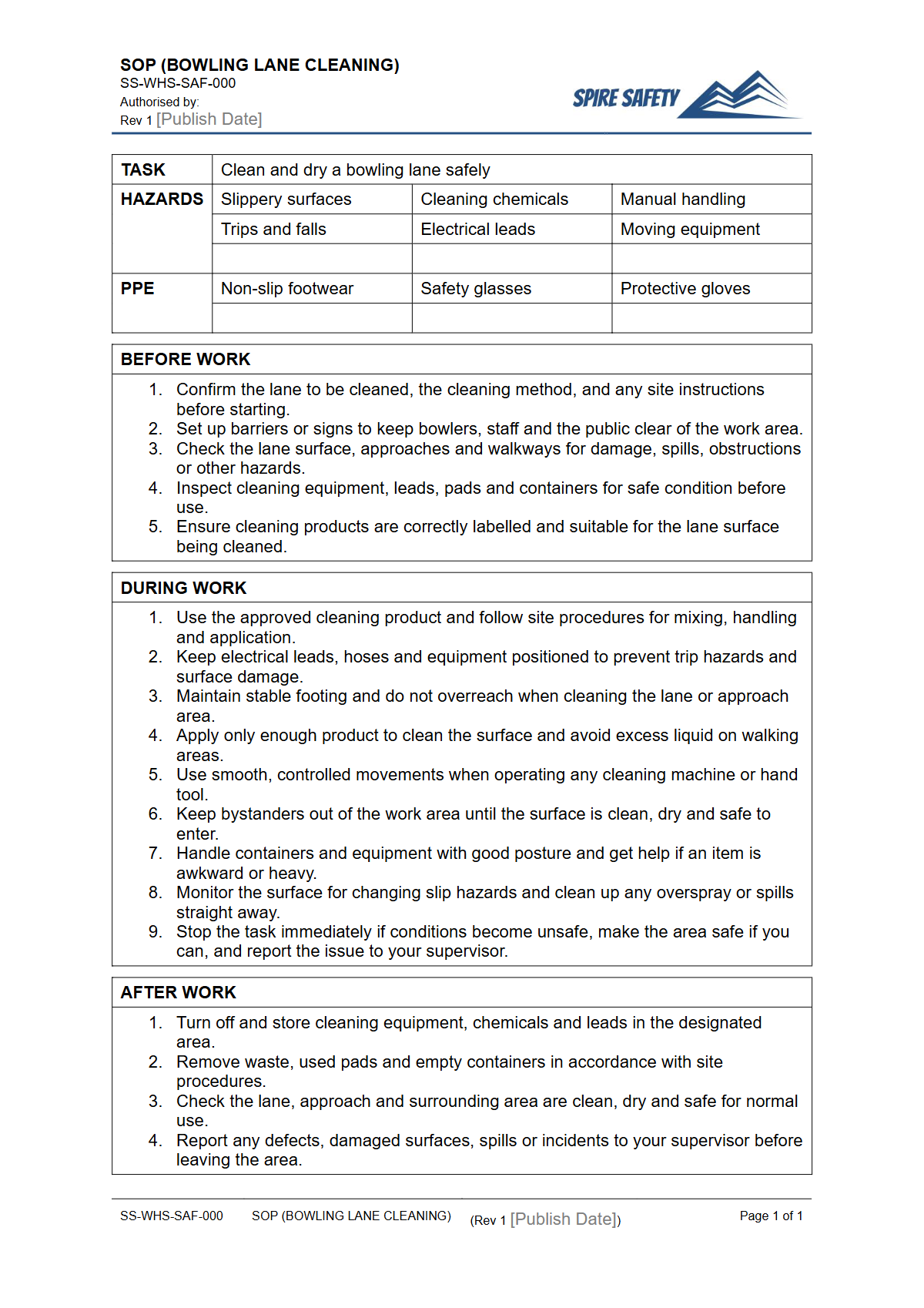
This Safe Operating Procedure (SOP) template provides a structured framework for documenting the required safety measures for cleaning and conditioning bowling lanes. While seemingly straightforward, this task involves significant risks that must be managed to ensure worker safety.
Key hazards include exposure to hazardous chemicals found in lane cleaners and conditioners, manual handling risks associated with moving equipment and supplies, and the high potential for slips, trips, and falls on slick or wet surfaces. Using this template helps your organisation meet its duty of care by systematically identifying these hazards and outlining clear, step-by-step control measures.
A documented SOP ensures that the cleaning process is performed consistently and safely by all employees, regardless of their experience level. It serves as a critical training tool for new staff and a reference point for experienced workers.
Formalising the procedure helps to minimise the risk of incidents, reduce chemical wastage, and maintain the playing surface to a high standard, contributing to a safer and more professional work environment. Establishing clear procedures is a fundamental part of an effective WHS management system.
Video walkthrough
How to use the Free Safe Operating Procedure (Bowling Lane Cleaning) Template
This document is a template that must be customised to reflect the specific circumstances of your workplace. To use this SOP, download the DOCX file and adapt it to your site-specific equipment, chemicals, environment, and personnel.
You should consult with workers who perform the task, as well as supervisors and WHS representatives, during the customisation process to ensure the procedure is practical and effective.
The template guides you through detailing essential safety information, including:
- Required Personal Protective Equipment (PPE) such as chemical-resistant gloves, safety glasses, and non-slip footwear.
- Pre-operational checks for cleaning machinery and equipment.
- A step-by-step guide to the cleaning and conditioning process, from preparation to clean-up.
- Emergency procedures in case of chemical spills, exposure, or other incidents.
Important: We have developed this template as a guide. You must review and amend it to suit the specific hazards, risks, and control measures unique to your workplace, equipment, and processes.
Spire Safety does not guarantee that this document will be compliant with your legal obligations without this customisation.
When to use a Safe Operating Procedure
An SOP for bowling lane cleaning should be used as a primary training document for any worker required to perform this task. It should be integrated into your induction process for all new employees assigned to lane maintenance duties.
The procedure should also be readily available in the work area for easy reference at all times.
Beyond initial training, the SOP is a valuable tool for conducting refresher training, especially if the task is performed infrequently or if changes are made to the process, chemicals, or equipment. It should also be reviewed and updated as part of any incident investigation or risk assessment review.
Regular reviews, often as part of a scheduled WHS compliance audit, ensure the procedure remains current and effective.
Who should use it
This template is designed for use by Persons Conducting a Business or Undertaking (PCBUs), such as bowling alley owners and operators. Managers and supervisors are responsible for implementing the SOP, ensuring workers are trained on its contents, and monitoring its application in the workplace.
Health and Safety Representatives (HSRs) can use the SOP as a benchmark for reviewing safety standards and consulting on WHS matters.
Crucially, the workers who perform the lane cleaning are the end-users of the finalised procedure. They must understand and follow the steps outlined to protect their own health and safety and that of others in the workplace.
Their involvement in the development and review of the SOP is vital for its success. In some maintenance activities, staff may need to access areas at height for cleaning signs or fixtures; in these cases, a separate procedure for step ladder use is essential.
Many entertainment venues have a small workshop for general repairs and maintenance. If your facility uses compressed air for cleaning tools or equipment, you should also document safe procedures with our Air Compressor SOP to manage associated risks like noise, air injection, and hose whip.
For more extensive repairs or fit-out tasks that involve cutting materials, specific procedures are required. For example, a circular saw SOP should be developed and implemented for any staff authorised to use such equipment, ensuring they are trained on its specific hazards and controls. You can find many other useful documents in our complete free WHS resources library.
Common mistakes
Common mistakes to avoid
- Using incorrect dilution ratios for cleaning chemicals, leading to surface damage or ineffective cleaning.
- Failing to use or inspect Personal Protective Equipment (PPE) before starting work.
- Not providing adequate ventilation, allowing for the buildup of chemical vapours in the air.
- Leaving floors wet without using appropriate warning signs, creating a slip hazard for others.
Legal references
Legal considerations
The following legal requirements may be relevant to this type of work.
- Work Health and Safety Act (Harmonised) — Provides the primary duties for protecting workers and other people from work health and safety risks.
- Work Health and Safety Regulations (Harmonised) — Sets out requirements supporting the management of workplace hazards and risks.
The following codes may be relevant to this type of work.
- Managing WHS Risks Code of Practice — Provides practical guidance on identifying hazards, assessing risks and applying effective controls.
- Work Health and Safety Consultation, Cooperation and Coordination Code of Practice — Provides practical guidance on consulting workers and coordinating with other duty holders.
- Managing the Work Environment and Facilities Code of Practice — Provides practical guidance on safe work environments, workplace facilities and related controls.
Did you know
Lane Conditioner
The oil, or 'conditioner', applied to bowling lanes is not just for shine. It's a highly engineered fluid designed to protect the lane surface from the impact of the bowling ball and to influence the ball's trajectory.
Slips, Trips, and Falls
Slips, trips, and falls are a leading cause of injury in the arts and recreation services industry. Implementing procedures like SOPs for cleaning is a critical control measure to prevent these common incidents.
FAQ
Frequently asked questions
01Why is an SOP necessary for a seemingly simple task like cleaning bowling lanes?
02What kind of PPE is typically required for bowling lane cleaning?
03How often should a Safe Operating Procedure for bowling lane cleaning be reviewed?
04Does this SOP template cover automatic lane cleaning machines?
Share this resource
Free Safe Operating Procedure (Bowling Lane Cleaning) Template
Browse Categories
How To Use It
- 1Download and open in Word or PDF.
- 2Replace the placeholders with your business details.
- 3Get it reviewed by a WHS specialist before rollout.
Need it customised?
Our WHS consultants can adapt this template to your site, run a gap analysis, or audit what you already have in place.
Book a Free Consultation WHS consulting servicesor call 1300 156 382
Related templates
- Free Safe Operating Procedure (Bowling Pin Handling) Template
- Free Safe Operating Procedure (Brake Bleeder) Template
- Free Safe Operating Procedure (Brake Disc Replacement) Template
- Free Safe Operating Procedure (Brake Drum Removal) Template
- Free Safe Operating Procedure (Brake Fluid Change) Template
- Free Safe Operating Procedure (Brake Lathe) Template