
Free Safe Operating Procedure (Brake Bleeder) Template
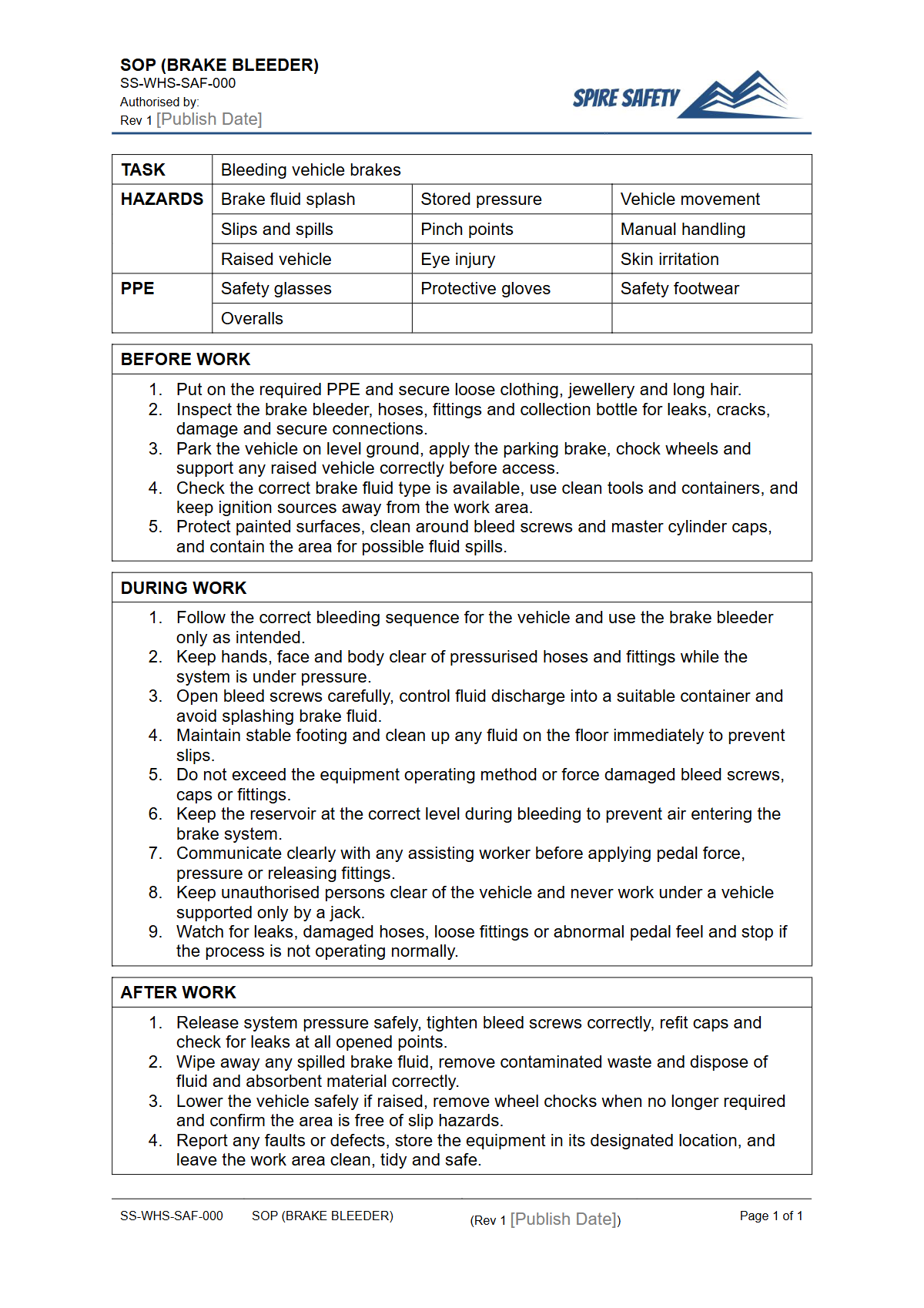
Download our free Safe Operating Procedure (Brake Bleeder) template. This DOCX & PDF resource helps create safe systems of work for brake maintenance.
Free Safe Operating Procedure (Brake Bleeder) Template
DOCX • 126 KB + PDF
Updated Oct 2026
No signup required
Purpose of the Free Safe Operating Procedure (Brake Bleeder) Template
Using a brake bleeder involves handling hazardous chemicals and working with high-pressure hydraulic systems. This Free Safe Operating Procedure (Brake Bleeder) Template provides a structured framework for documenting the correct, safe method for this critical task.
A detailed SOP helps your organisation meet its primary duty of care by minimising risks such as chemical burns from brake fluid, eye injuries, and the significant danger of brake failure due to improper procedure. Formalising this process ensures consistency, reduces errors, and provides a clear reference for training and competency assessments.
By clearly outlining the steps, required PPE, and emergency actions, this SOP becomes a vital component of your workshop's safety protocols. Integrating documented procedures like this is a cornerstone of effective WHS management systems, demonstrating a proactive approach to risk control and worker safety.
It helps ensure every mechanic, from an apprentice to a seasoned technician, follows a standardised and safe method for every job.
Video walkthrough
How to use the Free Safe Operating Procedure (Brake Bleeder) Template
This resource is available as a fully editable DOCX file and a print-ready PDF. The document is designed as a comprehensive starting point, pre-filled with common steps and safety considerations relevant to brake bleeding tasks.
To use it effectively, download the DOCX version and systematically work through each section, modifying the content to match your specific workplace environment and equipment.
It's crucial to remember that this is a template, not a finished document. We have provided a solid foundation based on Australian WHS principles, but you must adapt it to reflect your specific equipment (e.g., pressure vs.
vacuum bleeder), the types of brake fluid used, and the unique procedures within your organisation. Be sure to consult with workers who perform the task to ensure the SOP is practical and accurate.
For context on other workshop equipment, our Air Compressor SOP provides another example of a customisable equipment procedure.
When to use it
A Safe Operating Procedure for brake bleeding should be developed before any worker is permitted to undertake the task. It serves as a foundational document for several key activities in the workplace.
Use it to train new employees and apprentices, ensuring they learn the correct, safe method from day one. It should also be used for refresher training for experienced staff to prevent procedural drift and reinforce safety standards.
The SOP should be readily accessible in the work area for quick reference during a job. Furthermore, it is an essential tool during safety reviews and incident investigations.
Regular checks of workshop processes are a key part of maintaining safety standards, and a documented procedure provides a clear benchmark for a WHS compliance auditing program.
Who should use it
This SOP is intended for all personnel involved in vehicle maintenance and repair. This includes qualified mechanics, automotive technicians, apprentices, and workshop supervisors.
Supervisors and managers should use the SOP to ensure their team is trained, competent, and consistently following safe work practices. WHS and safety officers can use this template to develop and implement standardised procedures across a workshop or organisation.
Anyone operating a brake bleeder must be trained on the specific steps and hazards outlined in the finalised SOP for your workplace. This ensures they understand not just the 'how' but also the 'why' behind each safety control.
Documenting procedures for all vehicle maintenance tasks, such as those covered in our FREE Body Truck SOP, helps create a comprehensive safety framework for your entire fleet and workshop.
Personal Protective Equipment (PPE) and Hazard Controls
The SOP template includes a dedicated section for specifying Personal Protective Equipment. At a minimum, this will include safety glasses or goggles and chemical-resistant gloves to protect against brake fluid splashes. The document also prompts you to consider other hazard controls, such as adequate ventilation to deal with fumes, designated spill kits for managing brake fluid spills, and safe manual handling techniques for moving equipment. Even simple tasks in a workshop carry risks, which is why having procedures for all equipment, including a step ladder SOP, is crucial for overall site safety. You can find more templates and checklists in our free WHS resources library to build out your safety system.
Common mistakes
Common mistakes to avoid
- Using the incorrect type of brake fluid for the specific vehicle.
- Failing to wear appropriate PPE, especially safety glasses or goggles.
- Allowing the brake fluid reservoir to run dry, which introduces air into the system.
- Not properly cleaning up spills, as brake fluid is a slip hazard and can damage vehicle paintwork.
Legal references
Legal considerations
The following legal requirements may be relevant to this type of work.
- Work Health and Safety Act (Harmonised) — Provides the primary duties for protecting workers and other people from work health and safety risks.
- Work Health and Safety Regulations (Harmonised) — Sets out requirements supporting the management of workplace hazards and risks.
The following codes may be relevant to this type of work.
- Managing WHS Risks Code of Practice — Provides practical guidance on identifying hazards, assessing risks and applying effective controls.
- Work Health and Safety Consultation, Cooperation and Coordination Code of Practice — Provides practical guidance on consulting workers and coordinating with other duty holders.
- Managing the Work Environment and Facilities Code of Practice — Provides practical guidance on safe work environments, workplace facilities and related controls.
Did you know
Brake Fluid is Hygroscopic
This means it absorbs moisture directly from the atmosphere over time. This moisture lowers the fluid's boiling point, increasing the risk of 'brake fade' under heavy use and causing corrosion within the brake system.
DOT 5 vs The Rest
Unlike the common glycol-ether based brake fluids (DOT 3, 4, and 5.1), DOT 5 fluid is silicone-based. The two types are incompatible and should never be mixed, as it can cause brake system components to swell and fail.
FAQ
Frequently asked questions
01What are the main hazards when using a brake bleeder?
02Does this SOP template cover both pressure and vacuum bleeders?
03What PPE should be worn when bleeding brakes?
04How often should an SOP for a brake bleeder be reviewed?
Share this resource
Free Safe Operating Procedure (Brake Bleeder) Template
Browse Categories
How To Use It
- 1Download and open in Word or PDF.
- 2Replace the placeholders with your business details.
- 3Get it reviewed by a WHS specialist before rollout.
Need it customised?
Our WHS consultants can adapt this template to your site, run a gap analysis, or audit what you already have in place.
Book a Free Consultation WHS consulting servicesor call 1300 156 382
Related templates
- Free Safe Operating Procedure (Brake Disc Replacement) Template
- Free Safe Operating Procedure (Brake Drum Removal) Template
- Free Safe Operating Procedure (Brake Fluid Change) Template
- Free Safe Operating Procedure (Brake Lathe) Template
- Free Safe Operating Procedure (Brake Pad Replacement) Template
- Free Safe Operating Procedure (Branch Chipping Prep) Template