
Free Safe Operating Procedure (Brake Lathe) Template
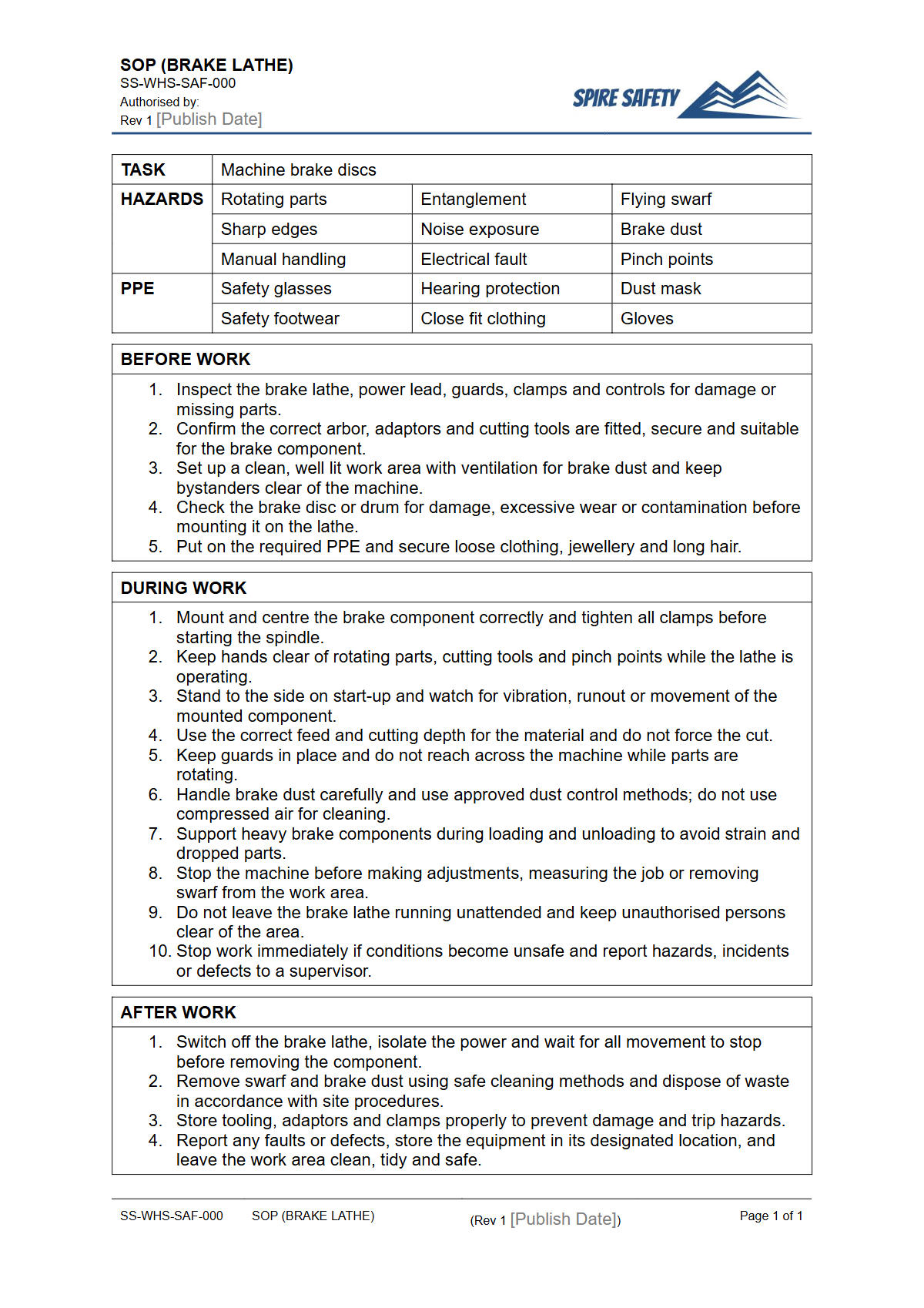
Download our free Safe Operating Procedure (Brake Lathe) template. This structured Word & PDF helps outline WHS controls for operating brake lathes.
Free Safe Operating Procedure (Brake Lathe) Template
DOCX • 126 KB + PDF
Updated Oct 2026
No signup required
Purpose of the Free Safe Operating Procedure (Brake Lathe) Template
Operating a brake lathe involves significant risks, including entanglement with rotating parts, cuts from sharp metal swarf, and crush injuries. This Free Safe Operating Procedure (Brake Lathe) Template provides a structured framework for documenting the safest method to perform this task.
By clearly outlining hazards, controls, and step-by-step instructions, you can standardise workshop practices, reduce the likelihood of incidents, and ensure workers are properly informed.
A well-drafted Safe Operating Procedure (SOP) is a fundamental component of an effective safety management system. It serves as a crucial training tool for new operators and a reference for experienced technicians, helping your organisation meet its primary duty of care obligations under WHS legislation.
Using this template helps formalise your processes, demonstrating a proactive approach to risk management and contributing to a safer overall work environment. It forms a key part of your broader WHS management systems.
Video walkthrough
How to use the Free Safe Operating Procedure (Brake Lathe) Template
This template is provided in both DOCX and PDF formats for your convenience. The DOCX file is fully editable, allowing you to tailor the content to the specific make and model of brake lathe used in your workshop, as well as your unique operational context and risk profile.
To use this resource effectively, download the document and methodically work through each section, replacing the placeholder text with your site-specific information.
Involve your team in the process. Consult with experienced mechanics and workshop supervisors who operate the equipment daily.
Their practical knowledge is invaluable for identifying all potential hazards and effective control measures. Once customised, the SOP should be formally approved, communicated to all relevant personnel, and made readily accessible in the work area.
Regular reviews and updates are essential to keep it relevant. An external review can ensure it is robust, which is often a component of WHS compliance auditing.
Important Customisation Note
This document is a template and is not a complete Safe Operating Procedure. It is essential that you customise this template to reflect the specific hazards, risks, and control measures relevant to your workplace, equipment, and processes.
We are not responsible for your WHS outcomes; compliance depends on the thoroughness of your risk assessment and the implementation of controls appropriate for your business.
When to use a Brake Lathe SOP
A Safe Operating Procedure for a brake lathe should be used as a primary reference document in several key situations. It is essential during the induction and training of new employees, apprentices, or any worker unfamiliar with the specific equipment.
It provides the foundation for demonstrating competence before a worker is authorised to operate the lathe unsupervised. The SOP should also be used for regular refresher training to prevent complacency and reinforce safe work habits among all staff.
Furthermore, it serves as a benchmark for workplace inspections and behavioural observations. Following an incident or a near-miss involving the brake lathe, the SOP should be a key part of the investigation to determine if the procedure was followed and whether it needs revision. This process is similar for other heavy machinery, as outlined in documents like our Free Brake Press SOP (Safe Operating Procedure) Template.
Who should use this document
This template is designed for use by Persons Conducting a Business or Undertaking (PCBUs), workshop managers, supervisors, and WHS professionals responsible for workshop safety. Managers and supervisors use it to fulfil their duty to provide safe systems of work and adequate training.
They are responsible for ensuring the SOP is developed, implemented, and enforced.
The end-users of the finalised SOP are the workers themselves—the mechanics, technicians, and operators who physically use the brake lathe. The document should be written in clear, simple language that is easy for them to understand and follow.
Just as you would for other workshop equipment, this process ensures clarity and safety across the board. For example, similar principles apply when creating a FREE Plasma Cutter SOP (Safe Operating Procedure) Template for your facility.
Effective safety procedures are built on collaboration. Using this template as a starting point for consultation with your team helps foster a positive safety culture where everyone takes ownership of workplace health and safety.
You can find more templates for common equipment in our free WHS resources library to support your safety program.
Common mistakes
Common mistakes to avoid
- Using the template without customising it for the specific machine model and workplace.
- Failing to consult with experienced operators when drafting the procedure.
- Not providing adequate training on the finalised SOP to all relevant workers.
- Forgetting to review and update the SOP after an incident or change in workshop process.
Legal references
Legal considerations
The following legal requirements may be relevant to this type of work.
- Work Health and Safety Act (Harmonised) — Provides the primary duties for protecting workers and other people from work health and safety risks.
- Work Health and Safety Regulations (Harmonised) — Sets out requirements supporting the management of workplace hazards and risks.
The following codes may be relevant to this type of work.
- Managing WHS Risks Code of Practice — Provides practical guidance on identifying hazards, assessing risks and applying effective controls.
- Work Health and Safety Consultation, Cooperation and Coordination Code of Practice — Provides practical guidance on consulting workers and coordinating with other duty holders.
- Managing the Work Environment and Facilities Code of Practice — Provides practical guidance on safe work environments, workplace facilities and related controls.
Did you know
Entanglement Hazard
The rotating chuck and workpiece on a brake lathe are major entanglement hazards. Loose clothing, long hair, and jewellery can be caught in seconds, causing severe injuries.
Flying Debris
Without proper guarding and the use of Personal Protective Equipment (PPE), metal shavings known as swarf can be ejected at high speed, posing a significant risk of eye injury.
FAQ
Frequently asked questions
01What should be included in a Safe Operating Procedure for a brake lathe?
02Who is responsible for writing a brake lathe SOP?
03How often should a brake lathe SOP be reviewed?
04Is a Safe Work Method Statement (SWMS) the same as an SOP for a brake lathe?
Share this resource
Free Safe Operating Procedure (Brake Lathe) Template
Browse Categories
How To Use It
- 1Download and open in Word or PDF.
- 2Replace the placeholders with your business details.
- 3Get it reviewed by a WHS specialist before rollout.
Need it customised?
Our WHS consultants can adapt this template to your site, run a gap analysis, or audit what you already have in place.
Book a Free Consultation WHS consulting servicesor call 1300 156 382
Related templates
- Free Safe Operating Procedure (Brake Pad Replacement) Template
- Free Safe Operating Procedure (Branch Chipping Prep) Template
- Free Safe Operating Procedure (Brazing Torch) Template
- Free Safe Operating Procedure (Bread Slicer) Template
- Free Safe Operating Procedure (Brick Saw) Template
- Free Safe Operating Procedure (Brick Splitter) Template