
Free Safe Operating Procedure (Brick Saw) Template
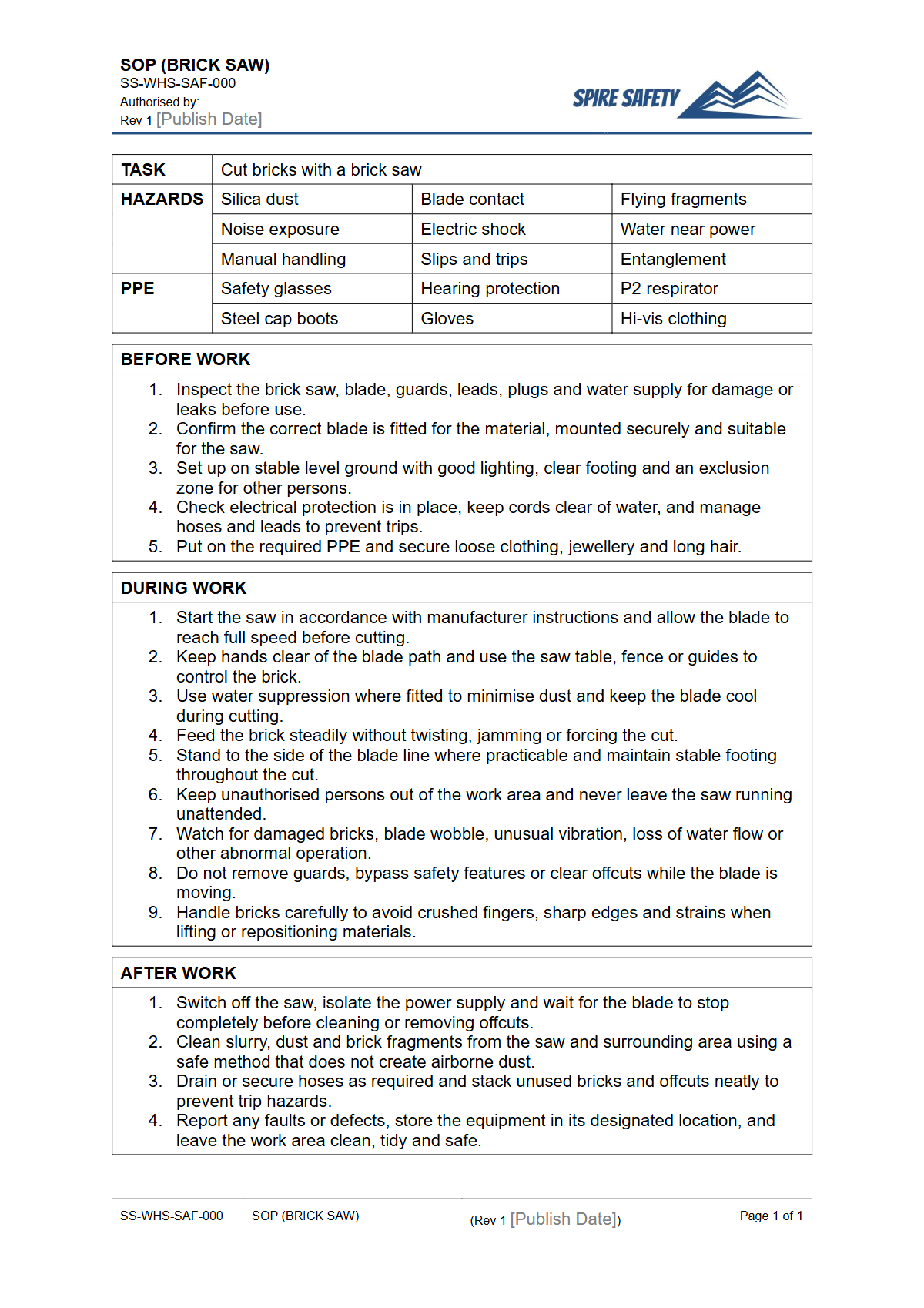
Download our free Safe Operating Procedure (Brick Saw) template. This customisable DOCX & PDF provides a structured framework for safe brick saw use.
Free Safe Operating Procedure (Brick Saw) Template
DOCX • 126 KB + PDF
Updated Oct 2026
No signup required
Purpose of the Free Safe Operating Procedure (Brick Saw) Template
This free Safe Operating Procedure (Brick Saw) template provides a structured starting point for documenting the safe use of masonry saws in your workplace. Operating a brick saw introduces significant risks, including severe cuts from the blade, eye injuries from flying debris, hearing damage from high noise levels, and respiratory diseases like silicosis from inhaling crystalline silica dust.
A documented SOP is a fundamental tool for controlling these hazards and is a key component of effective WHS management systems. By outlining a clear, step-by-step process, this template helps your organisation meet its primary duty of care under Australian WHS laws.
Video walkthrough
How to use the Free Safe Operating Procedure (Brick Saw) Template
To effectively use this Safe Operating Procedure (Brick Saw) template, download the DOCX file and adapt it to your specific operational context. It is designed to be modified.
You must add details about the makes and models of equipment used, the specific types of materials being cut, and the unique conditions of your work environment. Consultation with the workers who will be using the equipment is a critical step in this process to ensure the procedure is practical and reflects on-the-ground realities.
For guidance on structuring procedures for other high-risk cutting equipment, you might find our waterjet cutter SOP template a useful comparison.
A Note on Customisation
IMPORTANT: This document is a template and must be customised to reflect the specific brick saw models, work tasks, and environment at your workplace. We have not been to your site and do not know your specific risks.
A generic procedure does not provide adequate control. You must conduct your own risk assessment and tailor this SOP accordingly.
When to Use a Brick Saw SOP
A Safe Operating Procedure for a brick saw should be used consistently as part of your daily operations. It is not a document to be filed away and forgotten. Use it:
- During the induction and training of new workers who will operate the saw.
- As a basis for refresher training, especially if work practices change or after a prolonged break.
- As a reference tool for workers before they begin a task (e.g., during pre-start checks).
- During toolbox talks to reinforce key safety messages, such as the importance of wet cutting.
- As a review document following any incident or near miss involving a brick saw to identify and implement improvements.
Integrating SOPs for all key equipment is vital for site safety. You may also need procedures for other common equipment, like our Telehandler SOP template, to build a comprehensive safety framework.
Who Should Use This SOP
This SOP is intended for a range of personnel within an organisation:
- Persons Conducting a Business or Undertaking (PCBUs): To fulfil their legal obligation to provide and maintain safe systems of work.
- Managers and Supervisors: To train, instruct, and supervise workers, ensuring they operate the equipment according to the agreed-upon safe procedure.
- Workers: As a clear guide on how to perform their tasks safely, protecting themselves and others.
- WHS/HSE Officers: To incorporate into the broader safety management system and use as a benchmark during workplace inspections and audits.
If you need assistance integrating this procedure into your existing systems or developing a more comprehensive safety framework, our general WHS consulting services can provide expert guidance.
Key Safety Considerations for Brick Saws
When customising this template, pay close attention to the following critical areas. These are common sources of incidents and must be addressed with specific controls.
Controlling Silica Dust
The most severe long-term hazard is the inhalation of respirable crystalline silica (RCS) dust, which can cause fatal lung diseases. The primary control must be a water suppression system (wet cutting) that is properly used and maintained.
Your SOP must mandate its use and include checks to ensure it is functioning correctly. Respiratory Protective Equipment (RPE) is also required as a supplementary control.
Guarding and Blade Safety
Ensure all guards supplied by the manufacturer are in place and functioning correctly. The SOP should include pre-start checks for guard integrity.
Specify procedures for changing blades, and ensure workers only use blades that are sharp, undamaged, and appropriate for the material being cut. Using other rotating blade tools on site also requires documented procedures, such as those in our free Circular Saw SOP template.
Personal Protective Equipment (PPE)
Your SOP must clearly list all mandatory PPE. For brick saw operation, this typically includes:
- P2 or P3 rated respiratory protection.
- Impact-rated safety glasses or a face shield.
- Hearing protection (Class 5 recommended).
- Steel-capped, non-slip boots.
- Cut-resistant gloves may be appropriate, subject to a risk assessment (to avoid entanglement risk).
You can find many more helpful documents like this one in our complete free WHS resources library.
Common mistakes
Common mistakes to avoid
- Performing 'dry cutting', which generates massive amounts of hazardous silica dust.
- Using a saw with missing or damaged blade guards.
- Failing to secure the workpiece properly before starting a cut, leading to kickback or blade jam.
- Neglecting pre-start checks, such as inspecting the blade for cracks or ensuring the water supply is working.
Legal references
Legal considerations
The following legal requirements may be relevant to this type of work.
- Work Health and Safety Act (Harmonised) — Provides the primary duties for protecting workers and other people from work health and safety risks.
- Work Health and Safety Regulations (Harmonised) — Sets out requirements supporting the management of workplace hazards and risks.
The following codes may be relevant to this type of work.
- Managing WHS Risks Code of Practice — Provides practical guidance on identifying hazards, assessing risks and applying effective controls.
- Work Health and Safety Consultation, Cooperation and Coordination Code of Practice — Provides practical guidance on consulting workers and coordinating with other duty holders.
- Managing the Work Environment and Facilities Code of Practice — Provides practical guidance on safe work environments, workplace facilities and related controls.
Did you know
Wet Cutting Is Critical
Using a properly functioning water-delivery system on a brick saw can reduce airborne respirable crystalline silica dust by over 85%, significantly lowering the risk of silicosis.
Noise Exposure
A typical brick saw operates at 100-115 decibels (dB), well above the Australian exposure standard of 85 dB. Unprotected exposure for even a few minutes can contribute to permanent hearing damage.
FAQ
Frequently asked questions
01What are the main hazards of using a brick saw?
02Does a brick saw require a specific licence to operate in Australia?
03How often should a brick saw SOP be reviewed?
04Can a generic SOP be used for all types of brick saws?
Share this resource
Free Safe Operating Procedure (Brick Saw) Template
Browse Categories
How To Use It
- 1Download and open in Word or PDF.
- 2Replace the placeholders with your business details.
- 3Get it reviewed by a WHS specialist before rollout.
Need it customised?
Our WHS consultants can adapt this template to your site, run a gap analysis, or audit what you already have in place.
Book a Free Consultation WHS consulting servicesor call 1300 156 382
Related templates
- Free Safe Operating Procedure (Brick Splitter) Template
- Free Safe Operating Procedure (Broaching Machine) Template
- Free Safe Operating Procedure (Brush Cutter Whipper Snipper Operation) Template
- Free Safe Operating Procedure (Brush Painting) Template
- Free Safe Operating Procedure (Bucket Elevator) Template
- Free Safe Operating Procedure (Buffet Packdown) Template