
Free Safe Operating Procedure (Buffet Packdown) Template
Download our free Safe Operating Procedure (Buffet Packdown) template.
Free Safe Operating Procedure (Buffet Packdown) Template
DOCX • 126 KB + PDF
Updated Oct 2026
No signup required
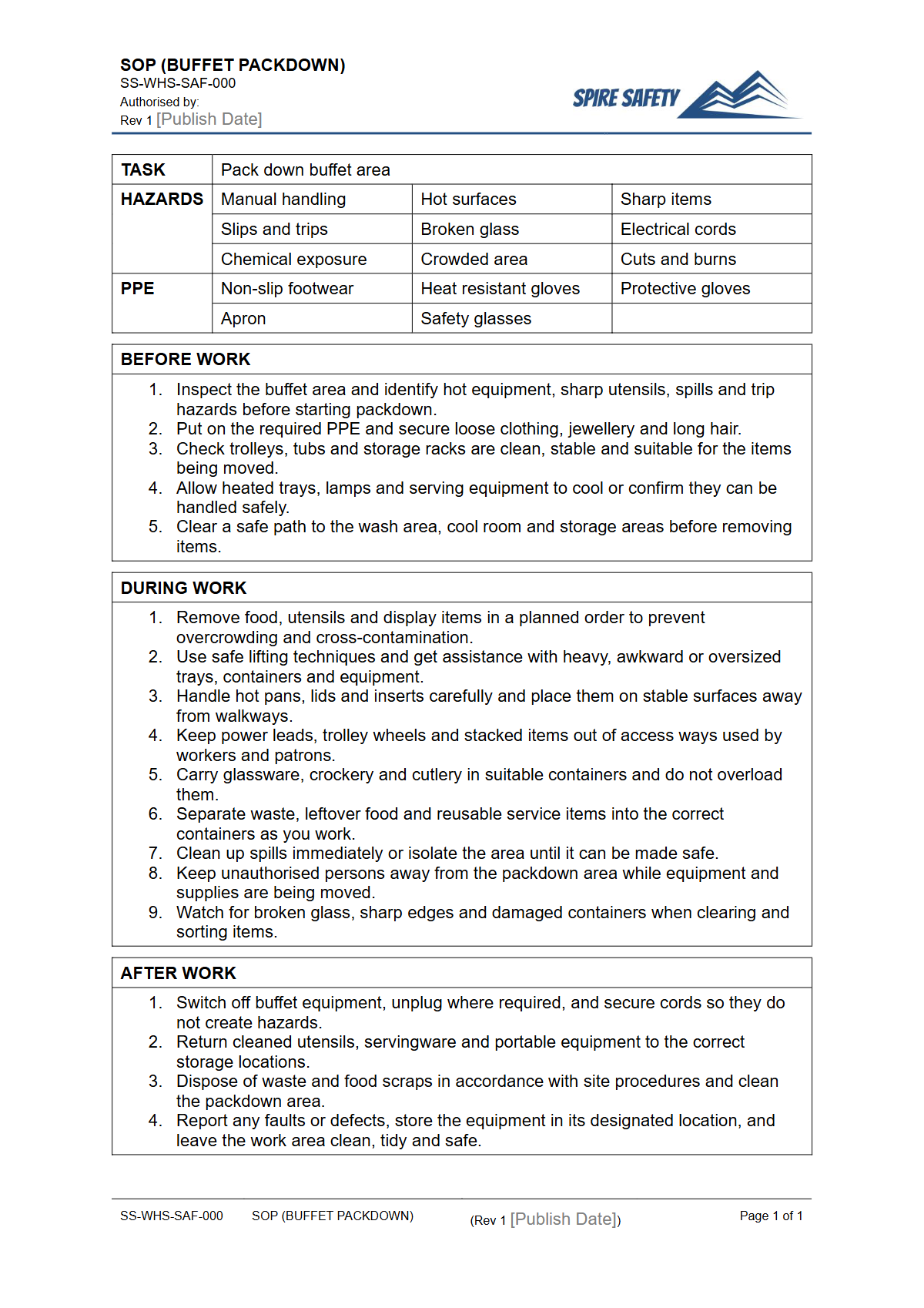
Purpose of the Free Safe Operating Procedure (Buffet Packdown) Template
Documenting high-risk tasks is fundamental to workplace safety. This Free Safe Operating Procedure (Buffet Packdown) Template provides a structured starting point for hospitality businesses to manage the risks associated with clearing and packing down buffet service areas.
While other industries might use an SOP to manage heavy machinery, such as our FREE Dozer SOP (Safe Operating Procedure) Template, or specific tools detailed in a FREE Plasma Cutter SOP (Safe Operating Procedure) Template, the principles of identifying hazards and outlining safe work steps remain the same. This resource helps you formalise procedures to protect your team from common hospitality hazards.
A Safe Operating Procedure (SOP) is a crucial administrative control that provides clear, step-by-step instructions on how to perform a task safely. For a buffet packdown, this involves managing risks like manual handling of heavy bain-marie trays, slips and trips on wet or greasy floors, cuts from equipment, and food safety breaches.
Using this template helps embed safe practices into your daily operations, forming a key part of your overall WHS management systems and demonstrating a commitment to worker safety.
Video walkthrough
How to use the Free Safe Operating Procedure (Buffet Packdown) Template
This template is provided in both DOCX and PDF formats for your convenience. The DOCX file is fully editable, allowing you to tailor the content directly to the specific equipment, layout, and processes in your venue.
It includes sections for outlining potential hazards, required Personal Protective Equipment (PPE), and a logical sequence of work steps from initial clearing to final cleaning and storage.
Important: This is a template we have developed to act as a guide. It is not a complete or document out-of-the-box.
You must customise it to the specific environment, equipment, and risks in your workplace. Consultation with your workers, supervisors, and any health and safety representatives is a critical part of this process to ensure the SOP is practical and effective.
If you need assistance with risk assessments or procedure development, consider engaging external WHS consulting services for expert guidance.
When to use it
An SOP for buffet packdown should be used consistently as a tool for training, supervision, and operational guidance. It is particularly valuable during staff inductions to ensure new team members understand the established safe method from day one.
It also serves as a refresher for existing staff and a reference point for supervisors monitoring work practices. You should also review and update the SOP after any incident or near-miss, or when introducing new equipment (like trolleys or dishwashers) or changing the buffet layout.
The hazards are diverse, from ergonomic strains during lifting to falls when accessing high storage areas, where a specific procedure like our FREE Step Ladder SOP (Safe Operating Procedure) Template may also be required.
Who should use it
This template is designed for use by anyone with responsibility for health and safety in a hospitality setting. This includes:
- Venue Managers and Business Owners: To fulfil their duty of care by implementing safe systems of work.
- Chefs and Supervisors: To train their teams and enforce safe procedures on the floor.
- WHS/OH&S Managers and Officers: As a tool to standardise safety documentation and manage operational risks within the organisation.
- Workers: As a clear guide on how to perform their duties safely, protecting themselves and their colleagues.
Regularly reviewing the effectiveness of your SOPs is a key part of maintaining a safe workplace. An independent review can provide valuable insights into potential gaps or areas for improvement in your safety systems.
This can be integrated into a broader program of WHS compliance auditing to ensure your organisation's safety framework remains robust and effective.
Common mistakes
Common mistakes to avoid
- Using the template without customising it for the specific venue, equipment, and staff.
- Failing to train all relevant workers on the finalised SOP and confirm their understanding.
- Neglecting to include specific ergonomic advice for manual handling, such as team lifting for heavy trays.
- Not reviewing or updating the SOP after an incident, near-miss, or change in procedure.
Legal references
Legal considerations
The following legal requirements may be relevant to this type of work.
- Work Health and Safety Act (Harmonised) — Provides the primary duties for protecting workers and other people from work health and safety risks.
- Work Health and Safety Regulations (Harmonised) — Sets out requirements supporting the management of workplace hazards and risks.
The following codes may be relevant to this type of work.
- Managing WHS Risks Code of Practice — Provides practical guidance on identifying hazards, assessing risks and applying effective controls.
- Work Health and Safety Consultation, Cooperation and Coordination Code of Practice — Provides practical guidance on consulting workers and coordinating with other duty holders.
- Managing the Work Environment and Facilities Code of Practice — Provides practical guidance on safe work environments, workplace facilities and related controls.
Did you know
Manual Handling Risk
In the accommodation and food services industry, injuries from lifting, pushing, and pulling objects are among the most common causes of serious workers' compensation claims in Australia.
The 2-Hour/4-Hour Rule
A critical part of a buffet packdown SOP is managing food safety. The 2-hour/4-hour rule provides guidance on how long potentially hazardous food can be held in the temperature danger zone (5°C to 60°C) before it must be refrigerated or discarded.
FAQ
Frequently asked questions
01What are the main hazards during a buffet packdown?
02How often should a Safe Operating Procedure for buffet packdown be reviewed?
03Is a Safe Operating Procedure a legal requirement in Australia?
04Can I use this template for other kitchen tasks?
Share this resource
Free Safe Operating Procedure (Buffet Packdown) Template
Browse Categories
How To Use It
- 1Download and open in Word or PDF.
- 2Replace the placeholders with your business details.
- 3Get it reviewed by a WHS specialist before rollout.
Need it customised?
Our WHS consultants can adapt this template to your site, run a gap analysis, or audit what you already have in place.
Book a Free Consultation WHS consulting servicesor call 1300 156 382
Related templates
- Free Safe Operating Procedure (Buffet Setup) Template
- Free Safe Operating Procedure (Buffing Machine) Template
- Free Safe Operating Procedure (Building Access Control) Template
- Free Safe Operating Procedure (Building Entry Clean) Template
- Free Safe Operating Procedure (Building Washdown) Template
- Free Safe Operating Procedure (Bulb Planting) Template