
Free Safe Operating Procedure (Building Washdown) Template
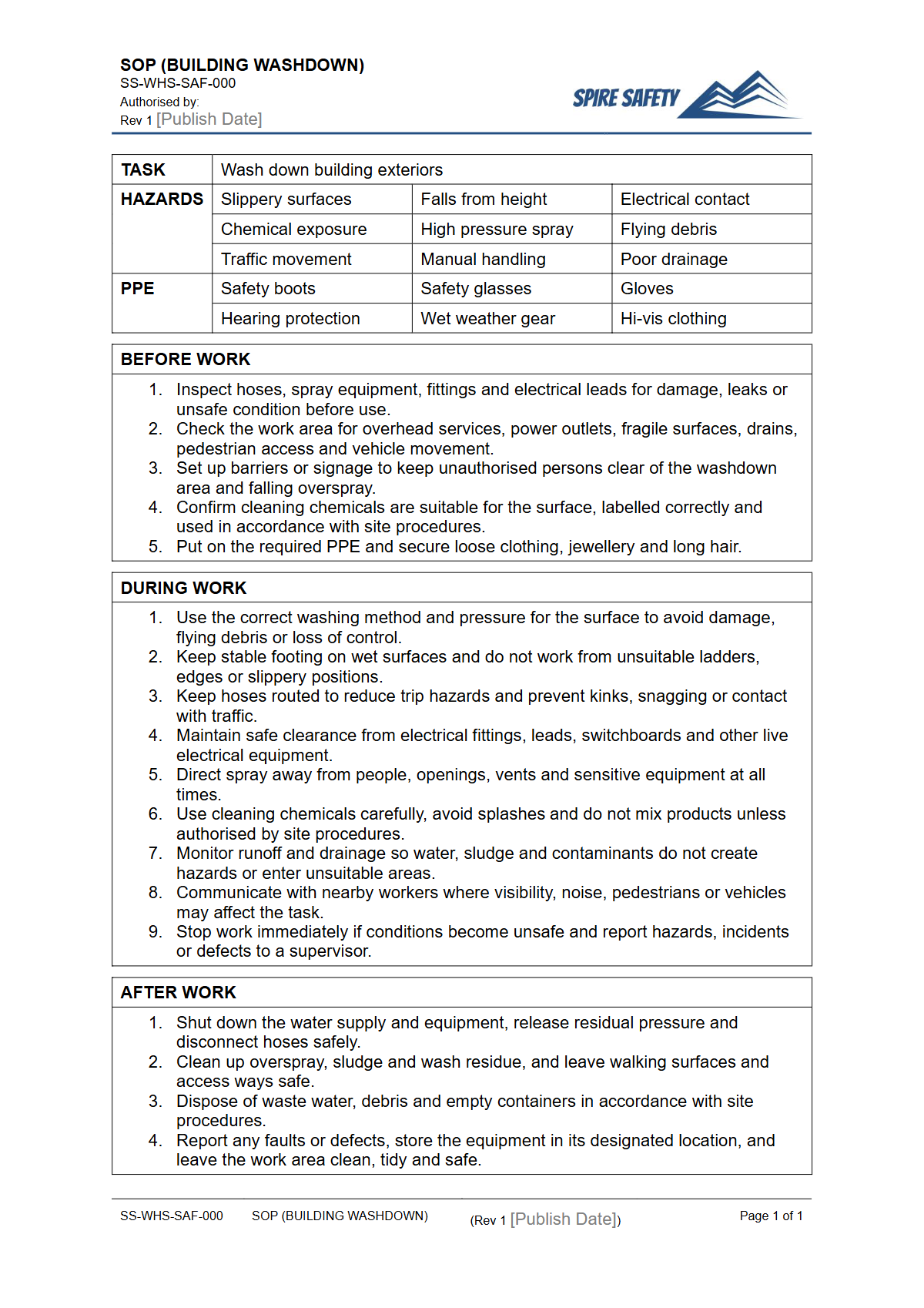
Download our free Safe Operating Procedure (Building Washdown) template. This DOCX/PDF resource helps you document safe work methods for building washdowns.
Free Safe Operating Procedure (Building Washdown) Template
DOCX • 126 KB + PDF
Updated Oct 2026
No signup required
Purpose of the Free Safe Operating Procedure (Building Washdown) Template
A Safe Operating Procedure (SOP) is a foundational document for any high-risk task. This Free Safe Operating Procedure (Building Washdown) Template provides a structured framework for documenting the step-by-step process required to clean building exteriors safely and effectively.
Building washdowns present a unique combination of hazards, including working at height, exposure to electricity and water, handling chemicals, and potential slips and trips. Using this template helps your organisation meet its primary duty of care under WHS law by establishing a clear, safe system of work.
A well-drafted SOP serves as more than just a procedural document; it's a vital training tool for new workers and a reference point for experienced staff. It standardises the washdown process, ensuring everyone follows the same safety protocols, uses the correct Personal Protective Equipment (PPE), and understands how to respond to potential emergencies.
By formalising these steps, you reduce the likelihood of incidents, equipment damage, and costly rework. This document is a key component of a proactive safety culture.
Video walkthrough
How to use the Free Safe Operating Procedure (Building Washdown) Template
This template is designed for ease of use. Simply download the DOCX or PDF file and open it to begin customisation.
The document is logically structured with pre-filled sections covering prerequisites, potential hazards, required PPE, step-by-step instructions, and emergency procedures. Your task is to adapt each section to reflect the specific realities of your workplace, including the types of buildings you service, the equipment you use (e.g., pressure washers, elevated work platforms), and the cleaning agents involved.
Important: It's critical to remember that we've created this document as a starting point. You must customise it to reflect the specific hazards, equipment, chemicals, and control measures relevant to your workplace.
We strongly recommend consulting with the workers who actually perform building washdowns; their direct experience is invaluable for identifying practical risks and effective controls. A generic SOP that doesn't match your operations offers little real-world protection.
Once customised, this SOP should be integrated into your broader WHS management systems. This ensures it's properly version-controlled, communicated to all relevant personnel, and included in your regular safety audits and reviews.
When to use it
A Building Washdown SOP should be developed and implemented before any washdown work commences at a new site or with new equipment. It forms the basis of task-specific training and induction for all workers involved.
The SOP should be readily accessible at the worksite for easy reference during operations, especially if unexpected issues arise. It is not a document to be filed away and forgotten.
It should also be used as a critical reference during pre-start meetings or toolbox talks to review hazards and reinforce safe work practices. Following any incident, near miss, or the introduction of a new chemical or piece of equipment, the SOP must be reviewed and updated to incorporate any new learnings or control measures. Tasks involving work at height, even on simple equipment, require strict procedural adherence, as outlined in our FREE Step Ladder SOP Template.
Who should use it
This Safe Operating Procedure is intended for use by multiple roles within an organisation:
- Workers and Contractors: To understand and follow the agreed-upon safe method for performing building washdowns.
- Supervisors and Team Leaders: To induct and train workers, supervise the task, and ensure the documented procedure is being followed correctly on-site.
- WHS Managers and Advisors: To develop, review, and integrate the SOP into the organisation’s overall safety framework. This includes ensuring it aligns with other risk assessments and procedures.
- Business Owners / Persons Conducting a Business or Undertaking (PCBUs): To demonstrate a key mechanism for discharging their legal duty to provide and maintain a safe system of work.
Effectively managing risks from pressurised systems is a core part of this task. The principles of hazard identification and control are shared with other high-pressure water tasks, like those detailed in our FREE Waterjet Cutter SOP Template. Regular reviews of your procedures can also be verified through a formal WHS compliance auditing program to ensure ongoing effectiveness.
If you're looking for other procedural documents for different types of equipment or tasks, you can explore our entire free WHS resources library.
Common mistakes
Common mistakes to avoid
- Using a generic SOP without customising it for the specific site, equipment, and chemicals.
- Failing to consult with workers who actually perform the washdown task during the SOP's development.
- Neglecting to provide proper training on the finalised SOP, treating it as a 'tick-box' exercise.
- Not reviewing or updating the SOP after an incident or when procedures change.
Legal references
Legal considerations
The following legal requirements may be relevant to this type of work.
- Work Health and Safety Act (Harmonised) — Provides the primary duties for protecting workers and other people from work health and safety risks.
- Work Health and Safety Regulations (Harmonised) — Sets out requirements supporting the management of workplace hazards and risks.
The following codes may be relevant to this type of work.
- Managing WHS Risks Code of Practice — Provides practical guidance on identifying hazards, assessing risks and applying effective controls.
- Work Health and Safety Consultation, Cooperation and Coordination Code of Practice — Provides practical guidance on consulting workers and coordinating with other duty holders.
- Managing the Work Environment and Facilities Code of Practice — Provides practical guidance on safe work environments, workplace facilities and related controls.
Did you know
Slips and Trips
According to Safe Work Australia, slips, trips and falls are a leading cause of serious workplace injuries. A wet, slippery environment created during a building washdown significantly increases this risk.
Electrical Danger
Water and electricity are a lethal combination. All electrical equipment used during a washdown must be suitable for wet conditions and protected by a residual current device (RCD) to prevent electrocution.
FAQ
Frequently asked questions
01What hazards should a Building Washdown SOP cover?
02Is a Safe Operating Procedure a legal requirement for building washdowns in Australia?
03Who is responsible for developing the SOP for building washdowns?
04How often should we review our Building Washdown SOP?
Share this resource
Free Safe Operating Procedure (Building Washdown) Template
Browse Categories
How To Use It
- 1Download and open in Word or PDF.
- 2Replace the placeholders with your business details.
- 3Get it reviewed by a WHS specialist before rollout.
Need it customised?
Our WHS consultants can adapt this template to your site, run a gap analysis, or audit what you already have in place.
Book a Free Consultation WHS consulting servicesor call 1300 156 382
Related templates
- Free Safe Operating Procedure (Bulb Planting) Template
- Free Safe Operating Procedure (Bulk Bag Lifting) Template
- Free Safe Operating Procedure (Bulk Bag Unloading) Template
- Free Safe Operating Procedure (Bulk Food Handling) Template
- Free Safe Operating Procedure (Bulk Freight Staging) Template
- Free Safe Operating Procedure (Bulk Ingredient Storage) Template