
Free Safe Operating Procedure (Bulk Freight Staging) Template
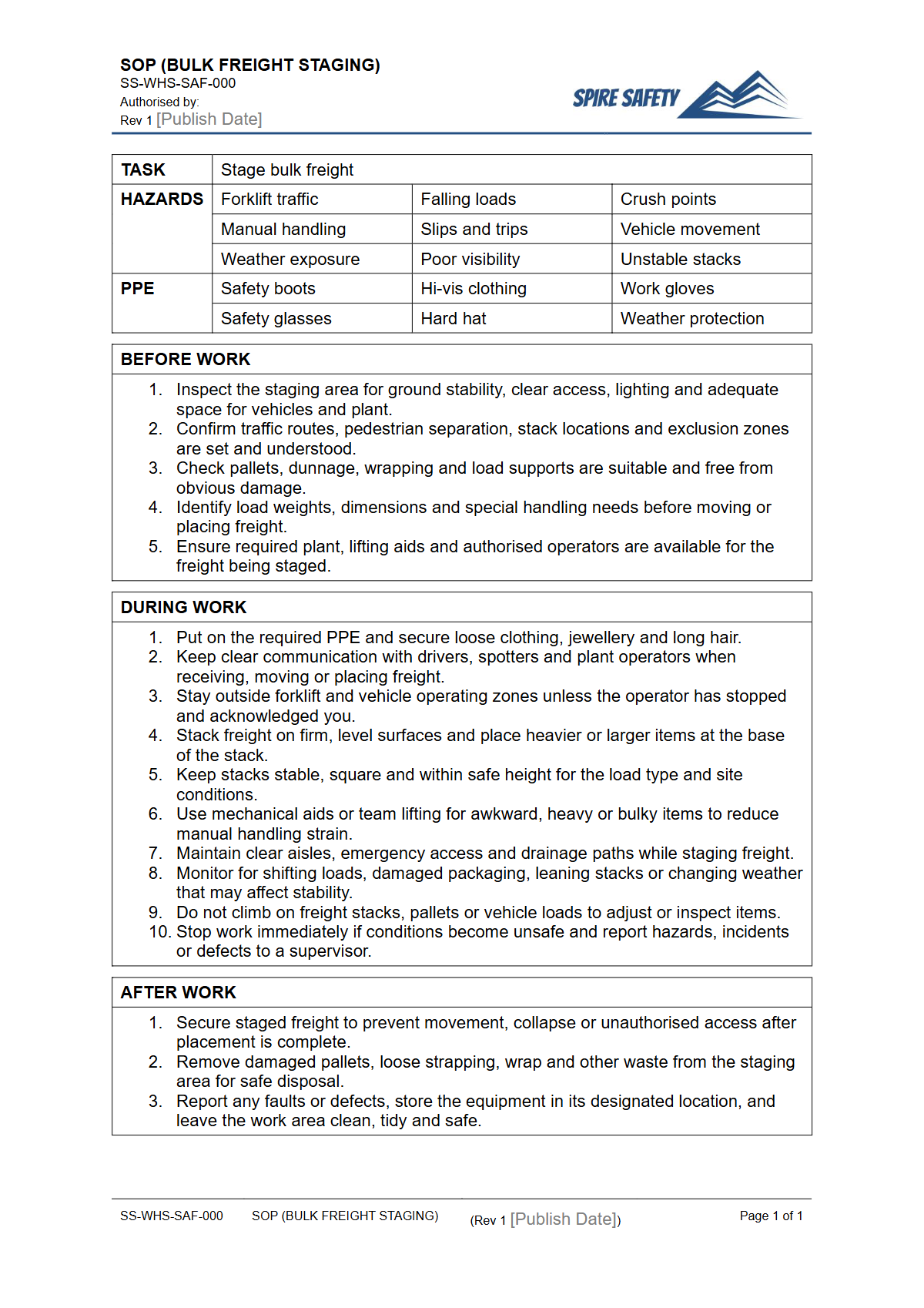
Download our free Safe Operating Procedure for Bulk Freight Staging. This template, available in DOCX and PDF, helps you outline key safety steps.
Free Safe Operating Procedure (Bulk Freight Staging) Template
DOCX • 126 KB + PDF
Updated Oct 2026
No signup required
Purpose of the Free Safe Operating Procedure (Bulk Freight Staging) Template
Effectively managing the staging area for bulk freight is critical for safety and efficiency in any logistics, transport, or warehouse operation. This area is often a high-traffic zone with constant interaction between pedestrians, mobile plant, and heavy vehicles.
Our Free Safe Operating Procedure (Bulk Freight Staging) Template provides a structured framework to help you document the agreed-upon method for performing this task safely. It guides you in identifying hazards like vehicle collisions, unstable loads, manual handling injuries, and falls from height, then implementing robust control measures to mitigate the associated risks.
Using a documented procedure helps standardise safe work practices across all shifts and teams, forming a key part of your safety management system. It's an essential tool for demonstrating due diligence and a commitment to providing a safe working environment.
Formalising your process for tasks involving heavy vehicles, such as those covered in our free Body Truck SOP template, ensures that all workers understand their responsibilities and the required safety protocols.
Video walkthrough
How to use the Free Safe Operating Procedure (Bulk Freight Staging) Template
This document is a comprehensive starting point, designed for easy adaptation. It is not a finished, universally applicable procedure.
To make it effective and relevant, it must be tailored to the unique conditions of your workplace. Follow these steps to implement it correctly:
- Download the DOCX version for easy editing.
- Conduct a thorough risk assessment of your bulk freight staging area, involving the workers who operate in that space.
- Populate the template with your site-specific information, including the types of freight handled, equipment used, designated pedestrian and vehicle routes, required PPE, and emergency response details.
- Consult with your team during the drafting process to ensure the procedure is practical and reflects how the work is actually done.
- Once finalised, the SOP should be approved by management and formally issued.
- Ensure all relevant personnel, including truck drivers, forklift operators, and yard staff, receive training on the contents of the new SOP before it is implemented.
Note: We strongly advise that you must customise this Safe Operating Procedure to reflect the specific hazards, equipment (such as those detailed in our FREE Telehandler SOP Template), site layout, and control measures unique to your organisation. A generic document will not adequately control risk.
When to use a Bulk Freight Staging SOP
A Safe Operating Procedure for bulk freight staging is a dynamic document used in various day-to-day scenarios. It should be the primary reference document for how the task is to be performed, ensuring consistency and safety.
Use it as a training tool for new employees or when onboarding contractors to familiarise them with your site's safety standards. It also serves as an excellent resource for pre-start meetings or toolbox talks to refresh your team's understanding of key hazards and controls.
Furthermore, the SOP is an essential document to review following any incident or near-miss in the staging area. This review helps identify any gaps in the procedure that may have contributed to the event.
Integrating this SOP is a practical step towards building more robust WHS management systems that proactively address operational risks rather than reacting to them after an incident.
Who should use this Safe Operating Procedure
This SOP is intended for a broad range of personnel within a logistics or freight-handling environment. The primary users are the frontline workers who perform the task daily.
This includes forklift operators, storepersons, transport operators, and yard staff who are directly involved in the movement, organisation, and securing of bulk freight. Their direct input and adherence are fundamental to the SOP's success.
Supervisors and team leaders are responsible for implementing the SOP, providing training, and monitoring its application on the ground. WHS managers and safety officers will use the document for inductions, risk assessments, and incident investigations. The effectiveness of these procedures can be verified through periodic workplace inspections and WHS compliance auditing to ensure the documented steps are being followed correctly in practice. Even minor tasks within the staging area, like accessing freight on pallets, require procedural guidance, similar to what is outlined in a FREE Step Ladder SOP Template. For more tools and guidance, explore our complete free WHS resources library.
Common mistakes
Common mistakes to avoid
- Using a generic template without customising it for site-specific hazards and equipment.
- Failing to consult with workers who perform the task when drafting the procedure.
- Not providing adequate training on the finalised SOP to all relevant staff and contractors.
- Treating the SOP as a document to be filed away, rather than a live tool for training and review.
Legal references
Legal considerations
The following legal requirements may be relevant to this type of work.
- Work Health and Safety Act (Harmonised) — Provides the primary duties for protecting workers and other people from work health and safety risks.
- Work Health and Safety Regulations (Harmonised) — Sets out requirements supporting the management of workplace hazards and risks.
The following codes may be relevant to this type of work.
- Managing WHS Risks Code of Practice — Provides practical guidance on identifying hazards, assessing risks and applying effective controls.
- Work Health and Safety Consultation, Cooperation and Coordination Code of Practice — Provides practical guidance on consulting workers and coordinating with other duty holders.
- Managing the Work Environment and Facilities Code of Practice — Provides practical guidance on safe work environments, workplace facilities and related controls.
Did you know
Traffic Management
Poorly managed traffic in loading zones is a leading cause of serious incidents in the logistics industry, often involving collisions between vehicles and pedestrians.
Unstable Loads
Securing bulk items correctly is critical. According to the National Transport Commission, inappropriate load positioning and restraint contribute significantly to heavy vehicle incidents and rollovers.
FAQ
Frequently asked questions
01What is a Safe Operating Procedure for bulk freight staging?
02Is this bulk freight staging SOP template enough for WHS compliance?
03Who is responsible for writing a Safe Operating Procedure?
04How often should we review our bulk freight staging SOP?
Share this resource
Free Safe Operating Procedure (Bulk Freight Staging) Template
Browse Categories
How To Use It
- 1Download and open in Word or PDF.
- 2Replace the placeholders with your business details.
- 3Get it reviewed by a WHS specialist before rollout.
Need it customised?
Our WHS consultants can adapt this template to your site, run a gap analysis, or audit what you already have in place.
Book a Free Consultation WHS consulting servicesor call 1300 156 382
Related templates
- Free Safe Operating Procedure (Bulk Ingredient Storage) Template
- Free Safe Operating Procedure (Bulk Seed Handling) Template
- Free Safe Operating Procedure (Bulk Waste Transfer) Template
- Free Safe Operating Procedure (Bus Shelter Cleaning) Template
- Free Safe Operating Procedure (Busbar Bender) Template
- Free Safe Operating Procedure (Busbar Cutter) Template