
Free Safe Operating Procedure (Bulk Waste Transfer) Template
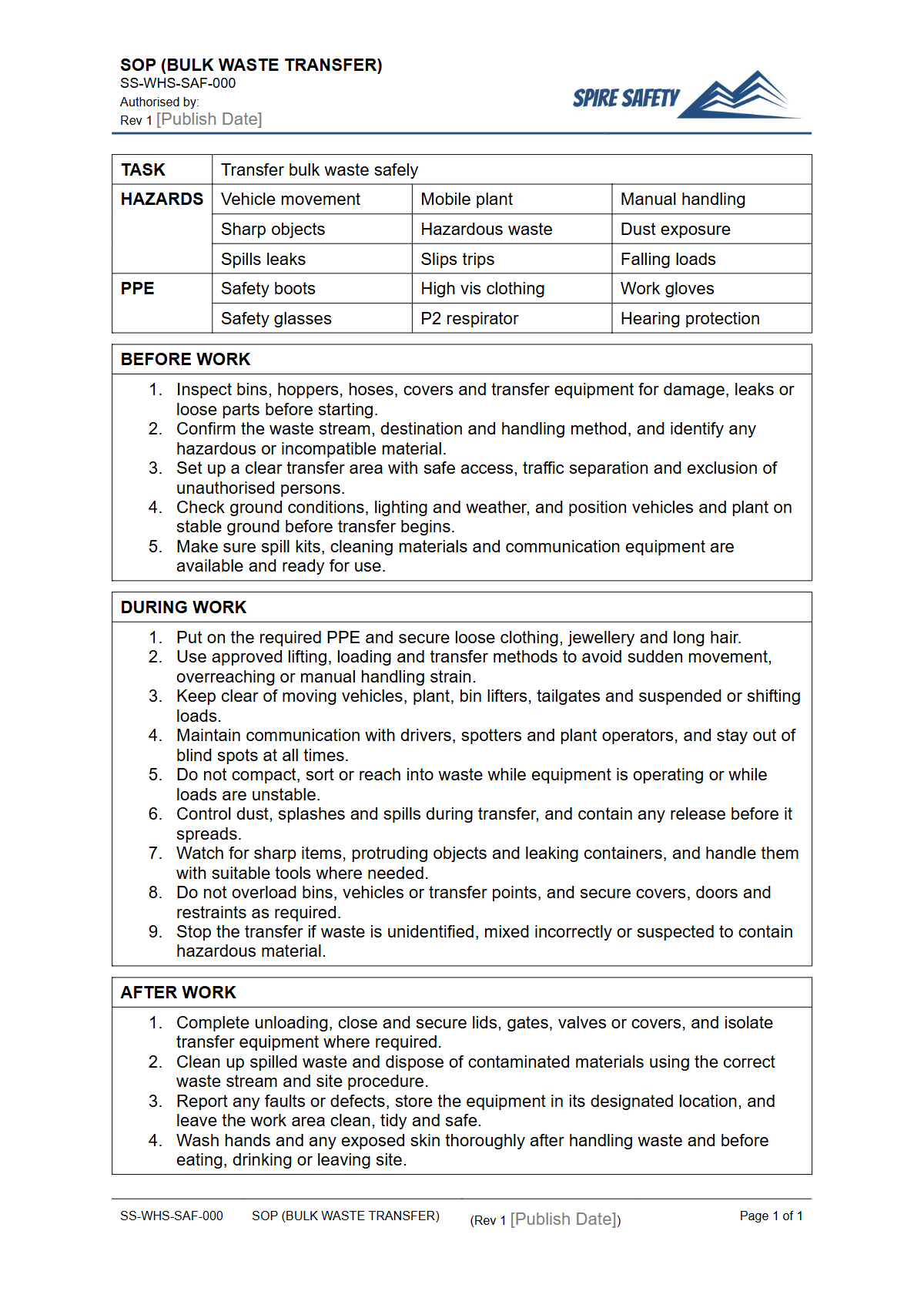
Download our free Safe Operating Procedure (Bulk Waste Transfer) template. This DOCX/PDF resource provides a clear framework for managing bulk waste safely.
Free Safe Operating Procedure (Bulk Waste Transfer) Template
DOCX • 126 KB + PDF
Updated Oct 2026
No signup required
Purpose of the Free Safe Operating Procedure (Bulk Waste Transfer) Template
Managing the transfer of bulk waste, whether on a construction site, in a manufacturing facility, or at a waste management centre, involves significant work health and safety risks. This Free Safe Operating Procedure (Bulk Waste Transfer) Template provides a structured starting point for your organisation to document a safe, repeatable process.
Using a clear SOP helps you identify hazards, implement control measures, and provide workers with explicit instructions for performing the task safely. It's a fundamental tool for managing risks associated with mobile plant, hazardous materials, and manual tasks, forming a key part of your safety management system.
Documenting a formal process helps meet your duties under Australian WHS legislation by demonstrating a systematic approach to risk management. It standardises your operational approach, which can reduce incidents, improve efficiency, and ensure all workers, including new starters and contractors, understand the expected safety standards.
An effective SOP is a critical component of your broader safety framework and can be invaluable during training, incident investigation, and safety audits. It demonstrates a commitment to creating a safer working environment for everyone involved.
Video walkthrough
How to use the Free Safe Operating Procedure (Bulk Waste Transfer) Template
This template is provided in both DOCX and PDF formats to serve as a foundation, not a final product. Download the DOCX file and adapt it to your specific operational context.
Effective safety procedures are never 'one-size-fits-all'.
Important: We have provided a framework based on common industry practice, but you must customise this template to reflect the specific equipment (e.g., loaders, skip bins, trucks), types of waste, site layout, and personnel at your workplace. Only you can ensure the final document accurately represents your unique operational environment and controls.
We strongly recommend you develop the final SOP in consultation with the workers who perform the task and their direct supervisors. Their direct experience is invaluable for identifying practical hazards and effective controls.
This collaborative process ensures the SOP is both practical and comprehensive.
A well-developed SOP is a cornerstone of a safe workplace. It should integrate seamlessly into your broader safety program, which may be part of more comprehensive WHS management systems. This holistic approach ensures that individual procedures are supported by overarching policies, training schedules, and review mechanisms.
When to use a Safe Operating Procedure
A Safe Operating Procedure for bulk waste transfer should be developed and implemented before any work commences. It is a proactive safety tool, not a reactive one.
The finalised SOP should be used for several key activities: inducting and training new employees, refreshing the knowledge of existing workers, and as a reference during daily pre-start or toolbox talks. It also serves as a benchmark for workplace inspections and safety observations.
In the event of a near miss or incident, the SOP is a critical document to review as part of the investigation process to determine if the procedure was followed and if it needs revision.
The process of transferring bulk waste often involves specific types of heavy vehicles. If your operations use particular machinery, you should ensure you have procedures for each.
For instance, you may need a separate body truck SOP to complement this more general bulk waste transfer procedure.
Who should use this Safe Operating Procedure
This SOP template is designed for use by any person or organisation involved in the handling and transportation of bulk waste. This includes:
- WHS Managers and Safety Officers: To develop and formalise safety processes as part of the wider safety system.
- Site Supervisors and Team Leaders: To train their teams, enforce safe work practices, and lead toolbox talks.
- Business Owners and PCBUs: To fulfil their legal duty of care by providing a safe system of work.
- Workers and Operators: To understand the approved, safe method for completing the task and to use as a reference.
The responsibility for safety is shared, and the SOP is a tool that helps everyone, from management to the frontline, understand their role in maintaining a safe workplace. For complex operations or organisations needing expert guidance on customising such documents, engaging professional WHS consulting services can provide clarity and ensure best practices are adopted.
Key Hazards in Bulk Waste Transfer
Your customised SOP must address the specific hazards present in your workplace. Common hazards include:
- Mobile Plant Interaction: Collisions between trucks, loaders, forklifts, and personnel are a leading cause of serious injury. This risk is especially high in busy or confined spaces.
- Manual Tasks: Lifting heavy container lids, dragging hoses, or manually adjusting loads can lead to sprains, strains, and other musculoskeletal disorders.
- Hazardous Substances: Waste may contain chemical, biological (e.g., mould, bacteria), or physical hazards (e.g., asbestos, sharps) that require specific handling procedures and PPE.
- Slips, Trips, and Falls: Spilled liquid or debris from waste can create slippery or uneven surfaces, leading to falls.
- Falls from Height: Workers climbing on or off trucks, or onto bulk bins, are at risk of falls.
When dealing with mobile plant, having specific procedures for each type of equipment is crucial. For instance, if a telehandler is used for loading, a dedicated telehandler SOP should be referenced or integrated into your overall plan.
Implementing Your SOP Effectively
A document alone does not create safety. Once your SOP is customised and finalised, it must be effectively communicated and implemented.
Hold training sessions to walk through the procedure with all relevant workers. Ensure they have opportunities to ask questions.
Place copies of the SOP in accessible locations, such as in lunchrooms or near the work area itself. Most importantly, supervisors must monitor work to ensure the procedure is being followed consistently.
This active oversight turns the document into a lived safety practice. Reviewing your procedures regularly, especially after any changes or incidents, is critical to maintaining a safe system of work.
For large-scale waste management or earthmoving sites, specific heavy machinery like bulldozers may be involved in moving bulk materials after transfer. In such cases, a dedicated dozer SOP is essential to manage the unique risks associated with that equipment.
If you are looking for more templates like this one, browse our complete free WHS resources library for a wide range of documents.
Common mistakes
Common mistakes to avoid
- Using a generic template without customising it for the specific site, equipment, and materials.
- Failing to consult with the workers who actually perform the task when drafting the procedure.
- Not providing adequate training to all relevant staff on the contents of the finalised SOP.
- Treating the SOP as a static document instead of reviewing and updating it regularly or after an incident.
Legal references
Legal considerations
The following legal requirements may be relevant to this type of work.
- Work Health and Safety Act (Harmonised) — Provides the primary duties for protecting workers and other people from work health and safety risks.
- Work Health and Safety Regulations (Harmonised) — Sets out requirements supporting the management of workplace hazards and risks.
The following codes may be relevant to this type of work.
- Managing WHS Risks Code of Practice — Provides practical guidance on identifying hazards, assessing risks and applying effective controls.
- Work Health and Safety Consultation, Cooperation and Coordination Code of Practice — Provides practical guidance on consulting workers and coordinating with other duty holders.
- Managing the Work Environment and Facilities Code of Practice — Provides practical guidance on safe work environments, workplace facilities and related controls.
Did you know
High-Risk Industry
The waste collection, treatment, and disposal services industry in Australia consistently records one of the highest rates of serious workplace injury claims.
Hidden Dangers
Bulk waste isn't just solid refuse. It can include liquids, sludge, and powders, each presenting unique challenges for containment, handling, and transport, often requiring specialised equipment and procedures.
FAQ
Frequently asked questions
01What is a Safe Operating Procedure for bulk waste transfer?
02Is this bulk waste transfer SOP template ready to use immediately?
03Who is responsible for writing a Safe Operating Procedure?
04How often should we review our bulk waste transfer SOP?
Share this resource
Free Safe Operating Procedure (Bulk Waste Transfer) Template
Browse Categories
How To Use It
- 1Download and open in Word or PDF.
- 2Replace the placeholders with your business details.
- 3Get it reviewed by a WHS specialist before rollout.
Need it customised?
Our WHS consultants can adapt this template to your site, run a gap analysis, or audit what you already have in place.
Book a Free Consultation WHS consulting servicesor call 1300 156 382
Related templates
- Free Safe Operating Procedure (Bus Shelter Cleaning) Template
- Free Safe Operating Procedure (Busbar Bender) Template
- Free Safe Operating Procedure (Busbar Cutter) Template
- Free Safe Operating Procedure (Cabin Supply Loading) Template
- Free Safe Operating Procedure (Cable Avoidance Tool) Template
- Free Safe Operating Procedure (Cable Blower) Template