
Free Safe Operating Procedure (Busbar Cutter) Template
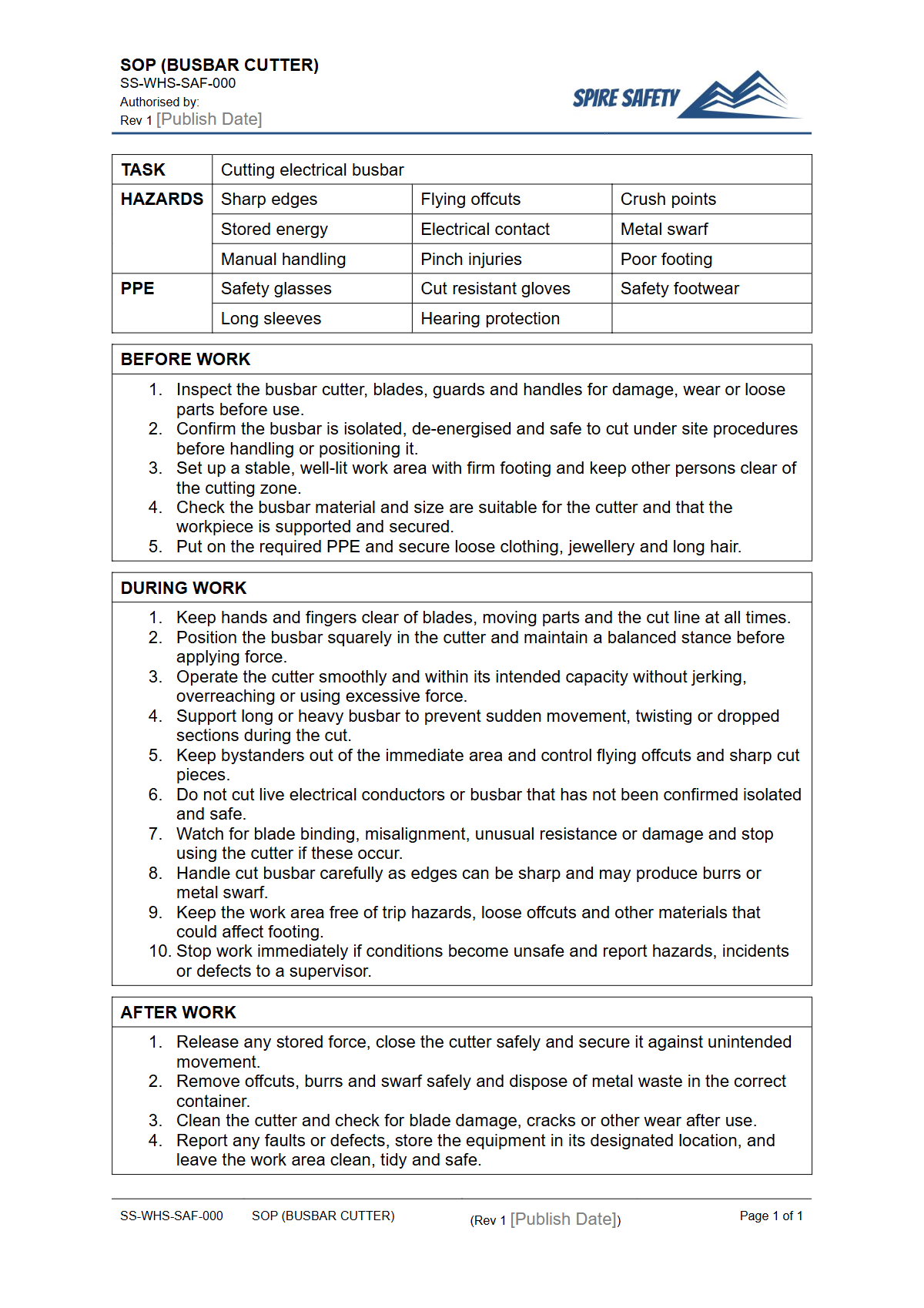
Download our free Safe Operating Procedure (Busbar Cutter) Template. This user-friendly DOCX and PDF provides a structured guide for safe busbar cutter use.
Free Safe Operating Procedure (Busbar Cutter) Template
DOCX • 126 KB + PDF
Updated Oct 2026
No signup required
Purpose of the Free Safe Operating Procedure (Busbar Cutter) Template
Effectively managing the risks associated with specialised electrical equipment is critical for any organisation working with switchboards and power distribution systems. Our Free Safe Operating Procedure (Busbar Cutter) Template provides a structured foundation for documenting safe work practices for this high-risk task.
This document is designed to help your business outline the step-by-step processes required to operate busbar cutters safely, minimising the risk of electrical shock, severe cuts, and crush injuries.
The primary purpose of this Safe Operating Procedure for a Busbar Cutter is to provide a clear, consistent, and documented method for its use. It serves as a vital tool for risk management, helping to control hazards associated with cutting copper or aluminium busbars.
By formalising the process, you can ensure all operators understand the required pre-operational checks, personal protective equipment (PPE), safe operating sequence, and shutdown procedures. Much like the procedures for other high-energy tools, such as our FREE Plasma Cutter SOP, a well-defined SOP for a busbar cutter helps prevent incidents and ensures work is performed to a consistent, safe standard.
Video walkthrough
How to use the Free Safe Operating Procedure (Busbar Cutter) Template
This downloadable file is a starting point, not a finished document. It provides a comprehensive structure aligned with Australian WHS principles, but it requires input from your team to be effective. You must customise this Safe Operating Procedure to reflect the specific busbar cutter models, work environment, and unique risks at your workplace. We cannot guarantee its suitability for your specific circumstances without thorough customisation.
To implement it correctly, follow these steps:
- Consult: Engage with the electricians, switchboard builders, and supervisors who use the equipment daily. Their practical experience is invaluable for identifying real-world hazards and effective controls.
- Customise: Adapt the template by adding details specific to your machinery, including manufacturer, model, and capacity. Detail the exact type of PPE required, such as specific voltage-rated gloves and Australian Standards-compliant eye protection.
- Risk Assess: Use the document as a guide to conduct a task-specific risk assessment. Identify all potential hazards, including electrical, mechanical (crushing, cutting), and hydraulic (fluid injection), and document the control measures.
- Integrate: Incorporate the finished SOP into your broader WHS management systems. This ensures it connects with your training, incident reporting, and review processes.
- Train: Ensure every operator is formally trained on the contents of the finalised SOP. Competency should be verified before any individual is authorised to use a busbar cutter unsupervised.
When to use it
A Safe Operating Procedure for a busbar cutter should be a living document, integrated into daily operations. It is essential during the induction and training of new employees who will be required to operate the equipment.
The SOP should be readily available in the work area and used as a reference for pre-start checks and as a basis for toolbox talks on electrical safety or specific high-risk tasks. Regular use during refresher training helps reinforce correct behaviour and addresses any complacency that may develop over time. It's also a critical document to review after an incident or near miss, or when assessing procedures for similar fabrication equipment like those covered in our Free Brake Press SOP Template.
Who should use it
This SOP is intended for a range of personnel within an organisation, each with distinct responsibilities. Operators and Tradespersons (e.g., electricians, switchboard builders) must use it as the primary guide for performing the task safely from start to finish.
Supervisors and Team Leaders are responsible for ensuring workers are trained on the SOP and follow it correctly during every operation. WHS Managers and Advisors will use the template to develop and formalise workplace procedures as part of the overall safety management system, ensuring a consistent approach to documentation across different equipment, similar to how procedures are managed for tools covered in our FREE Circular Saw SOP Template. Finally, Maintenance Personnel should refer to it, particularly sections on isolation and de-energisation (LOTO), before conducting repairs or servicing.
By implementing a detailed SOP, your business takes a significant step towards managing the serious risks posed by busbar cutters. A documented procedure promotes a culture of safety, clarifies expectations, and provides a clear standard for training and supervision.
Explore our full free WHS resources library for more templates to support your safety management efforts.
Common mistakes
Common mistakes to avoid
- Failing to de-energise and lock out the power source before starting work.
- Using the cutter on materials, hardness levels, or sizes it is not rated for, leading to blade shatter or equipment failure.
- Neglecting to inspect hydraulic hoses and electrical cords for damage before use.
- Not wearing appropriate PPE, especially rated insulated gloves and standards-approved eye protection.
Legal references
Legal considerations
The following legal requirements may be relevant to this type of work.
- Work Health and Safety Act (Harmonised) — Provides the primary duties for protecting workers and other people from work health and safety risks.
- Work Health and Safety Regulations (Harmonised) — Sets out requirements supporting the management of workplace hazards and risks.
The following codes may be relevant to this type of work.
- Managing WHS Risks Code of Practice — Provides practical guidance on identifying hazards, assessing risks and applying effective controls.
- Work Health and Safety Consultation, Cooperation and Coordination Code of Practice — Provides practical guidance on consulting workers and coordinating with other duty holders.
- Managing the Work Environment and Facilities Code of Practice — Provides practical guidance on safe work environments, workplace facilities and related controls.
Did you know
The Hidden Danger
Hydraulic busbar cutters operate under immense pressure. A pinhole leak in a hose can inject fluid into the skin at high velocity, causing severe injury and poisoning that requires immediate, specialist medical attention.
Conductivity Matters
Busbars are made of copper or aluminium due to their high electrical conductivity. This property means any residual charge can be extremely dangerous, highlighting the critical importance of lock-out tag-out (LOTO) procedures before work begins.
FAQ
Frequently asked questions
01Is a Safe Operating Procedure a legal requirement for a busbar cutter in Australia?
02What are the main hazards to include in a busbar cutter SOP?
03How often should a busbar cutter SOP be reviewed?
04Can this template be used for both hydraulic and manual busbar cutters?
Share this resource
Free Safe Operating Procedure (Busbar Cutter) Template
Browse Categories
How To Use It
- 1Download and open in Word or PDF.
- 2Replace the placeholders with your business details.
- 3Get it reviewed by a WHS specialist before rollout.
Need it customised?
Our WHS consultants can adapt this template to your site, run a gap analysis, or audit what you already have in place.
Book a Free Consultation WHS consulting servicesor call 1300 156 382
Related templates
- Free Safe Operating Procedure (Cabin Supply Loading) Template
- Free Safe Operating Procedure (Cable Avoidance Tool) Template
- Free Safe Operating Procedure (Cable Blower) Template
- Free Safe Operating Procedure (Cable Crimper) Template
- Free Safe Operating Procedure (Cable Cutter) Template
- Free Safe Operating Procedure (Cable Drum Jack) Template