
Free Safe Operating Procedure (Cabin Supply Loading) Template
Download our free Safe Operating Procedure (Cabin Supply Loading) Template.
Free Safe Operating Procedure (Cabin Supply Loading) Template
DOCX • 126 KB + PDF
Updated Oct 2026
No signup required
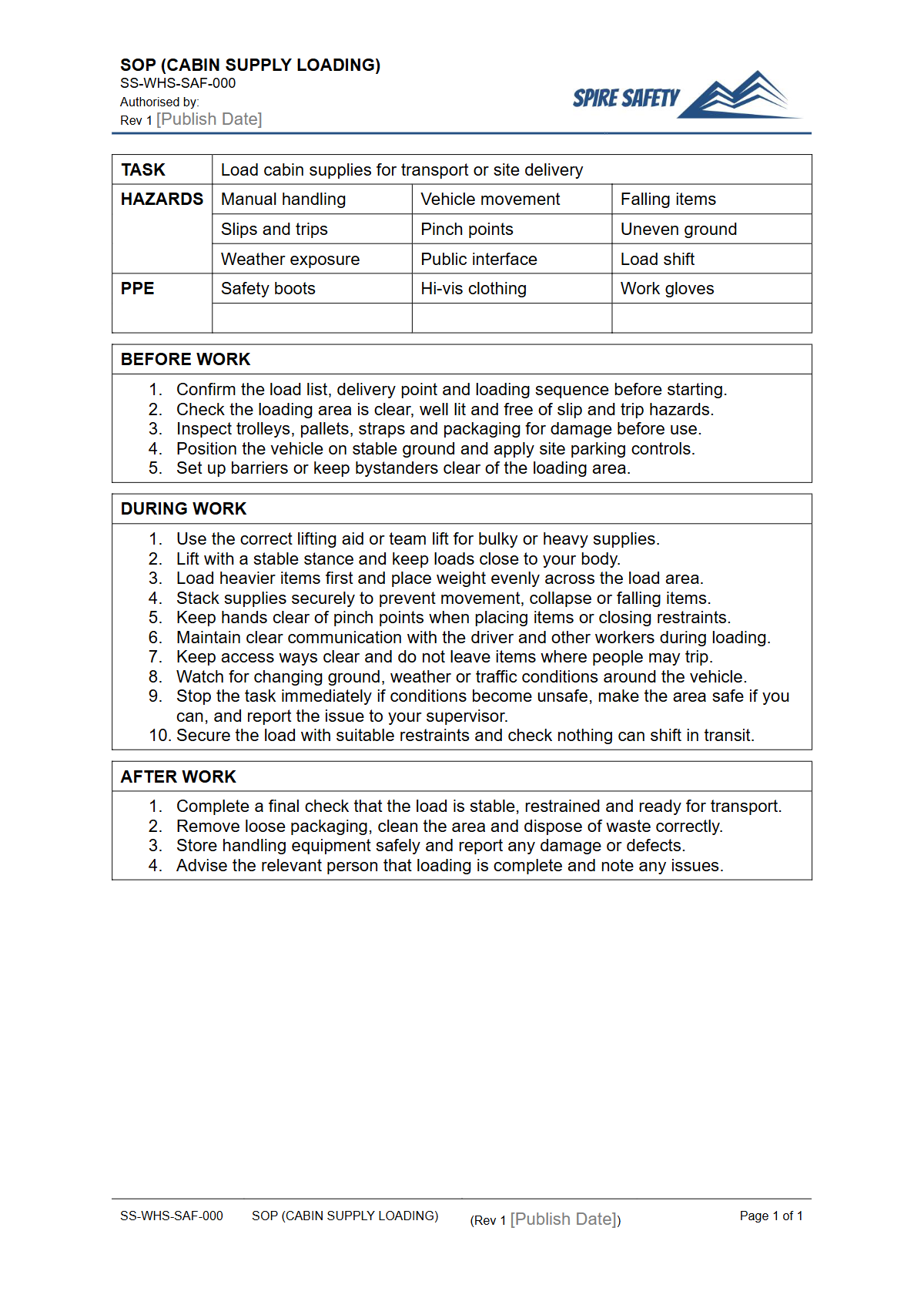
Purpose of the Free Safe Operating Procedure (Cabin Supply Loading) Template
Loading supplies into an aircraft cabin is a high-risk task involving manual handling, specialised equipment, and a dynamic operational environment. This Free Safe Operating Procedure (Cabin Supply Loading) Template provides a structured starting point for your organisation to document the required safety protocols for this activity.
It helps you formally outline the step-by-step process, identify significant hazards, and implement effective risk control measures. The primary goal is to prevent injuries to ground crew, such as musculoskeletal disorders from lifting, falls from height, or incidents involving ground support equipment (GSE), while also preventing costly damage to the aircraft.
A well-defined SOP ensures consistency in how tasks are performed, forming a critical part of your safety management system. It covers the entire logistics chain on the tarmac, from the arrival of the catering truck to the final securing of items in the galley.
This includes integrating with other procedures, such as those covered in a Safe Operating Procedure for body trucks that deliver supplies to the airside area.
Video walkthrough
How to use the Free Safe Operating Procedure (Cabin Supply Loading) Template
This resource is available as a fully editable DOCX file for easy customisation, as well as a print-ready PDF. To use the template effectively, download the file and systematically work through each section, adapting the content to match your specific operational context.
Important Note: This document is a template and not a finished procedure. We've provided a solid foundation based on Australian WHS principles, but you must customise it to reflect your specific aircraft fleet, types of ground support equipment (e.g., high-lift trucks, scissor lifts), airport environment, and company policies.
We strongly recommend consulting directly with the ground crew and supervisors who perform the loading tasks to ensure the final procedure is practical and comprehensive.
If you need assistance in tailoring this document or developing other complex safety procedures, our WHS consulting team can provide expert guidance to ensure your documentation is robust and fit for purpose.
When to use this Safe Operating Procedure
A Safe Operating Procedure for cabin supply loading should be a core document used in several key situations. It serves as the primary reference guide for any worker tasked with loading catering trolleys, supplies, or other items onto an aircraft.
It is essential for new worker inductions and for specific task training, ensuring everyone understands the established safe method from day one. It should also be used during refresher training sessions and be readily accessible in the workplace for quick reference.
Furthermore, the SOP acts as a baseline for workplace safety observations and is an invaluable tool during incident investigations. Should an accident or near-miss occur during loading operations, the SOP helps investigators understand the prescribed work method and identify any deviations that may have contributed to the event.
In situations involving complex logistics at the catering depot, you may need other specific procedures, such as for equipment used to load the trucks themselves. For example, if your operation uses a telehandler, it must be covered by its own document like a FREE Telehandler SOP (Safe Operating Procedure) Template.
Who should use it
This template is designed for use by a range of personnel within an aviation or ground handling organisation. This includes:
- WHS Managers and Safety Professionals: To establish and formalise a best-practice procedure aligned with Australian WHS standards.
- Ground Operations Managers and Supervisors: To train their teams, enforce safety standards, and oversee the loading process on a day-to-day basis.
- Ground Crew and Catering Staff: As a practical guide for performing the task safely and consistently.
- Training and Assessment Officers: To develop training materials and competency checks based on a standardised procedure.
Ultimately, the SOP should be a key component of your broader WHS management systems, linking operational tasks directly to your organisation's overall safety policy and objectives. For more templates covering different tasks and equipment, browse our complete free WHS resources library.
Integrating the SOP into Your Safety System
An SOP is most effective when it is part of a living safety system, not just a document filed away. Its implementation should be supported by practical training, clear communication, and ongoing supervision.
The procedure should be referenced in your risk register and linked to relevant training records for all applicable personnel. Regular reviews are critical to ensure it remains current with any changes in equipment, regulations, or industry best practice.
Verifying that the documented steps are being followed correctly through periodic WHS compliance auditing closes the loop and reinforces a positive safety culture.
Common mistakes
Common mistakes to avoid
- Failing to customise the template for specific aircraft models and ground support equipment.
- Not providing practical training on the finalised SOP or verifying worker competency.
- Skipping pre-operational checks on high-lift trucks, scissor lifts, or catering trolleys.
- Neglecting ergonomic risks like awkward postures, repetitive lifting, and forceful exertions.
Legal references
Legal considerations
The following legal requirements may be relevant to this type of work.
- Work Health and Safety Act (Harmonised) — Provides the primary duties for protecting workers and other people from work health and safety risks.
- Work Health and Safety Regulations (Harmonised) — Sets out requirements supporting the management of workplace hazards and risks.
The following codes may be relevant to this type of work.
- Managing WHS Risks Code of Practice — Provides practical guidance on identifying hazards, assessing risks and applying effective controls.
- Work Health and Safety Consultation, Cooperation and Coordination Code of Practice — Provides practical guidance on consulting workers and coordinating with other duty holders.
- Managing the Work Environment and Facilities Code of Practice — Provides practical guidance on safe work environments, workplace facilities and related controls.
Did you know
Manual Handling Risk
Hazardous manual tasks, central to airline catering and loading, are a leading cause of workplace injuries in Australia. They account for a significant percentage of all serious workers' compensation claims each year.
Ground Damage Costs
Incorrectly performed loading procedures not only pose a risk to workers but are also a common cause of costly ground damage to aircraft fuselages, door sills, and galley equipment, potentially leading to flight delays.
FAQ
Frequently asked questions
01What is a Safe Operating Procedure for cabin supply loading?
02Is this template suitable for all types of aircraft?
03Who is responsible for creating the Cabin Supply Loading SOP?
04How often should this Safe Operating Procedure be reviewed?
Share this resource
Free Safe Operating Procedure (Cabin Supply Loading) Template
Browse Categories
How To Use It
- 1Download and open in Word or PDF.
- 2Replace the placeholders with your business details.
- 3Get it reviewed by a WHS specialist before rollout.
Need it customised?
Our WHS consultants can adapt this template to your site, run a gap analysis, or audit what you already have in place.
Book a Free Consultation WHS consulting servicesor call 1300 156 382
Related templates
- Free Safe Operating Procedure (Cable Avoidance Tool) Template
- Free Safe Operating Procedure (Cable Blower) Template
- Free Safe Operating Procedure (Cable Crimper) Template
- Free Safe Operating Procedure (Cable Cutter) Template
- Free Safe Operating Procedure (Cable Drum Jack) Template
- Free Safe Operating Procedure (Cable Drum Stand) Template