
Free Safe Operating Procedure (Cable Drum Jack) Template
Download our free Safe Operating Procedure (SOP) template for cable drum jacks. This DOCX and PDF resource helps you outline safe work practices.
Free Safe Operating Procedure (Cable Drum Jack) Template
DOCX • 126 KB + PDF
Updated Oct 2026
No signup required
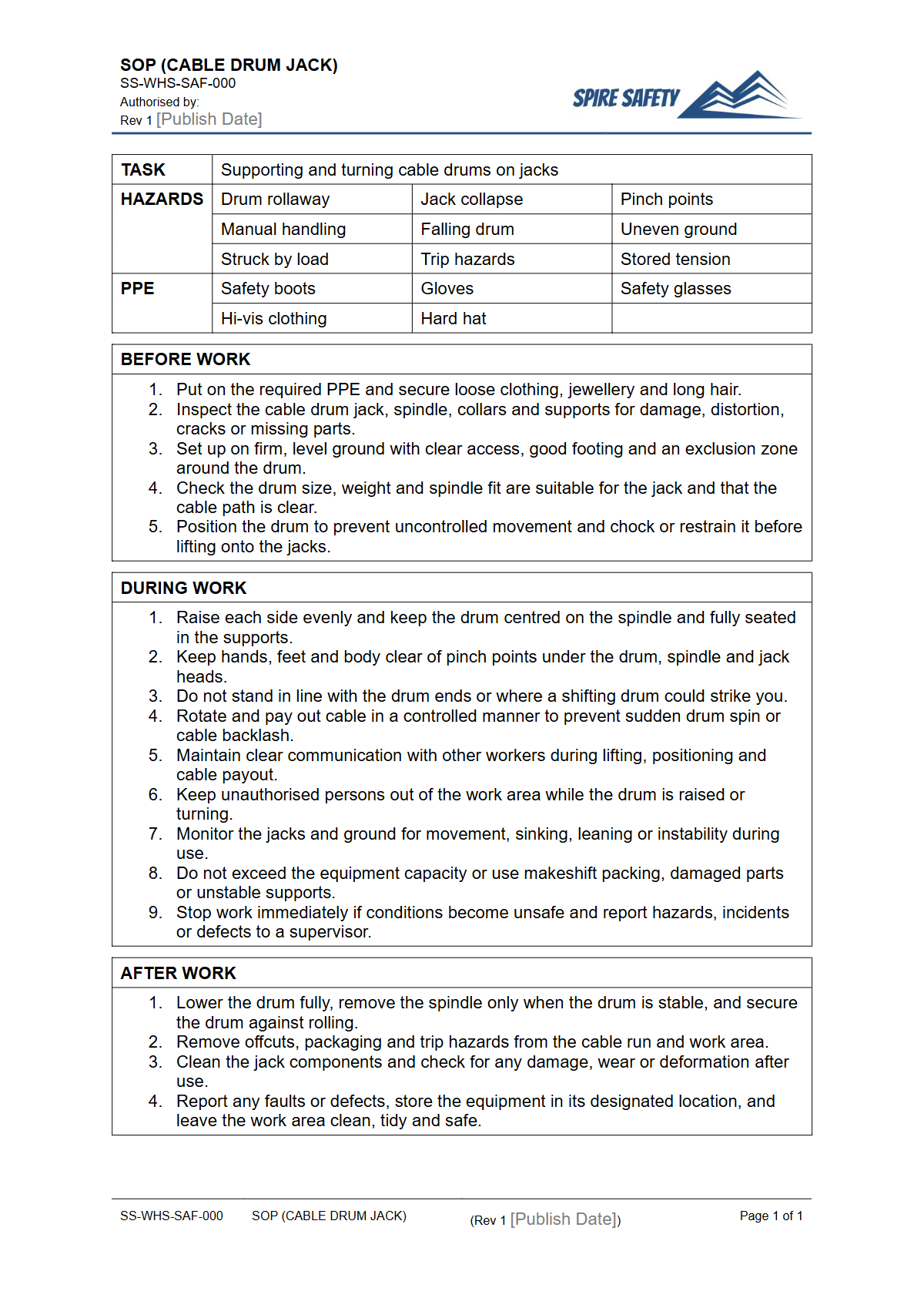
Purpose of the Free Safe Operating Procedure (Cable Drum Jack) Template
Effectively managing the risks associated with heavy equipment is a cornerstone of workplace safety. This Free Safe Operating Procedure (Cable Drum Jack) Template provides a structured starting point for organisations to document the required process for safely lifting, supporting, and dispensing cable from heavy drums.
While cable drum jacks may seem straightforward, they introduce significant hazards, including crushing injuries from falling drums, musculoskeletal disorders from hazardous manual handling, and equipment failure due to improper setup or maintenance.
Using this template helps you create a clear, step-by-step guide that standardises the task for all workers. A documented SOP serves as a critical training tool, a reference for pre-work planning, and evidence of your commitment to providing a safe system of work.
It forms an essential part of your overall safety framework, ensuring that controls identified in your risk assessments are consistently put into practice. Integrating such procedures is a key function of effective WHS management systems.
Video walkthrough
How to use the Free Safe Operating Procedure (Cable Drum Jack) Template
This Safe Operating Procedure is provided as a fully editable DOCX file, allowing for complete customisation. After downloading, open the document and methodically work through each section, replacing the placeholder text with information specific to your operational context.
It is crucial to adapt this procedure for the specific equipment used on your site and the environment in which it operates.
Note: This document is a template and must be customised to your specific workplace. We are not responsible for the implementation or compliance of the final document.
You must add site-specific details, including the make, model, and capacity of your cable drum jacks, the roles and responsibilities of personnel, your specific emergency procedures, and details of the operating environment. The same principle applies to all plant-specific procedures, whether for complex machinery like that covered in our FREE Trencher SOP (Safe Operating Procedure) Template or for simpler tools.
When to use a Cable Drum Jack SOP
A Safe Operating Procedure for cable drum jacks should be used as a primary reference before, during, and after any task involving their use. It is a critical document for planning work, especially when developing a Safe Work Method Statement (SWMS) for high-risk construction work.
Workers should review the SOP as part of their pre-task risk assessment (e.g., Take 5 or JSA) to refresh their understanding of the required controls.
It should also be a central part of any training and competency verification process for new and existing employees. Documenting procedures for all equipment, no matter how simple it may appear, is vital for safety consistency, a principle that applies equally to our FREE Step Ladder SOP Template.
Who should use it
This SOP template is designed for use by a range of personnel within an organisation. The primary users are the workers who directly operate the equipment, such as electricians, linespersons, telecommunications technicians, and construction labourers.
It provides them with clear instructions to perform their tasks safely and consistently.
Supervisors and team leaders must also use the SOP to plan jobs, conduct toolbox talks, and supervise work to ensure it aligns with documented procedures. WHS managers and advisors will use it as a tool to standardise safety practices across the business, assist in incident investigations, and support compliance activities.
On large-scale projects, numerous SOPs are required to manage different risks, including those detailed in resources like the FREE Dozer SOP (Safe Operating Procedure) Template for associated earthmoving activities.
What a comprehensive Cable Drum Jack SOP includes
To be effective, your customised SOP should detail several key areas:
- Required PPE: Specify mandatory personal protective equipment, such as steel-capped boots, high-visibility clothing, gloves, and safety glasses.
- Pre-Operational Checks: Create a checklist for inspecting the jacks, spindles, collars, and hydraulic components for damage, wear, or leaks before every use. This must also include assessing the ground for stability and levelness.
- Step-by-Step Operating Instructions: Clearly outline the sequence for setting up the jacks, lifting the drum, securing the load, dispensing cable, and lowering the drum. Emphasise critical safety actions like ensuring the load is balanced and locking mechanisms are engaged.
- Shutdown and Storage: Detail the correct procedure for safely dismantling the setup and storing the equipment to prevent damage or unauthorised use.
Regularly reviewing your safety documents against current practices and legislation is essential for maintaining a safe workplace. This can be supported through formal processes like WHS compliance auditing to identify any gaps or areas for improvement.
By thoroughly customising and implementing this procedure, you take a significant step towards mitigating risk and protecting your team. For more tools to enhance your safety management, explore our complete free WHS resources library.
Common mistakes
Common mistakes to avoid
- Exceeding the jack's specified Safe Working Load (SWL).
- Setting up jacks on soft, uneven, or sloping ground without suitable support plates.
- Failing to inspect jacks, spindles, and locking pins for wear, cracks, or damage before use.
- Incorrectly positioning the jacks relative to the drum's centre of gravity, leading to an unstable load.
Legal references
Legal considerations
The following legal requirements may be relevant to this type of work.
- Work Health and Safety Act (Harmonised) — Provides the primary duties for protecting workers and other people from work health and safety risks.
- Work Health and Safety Regulations (Harmonised) — Sets out requirements supporting the management of workplace hazards and risks.
The following codes may be relevant to this type of work.
- Managing WHS Risks Code of Practice — Provides practical guidance on identifying hazards, assessing risks and applying effective controls.
- Work Health and Safety Consultation, Cooperation and Coordination Code of Practice — Provides practical guidance on consulting workers and coordinating with other duty holders.
- Managing the Work Environment and Facilities Code of Practice — Provides practical guidance on safe work environments, workplace facilities and related controls.
Did you know
Ground Stability is Key
The majority of catastrophic cable drum jack failures are attributed to unstable or uneven ground, which can cause the setup to topple under load. A pre-start ground assessment is one of the most critical safety checks.
Manual Handling Risk
Musculoskeletal injuries from positioning heavy jacks and spindles are among the most common, and preventable, incidents associated with this task. Proper manual handling techniques and team lifting are essential.
FAQ
Frequently asked questions
01What must be included in an SOP for a cable drum jack?
02How often should a cable drum jack SOP be reviewed?
03Is a Safe Operating Procedure a legal requirement in Australia?
04Can a generic SOP be used for all types of cable drum jacks?
Share this resource
Free Safe Operating Procedure (Cable Drum Jack) Template
Browse Categories
How To Use It
- 1Download and open in Word or PDF.
- 2Replace the placeholders with your business details.
- 3Get it reviewed by a WHS specialist before rollout.
Need it customised?
Our WHS consultants can adapt this template to your site, run a gap analysis, or audit what you already have in place.
Book a Free Consultation WHS consulting servicesor call 1300 156 382
Related templates
- Free Safe Operating Procedure (Cable Drum Stand) Template
- Free Safe Operating Procedure (Cable Jetting) Template
- Free Safe Operating Procedure (Cable Jointing) Template
- Free Safe Operating Procedure (Cable Locator) Template
- Free Safe Operating Procedure (Cable Puller) Template
- Free Safe Operating Procedure (Cable Reel) Template