
Free Safe Operating Procedure (Cable Locator) Template
Download our free Safe Operating Procedure (Cable Locator) Template.
Free Safe Operating Procedure (Cable Locator) Template
DOCX • 126 KB + PDF
Updated Oct 2026
No signup required
Purpose of the Free Safe Operating Procedure (Cable Locator) Template
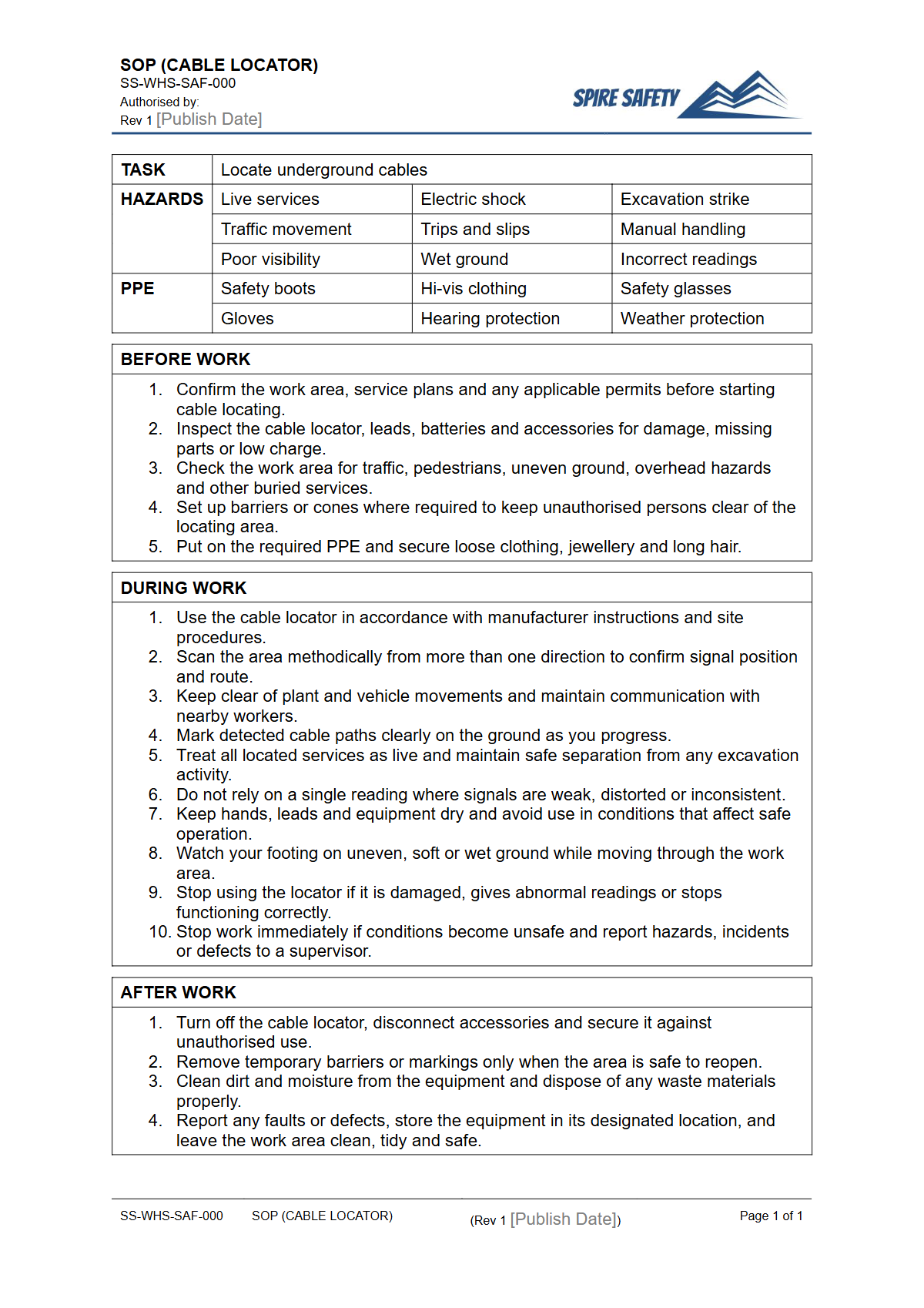
This free Safe Operating Procedure (Cable Locator) Template provides a structured framework for documenting the step-by-step process for safely locating underground services. Using a cable locator is a critical task before any excavation or ground penetration, designed to prevent asset strikes that can lead to serious injuries, fatalities, and costly service disruptions.
Formalising this process in an SOP helps ensure that all operators follow a consistent, safe method, minimising the risk of contact with live electrical cables, gas lines, or communication infrastructure.
A well-defined SOP is a fundamental component of a proactive safety culture. It serves as a training guide for new operators and a reference for experienced workers, reinforcing safe work habits and clarifying responsibilities. Implementing this procedure demonstrates a commitment to risk management and forms a key part of a comprehensive WHS management system.
Video walkthrough
How to use the Free Safe Operating Procedure (Cable Locator) Template
Our template is available for download as a DOCX file for easy editing and a PDF for straightforward distribution. The document is designed as a starting point, aligned with Australian WHS principles, that you must adapt to your specific operational context.
This includes detailing the exact make and model of cable locator used, the types of services commonly located, and site-specific hazards.
It is crucial to adapt this template to the specific equipment, site conditions, and your organisation's existing safety protocols. We have provided a structured starting point, but you must complete it to reflect your actual workplace. This involves conducting a site-specific risk assessment and consulting with your team to ensure the procedure is practical and effective. For activities that often follow utility location, it is vital to have documented procedures for all equipment, such as our FREE Trencher SOP Template.
The template guides you through key sections, including required Personal Protective Equipment (PPE), pre-operational checks like battery level and calibration, a detailed sequence for conducting the location sweep, and post-operational storage and maintenance. Regularly checking that these documented procedures are followed is a key activity verified during WHS compliance audits.
When to use it
This Safe Operating Procedure should be developed, implemented, and reviewed before any work that involves disturbing the ground. It is an essential preliminary step for a wide range of activities, including:
- Excavation and trenching
- Drilling, boring, or piling
- Installation of fences, posts, or signs
- Landscaping and civil construction
- Any project requiring site service plans
The SOP should also be used as a primary training document for any worker tasked with using a cable locator. Before work even begins, the safe transport and unloading of equipment must be considered, which might be covered in a document like our FREE Body Truck SOP Template. It acts as a checklist to ensure no critical safety steps are missed before, during, or after the locating task.
Who should use it
This SOP is intended for use by multiple roles within an organisation to ensure a shared understanding of the safe work method. Key personnel include:
- Operators: The primary users, including tradespeople, plant operators, and dedicated utility locators who perform the task.
- Site Supervisors and Forepersons: Responsible for ensuring operators are competent and are following the documented procedure on site.
- Project Managers: For planning works and ensuring that safety compliance documentation is in place before ground is broken.
- WHS Managers and Advisors: For developing, reviewing, and integrating the SOP into the broader safety management system.
If your organisation is navigating complex site conditions or needs assistance developing robust, practical safety documents, our WHS consulting team can provide expert guidance. You can also explore our entire free WHS resources library for more templates to support your safety management system.
Common mistakes
Common mistakes to avoid
- Failing to confirm the locator is calibrated and functioning correctly before starting.
- Relying solely on the locator's reading without consulting DBYD plans or conducting a visual inspection.
- Performing a sweep too quickly, missing weaker signals or failing to map the area methodically.
- Using an incorrect frequency or mode for the type of utility being traced, leading to inaccurate results.
Legal references
Legal considerations
The following legal requirements may be relevant to this type of work.
- Work Health and Safety Act (Harmonised) — Provides the primary duties for protecting workers and other people from work health and safety risks.
- Work Health and Safety Regulations (Harmonised) — Sets out requirements supporting the management of workplace hazards and risks.
The following codes may be relevant to this type of work.
- Managing WHS Risks Code of Practice — Provides practical guidance on identifying hazards, assessing risks and applying effective controls.
- Work Health and Safety Consultation, Cooperation and Coordination Code of Practice — Provides practical guidance on consulting workers and coordinating with other duty holders.
- Managing the Work Environment and Facilities Code of Practice — Provides practical guidance on safe work environments, workplace facilities and related controls.
Did you know
Dial Before You Dig
In Australia, the Dial Before You Dig (DBYD) service is a crucial first step before any excavation. However, the plans provided are indicative, and physical location using a cable locator is still required to confirm the exact position of underground assets.
Not All Utilities Are Detectable
Standard cable locators may not be able to detect certain types of utilities, such as fibre optic cables without a tracer wire, or pipes made from non-conductive materials like plastic or clay. This is why cross-referencing plans and using multiple location methods is critical.
FAQ
Frequently asked questions
01What should be included in a Safe Operating Procedure for a cable locator?
02Is specific training required to use a cable locator in Australia?
03How often should cable locator SOPs be reviewed?
04What is the biggest risk when using a cable locator?
Share this resource
Free Safe Operating Procedure (Cable Locator) Template
Browse Categories
How To Use It
- 1Download and open in Word or PDF.
- 2Replace the placeholders with your business details.
- 3Get it reviewed by a WHS specialist before rollout.
Need it customised?
Our WHS consultants can adapt this template to your site, run a gap analysis, or audit what you already have in place.
Book a Free Consultation WHS consulting servicesor call 1300 156 382
Related templates
- Free Safe Operating Procedure (Cable Puller) Template
- Free Safe Operating Procedure (Cable Reel) Template
- Free Safe Operating Procedure (Cable Stripper) Template
- Free Safe Operating Procedure (Cable Tensioner) Template
- Free Safe Operating Procedure (Cable Termination) Template
- Free Safe Operating Procedure (Cable Winch) Template