
Free Safe Operating Procedure (Cable Tensioner) Template
Download a free Safe Operating Procedure (Cable Tensioner) template. Our editable DOCX and PDF helps formalise safe work practices for your equipment.
Free Safe Operating Procedure (Cable Tensioner) Template
DOCX • 126 KB + PDF
Updated Oct 2026
No signup required
Purpose of the Free Safe Operating Procedure (Cable Tensioner) Template
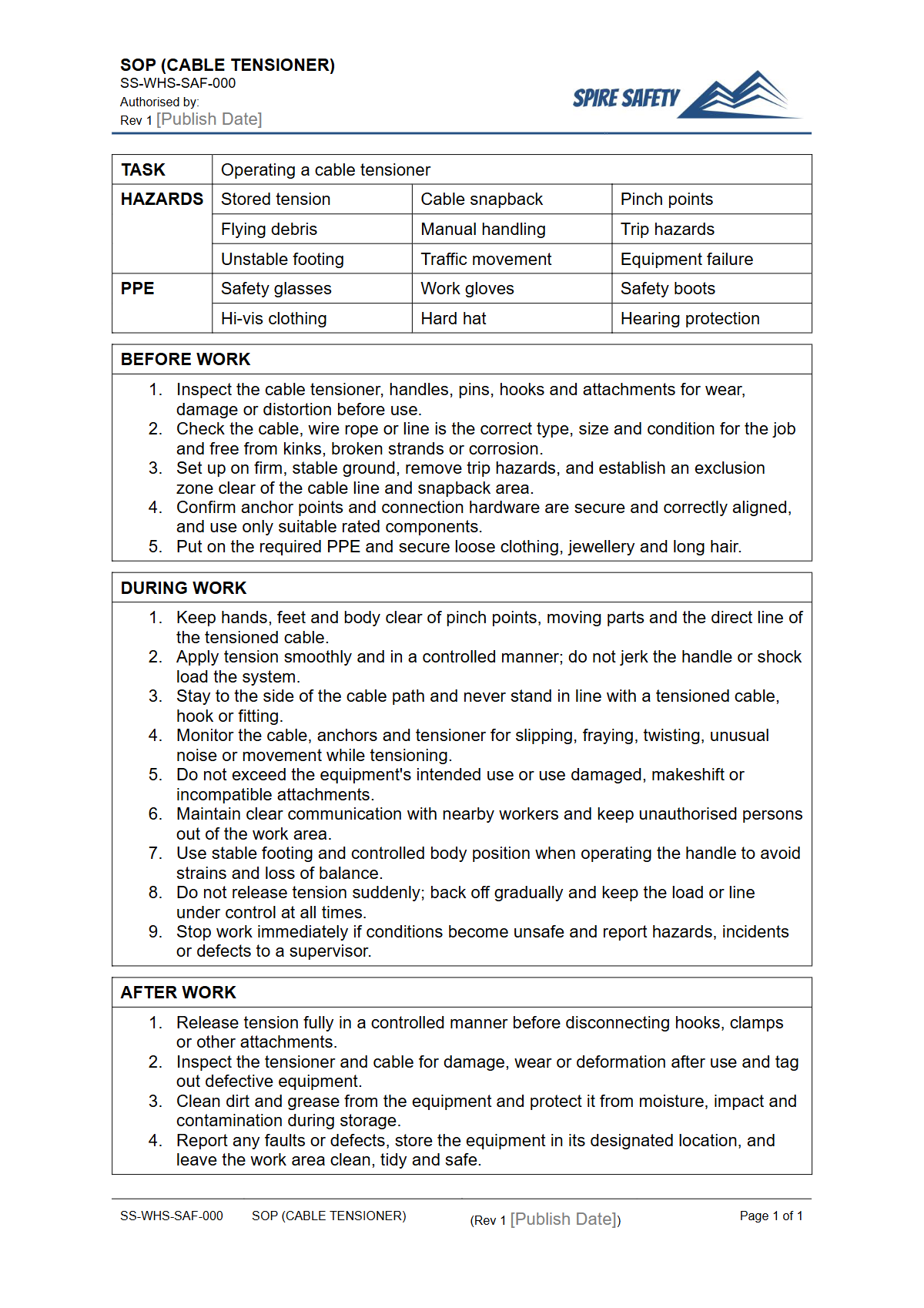
A Safe Operating Procedure (SOP) is a critical document for any high-risk task. This free Safe Operating Procedure (Cable Tensioner) template provides a structured framework for documenting the step-by-step process of safely setting up, operating, and maintaining cable tensioning equipment.
The primary purpose is to control hazards associated with high-tension cables, including stored energy release (snap-back), equipment failure, and entanglement. By formalising these procedures, you create a consistent and safe method of work for all operators, reducing the likelihood of incidents and forming a key component of your overall WHS management system.
Using a cable tensioner introduces significant risks if not managed correctly. This template helps a Person Conducting a Business or Undertaking (PCBU) fulfil their duty of care by providing clear, written instructions to workers.
It acts as both a training tool for new operators and a reference for experienced personnel, ensuring that safety protocols are understood and consistently followed.
Video walkthrough
How to use the Free Safe Operating Procedure (Cable Tensioner) Template
This Safe Operating Procedure (Cable Tensioner) template is available for download as an editable DOCX file, allowing for full customisation, as well as a print-ready PDF. To use it effectively, begin by downloading the document and reviewing its structure alongside the manufacturer's manual for your specific tensioning equipment.
The template prompts you to detail essential safety information relevant to your worksite and the tasks being performed.
Important: This document is a template and must be customised to your specific workplace. We are not familiar with your operational specifics, so you must add, remove, and amend the content to reflect the actual equipment, processes, and risks present in your environment.
A generic SOP is not sufficient; a site-specific risk assessment should always inform the final document.
The procedure should be developed in consultation with the workers who will be using the equipment. Their practical experience is invaluable for creating a procedure that is both safe and workable. Once completed, the SOP should be used in toolbox talks and training sessions for all relevant personnel, just as you would for other site machinery like those covered in our free Telehandler SOP template.
Key Sections in the Template
Our template is logically structured to guide you through documenting the entire work cycle. Key sections you will need to populate include:
- Required Personal Protective Equipment (PPE): Specify the exact PPE required, such as safety glasses, gloves, steel-capped boots, and high-visibility clothing.
- Pre-Operational Checks: Detail the visual and functional checks operators must perform before each use. This includes inspecting the tensioner body, hydraulic hoses, grips, and the cable itself for wear or damage.
- Operational Procedure: A step-by-step guide to performing the tensioning task safely. This must include instructions on setting up exclusion zones, correctly attaching the grips, applying tension gradually, and monitoring pressure gauges.
- Shutdown Procedure: Outline the correct sequence for de-pressurising the system, releasing the cable, and storing the equipment safely.
- Emergency Procedures: Clearly state the actions to take in case of equipment failure, hydraulic fluid leak, or injury.
Proper documentation of heavy machinery operation is crucial for site safety. For related earthmoving equipment, you might also find our free Trencher SOP template useful.
When to use it
A Safe Operating Procedure is not a 'set and forget' document. It should be an active part of your daily safety management. The cable tensioner SOP should be used:
- During the induction and training of new operators.
- As a basis for refresher training for all competent workers.
- Before commencing any cable tensioning task as a pre-start reference.
- When reviewing workplace safety after an incident or near-miss.
- As a key document during safety reviews and internal or external WHS compliance auditing.
Who should use it
Different roles within an organisation will interact with the SOP in different ways, all contributing to a safer work environment:
- Workers and Operators: Use the SOP as their primary guide for performing the task correctly and safely every time.
- Supervisors and Managers: Use the SOP to train their teams, supervise work, and ensure procedures are being followed on the ground.
- WHS Managers/Officers: Use the template to develop, implement, and review risk control measures as part of a formalised safety system. Adhering to structured documentation like this is a core principle in achieving higher standards, a process we assist with through our ISO 45001 consulting services.
- PCBUs: Use the finalised SOP as evidence that they are taking practicable steps to provide and maintain a safe system of work.
This template is one of many tools designed to help you build a robust safety framework. For more templates and checklists, browse our complete free WHS resources library.
Common mistakes
Common mistakes to avoid
- Using generic procedures that don't match the specific model of tensioner.
- Failing to establish and enforce a clear exclusion zone around the tensioned cable.
- Neglecting pre-use inspections of the cable, grips, and hydraulic components.
- Exceeding the manufacturer's specified maximum tension or load capacity.
Legal references
Legal considerations
The following legal requirements may be relevant to this type of work.
- Work Health and Safety Act (Harmonised) — Provides the primary duties for protecting workers and other people from work health and safety risks.
- Work Health and Safety Regulations (Harmonised) — Sets out requirements supporting the management of workplace hazards and risks.
The following codes may be relevant to this type of work.
- Managing WHS Risks Code of Practice — Provides practical guidance on identifying hazards, assessing risks and applying effective controls.
- Work Health and Safety Consultation, Cooperation and Coordination Code of Practice — Provides practical guidance on consulting workers and coordinating with other duty holders.
- Managing the Work Environment and Facilities Code of Practice — Provides practical guidance on safe work environments, workplace facilities and related controls.
Did you know
Stored Energy
A tensioned cable stores a massive amount of kinetic energy. If it fails, it can whip with enough force to cause fatal injuries or severe damage, a phenomenon known as 'snap-back'.
Manufacturer's Specs
The manufacturer's operating manual is a key source of information for your SOP. It contains critical data on load limits, inspection points, and maintenance schedules that must be included.
FAQ
Frequently asked questions
01What is the difference between an SOP and a SWMS?
02Do I need a licence to operate a cable tensioner?
03How often should a Safe Operating Procedure for a cable tensioner be reviewed?
04Can this template be used for hydraulic and manual cable tensioners?
Share this resource
Free Safe Operating Procedure (Cable Tensioner) Template
Browse Categories
How To Use It
- 1Download and open in Word or PDF.
- 2Replace the placeholders with your business details.
- 3Get it reviewed by a WHS specialist before rollout.
Need it customised?
Our WHS consultants can adapt this template to your site, run a gap analysis, or audit what you already have in place.
Book a Free Consultation WHS consulting servicesor call 1300 156 382
Related templates
- Free Safe Operating Procedure (Cable Termination) Template
- Free Safe Operating Procedure (Cable Winch) Template
- Free Safe Operating Procedure (Cage Cleaning) Template
- Free Safe Operating Procedure (Calendar Machine) Template
- Free Safe Operating Procedure (Call Bell Cord Check) Template
- Free Safe Operating Procedure (Call Bell Testing) Template