
Free Safe Operating Procedure (Cable Winch) Template
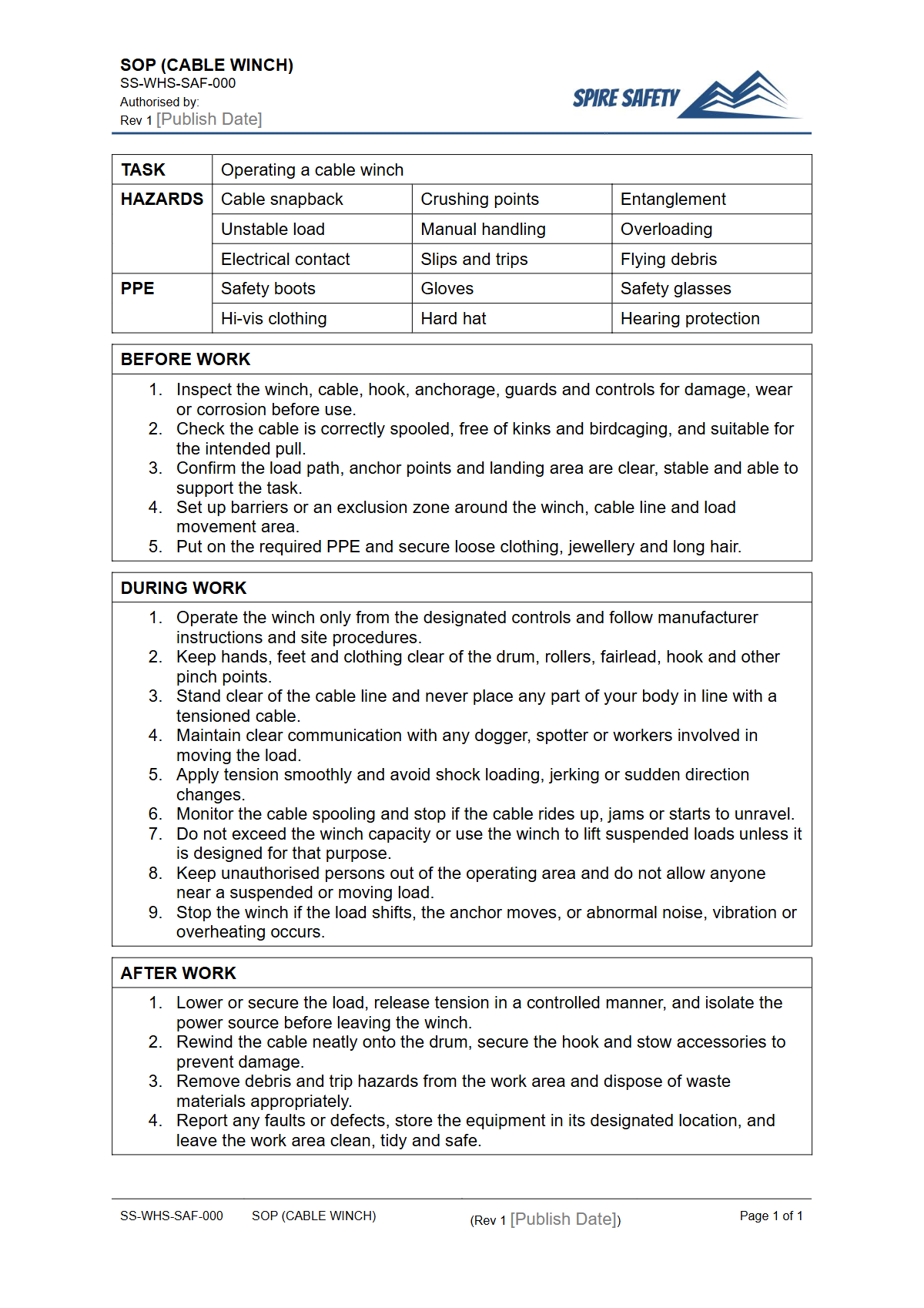
Download our free Safe Operating Procedure (Cable Winch) Template to formalise safe work methods for cable winch operations.
Free Safe Operating Procedure (Cable Winch) Template
DOCX • 126 KB + PDF
Updated Oct 2026
No signup required
Purpose of the Free Safe Operating Procedure (Cable Winch) Template
This Free Safe Operating Procedure (Cable Winch) Template provides a structured framework for documenting the safe use of cable winches in your workplace. A Safe Operating Procedure (SOP) is a critical administrative control that outlines a step-by-step process for performing a task safely.
For cable winches, this involves managing significant risks such as entanglement in moving parts, crushing injuries from the load or rope, and severe harm from wire rope failure (snap-back). Using an SOP ensures that all operators, regardless of experience, follow a consistent, pre-approved method that minimises risk.
It serves as an essential tool for worker training, competency assessments, and demonstrating due diligence in managing workplace hazards.
Formalising your procedures is a cornerstone of a robust safety framework. Integrating this SOP into your broader WHS management systems helps create a systematic approach to safety, ensuring that operational tasks are performed according to established best practices and organisational safety policies.
It provides clarity on expectations, required personal protective equipment (PPE), and emergency responses specific to winching operations.
Video walkthrough
How to use the Free Safe Operating Procedure (Cable Winch) Template
This Safe Operating Procedure (Cable Winch) document is provided as a starting point in both DOCX and PDF formats. It must be adapted to reflect the specific equipment and conditions at your workplace.
Start by downloading the DOCX file and engaging in consultation with the workers who will be using the equipment. Their practical experience is invaluable for creating a procedure that is both safe and workable.
You will need to detail the specific make and model of your winch, its location, and the personnel authorised to operate it. It is crucial to conduct a site-specific risk assessment to identify all potential hazards associated with your particular winching tasks and environment.
Remember, this is a template, not a finished document. We have provided the structure and key safety prompts based on Australian WHS principles, but you must complete the detail.
This includes specifying the exact sequence of operations, required PPE (e.g., leather gloves, safety glasses, high-visibility clothing), and emergency shutdown procedures relevant to your setup. A generic procedure is not sufficient; customisation is essential for effectiveness.
Many workplaces use SOPs for a wide range of heavy equipment, such as our free Dozer SOP, to ensure consistent safety standards across all plant.
When to use a Cable Winch SOP
A Safe Operating Procedure for a cable winch should be developed and implemented before the equipment is first used. It becomes a core part of the operational lifecycle.
It must be used during the induction and training of new operators to ensure they understand the correct, safe method from the beginning. It also serves as a practical checklist for pre-start inspections, guiding operators to check the condition of the wire rope, hook, safety latch, and anchor points before every use.
For experienced operators, the SOP acts as a ready reference to reinforce safe practices and prevent complacency. Furthermore, in the event of an incident or near-miss, the SOP is a vital document for investigation, helping to determine if procedures were followed and whether they need to be updated.
Who should use it
This SOP is intended for use by multiple groups within an organisation. A Person Conducting a Business or Undertaking (PCBU) is responsible for ensuring safe systems of work are in place, making this template a key tool for meeting that duty.
Managers and supervisors must use the finalised SOP to train their teams, supervise work, and enforce safe practices on the ground. They are responsible for ensuring the procedure is understood and followed by all relevant personnel.
Most importantly, operators of the cable winch are the primary end-users. They must be thoroughly familiar with the SOP and use it to guide their actions from pre-start checks to post-operation shutdown.
This process of documentation is common for all high-risk plant, and you may find our FREE Telehandler SOP Template useful for other equipment on site.
Regularly reviewing and updating your safe work documents is a key part of maintaining a safe workplace. This can be verified through routine checks or more formal WHS compliance auditing to ensure procedures are being implemented effectively.
This template is just one of many documents available in our free WHS resources library, designed to help you build out your safety management system.
Common mistakes
Common mistakes to avoid
- Using a winch with a load rating insufficient for the task.
- Failing to inspect the wire rope, hook, and anchor points before each use.
- Standing within the 'snap-back' zone or allowing others in the area during operation.
- Wrapping the wire rope around a hand or failing to wear appropriate PPE, such as heavy-duty gloves and safety glasses.
Legal references
Legal considerations
The following legal requirements may be relevant to this type of work.
- Work Health and Safety Act (Harmonised) — Provides the primary duties for protecting workers and other people from work health and safety risks.
- Work Health and Safety Regulations (Harmonised) — Sets out requirements supporting the management of workplace hazards and risks.
The following codes may be relevant to this type of work.
- Managing WHS Risks Code of Practice — Provides practical guidance on identifying hazards, assessing risks and applying effective controls.
- Work Health and Safety Consultation, Cooperation and Coordination Code of Practice — Provides practical guidance on consulting workers and coordinating with other duty holders.
- Managing the Work Environment and Facilities Code of Practice — Provides practical guidance on safe work environments, workplace facilities and related controls.
Did you know
Wire Rope Strength
A steel wire rope's strength can be significantly reduced by kinks, broken strands, or corrosion. A single sharp kink can reduce its breaking strength by as much as 50%.
The Snap-Back Zone
The 'snap-back' or 'snap zone' is the area a tensioned wire rope will recoil into if it breaks. This zone can be deadly, and all personnel must remain clear of it during winching operations.
FAQ
Frequently asked questions
01What are the main hazards of operating a cable winch?
02Is a Safe Operating Procedure a legal requirement in Australia?
03How often should a cable winch SOP be reviewed?
04Can I use this template for any type of cable winch?
Share this resource
Free Safe Operating Procedure (Cable Winch) Template
Browse Categories
How To Use It
- 1Download and open in Word or PDF.
- 2Replace the placeholders with your business details.
- 3Get it reviewed by a WHS specialist before rollout.
Need it customised?
Our WHS consultants can adapt this template to your site, run a gap analysis, or audit what you already have in place.
Book a Free Consultation WHS consulting servicesor call 1300 156 382
Related templates
- Free Safe Operating Procedure (Cage Cleaning) Template
- Free Safe Operating Procedure (Calendar Machine) Template
- Free Safe Operating Procedure (Call Bell Cord Check) Template
- Free Safe Operating Procedure (Call Bell Testing) Template
- Free Safe Operating Procedure (Can Opener Use) Template
- Free Safe Operating Procedure (Cane Pruning) Template