
Free Safe Operating Procedure (Cage Cleaning) Template
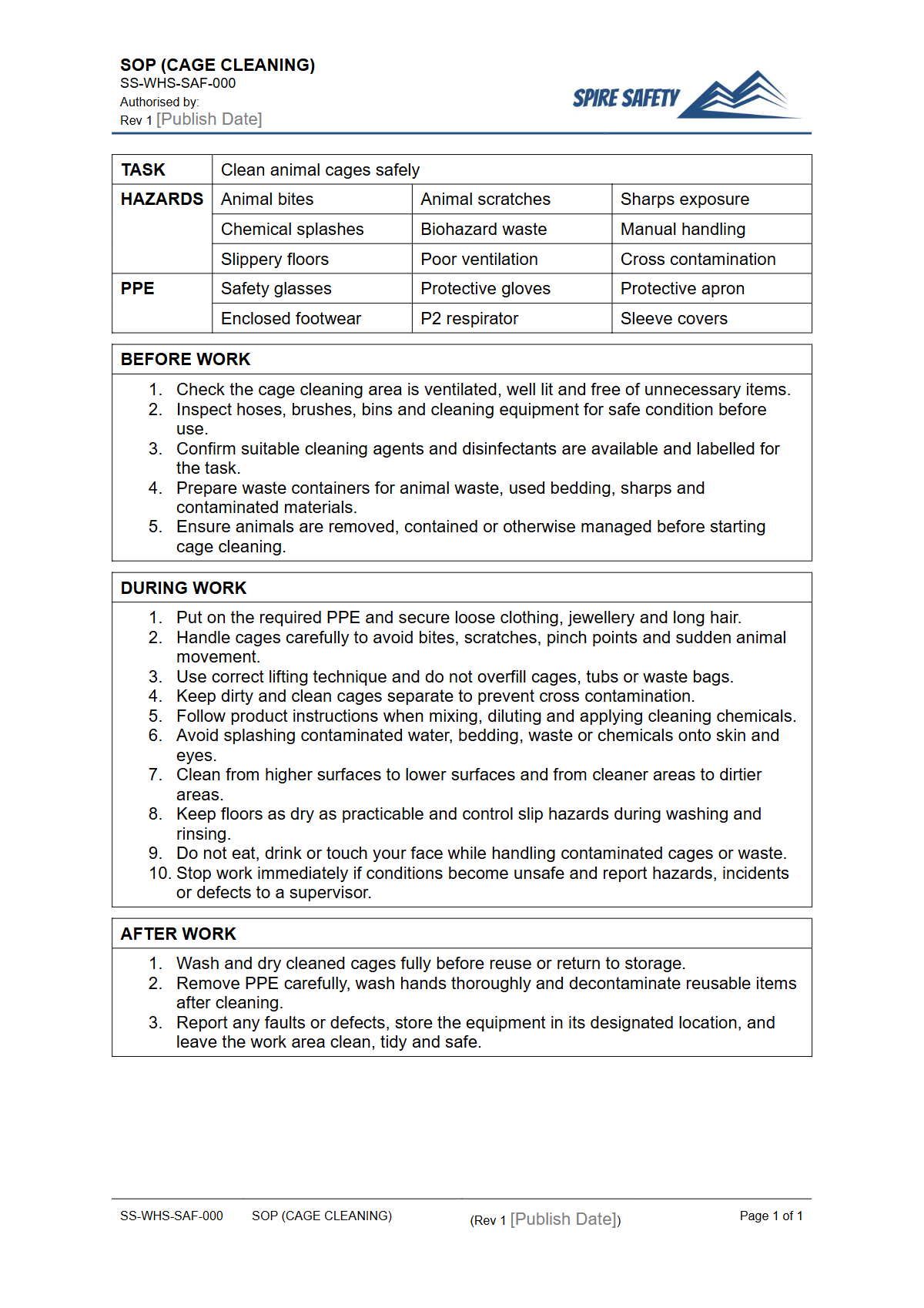
Download our free Safe Operating Procedure (Cage Cleaning) template. This customisable DOCX & PDF resource helps document safe work methods for cage cleaning.
Free Safe Operating Procedure (Cage Cleaning) Template
DOCX • 126 KB + PDF
Updated Oct 2026
No signup required
Purpose of the Free Safe Operating Procedure (Cage Cleaning) Template
Establishing a clear, documented process for routine tasks is fundamental to workplace safety. This is especially true for activities like cage cleaning, which can present a range of hazards, from manual handling strains to exposure to hazardous chemicals and biological agents.
Our Free Safe Operating Procedure (Cage Cleaning) Template provides a structured framework for your organisation to detail the step-by-step process for performing this task safely and efficiently. By formally documenting the procedure, you create a consistent benchmark for training, supervision, and performance.
A Safe Operating Procedure (SOP), sometimes called a Safe Work Procedure (SWP), breaks down a task into its core components. For cage cleaning, this involves identifying potential risks such as musculoskeletal injuries from awkward postures, slips and falls on wet surfaces, or respiratory irritation from cleaning agents.
The SOP then outlines the specific control measures required to mitigate these risks, such as correct manual handling techniques, required Personal Protective Equipment (PPE), and proper ventilation. Using a template ensures all critical safety elements are considered, helping you build a safer system of work.
Video walkthrough
How to use the Free Safe Operating Procedure (Cage Cleaning) Template
This template is available in both DOCX and PDF formats for your convenience. The DOCX file is fully editable, allowing you to tailor the content directly to your operational needs.
We recommend downloading the DOCX version, customising it with your site-specific details, and then saving a finalised version as a PDF to use as a controlled document for training and display in the work area.
The document is structured to prompt you for key information, including required PPE, associated hazards, pre-operational checks, step-by-step instructions, and emergency procedures. You should methodically work through each section, consulting with the workers who actually perform the cleaning tasks to ensure the procedure is practical and reflects how the job is done.
Important Customisation Note
Please note: this is a template document. We have drafted it as a structured starting point, but you must customise it to reflect the specific hazards, equipment, chemicals, and control measures relevant to your workplace. Its effectiveness is entirely dependent on how well it is adapted to your unique operational context.
When to use a Cage Cleaning SOP
A documented SOP for cage cleaning should be a core component of your safety management system. It should be used in several key situations:
- Training and Induction: Use the SOP as a primary training tool for new employees or workers assigned to cleaning tasks for the first time.
- Refresher Training: Periodically review the SOP with experienced staff to reinforce safe work habits and communicate any changes in procedure.
- Task Planning and Supervision: Supervisors can use the SOP as a checklist to ensure all safety precautions are in place before and during the cleaning task.
- Incident Investigation: If an incident or near miss occurs during cage cleaning, the SOP serves as a baseline to evaluate whether procedures were followed and if they need to be updated.
- Audits and Reviews: The SOP provides clear evidence of your risk management processes during internal or external safety audits. An effective way to verify procedures are being followed is through regular WHS compliance auditing.
Who should use this Safe Operating Procedure
The development and use of an SOP is a collaborative process involving several roles within an organisation:
- Workers/Operators: The primary users of the SOP. They must be trained on its contents and follow the prescribed steps to perform their work safely. Their input during the drafting phase is crucial for ensuring the procedure is practical.
- Supervisors and Line Managers: Responsible for ensuring workers are trained on the SOP and adhere to it. They also play a key role in reviewing and updating the document.
- WHS/HSE Managers or Advisors: This role typically oversees the development and implementation of SOPs as part of broader WHS management systems. They ensure the procedure aligns with legislative requirements and best practices.
- Persons Conducting a Business or Undertaking (PCBUs): Ultimately responsible for providing safe systems of work, which includes ensuring adequate SOPs are developed, implemented, and maintained.
For complex cleaning tasks, such as those involving large cages or specific equipment, it may be necessary to integrate procedures from other documents. For example, if cleaning requires working at height, you might incorporate elements from a FREE Step Ladder SOP Template. Similarly, if mechanised equipment is used, the relevant safety checks must be included.
For instance, if using compressed air for drying or debris removal, you should cross-reference the safe use instructions outlined in your Air Compressor SOP. The principle of isolating energy sources, a critical safety step detailed in procedures like a Free Brake Press SOP, is also applicable if cleaning caged machinery.
You can find many other helpful documents like this one in our complete free WHS resources library, covering a wide range of plant, equipment, and tasks.
Common mistakes
Common mistakes to avoid
- Using a generic SOP that isn't customised for the specific chemicals, equipment, and environment.
- Failing to adequately train workers on the procedure and verify their understanding before they perform the task.
- Not including specific details from the Safety Data Sheet (SDS) for the cleaning chemicals being used.
- Forgetting to review and update the SOP after a process change or a near miss.
Legal references
Legal considerations
The following legal requirements may be relevant to this type of work.
- Work Health and Safety Act (Harmonised) — Provides the primary duties for protecting workers and other people from work health and safety risks.
- Work Health and Safety Regulations (Harmonised) — Sets out requirements supporting the management of workplace hazards and risks.
The following codes may be relevant to this type of work.
- Managing WHS Risks Code of Practice — Provides practical guidance on identifying hazards, assessing risks and applying effective controls.
- Work Health and Safety Consultation, Cooperation and Coordination Code of Practice — Provides practical guidance on consulting workers and coordinating with other duty holders.
- Managing the Work Environment and Facilities Code of Practice — Provides practical guidance on safe work environments, workplace facilities and related controls.
Did you know
Hierarchy of Controls
An SOP is an 'administrative control' in the hierarchy of risk controls. While important, it is more effective to first try to eliminate or substitute hazards, or implement engineering controls to isolate workers from the hazard.
Zoonotic Disease Risk
When cleaning animal enclosures, workers can be exposed to zoonotic diseases that pass from animals to humans. Proper cleaning protocols, disinfection, and use of PPE are critical controls to manage this biological hazard.
FAQ
Frequently asked questions
01What key information should be included in a Cage Cleaning SOP?
02How often should a Safe Operating Procedure for cage cleaning be reviewed?
03Is a Safe Operating Procedure the same as a risk assessment?
04Who is responsible for writing a Cage Cleaning SOP?
Share this resource
Free Safe Operating Procedure (Cage Cleaning) Template
Browse Categories
How To Use It
- 1Download and open in Word or PDF.
- 2Replace the placeholders with your business details.
- 3Get it reviewed by a WHS specialist before rollout.
Need it customised?
Our WHS consultants can adapt this template to your site, run a gap analysis, or audit what you already have in place.
Book a Free Consultation WHS consulting servicesor call 1300 156 382
Related templates
- Free 3D Printer SOP (Safe Operating Procedure) Template
- FREE Agricultural Equipment SOP (Safe Operating Procedure) Template
- Free Air Compressor SOP (Safe Operating Procedure) Template
- Free Angle Grinder SOP (Safe Operating Procedure) Template
- FREE Backhoe SOP (Safe Operating Procedure) Template
- FREE Baler SOP (Safe Operating Procedure) Template