
Free Safe Operating Procedure (Canoe Operation) Template
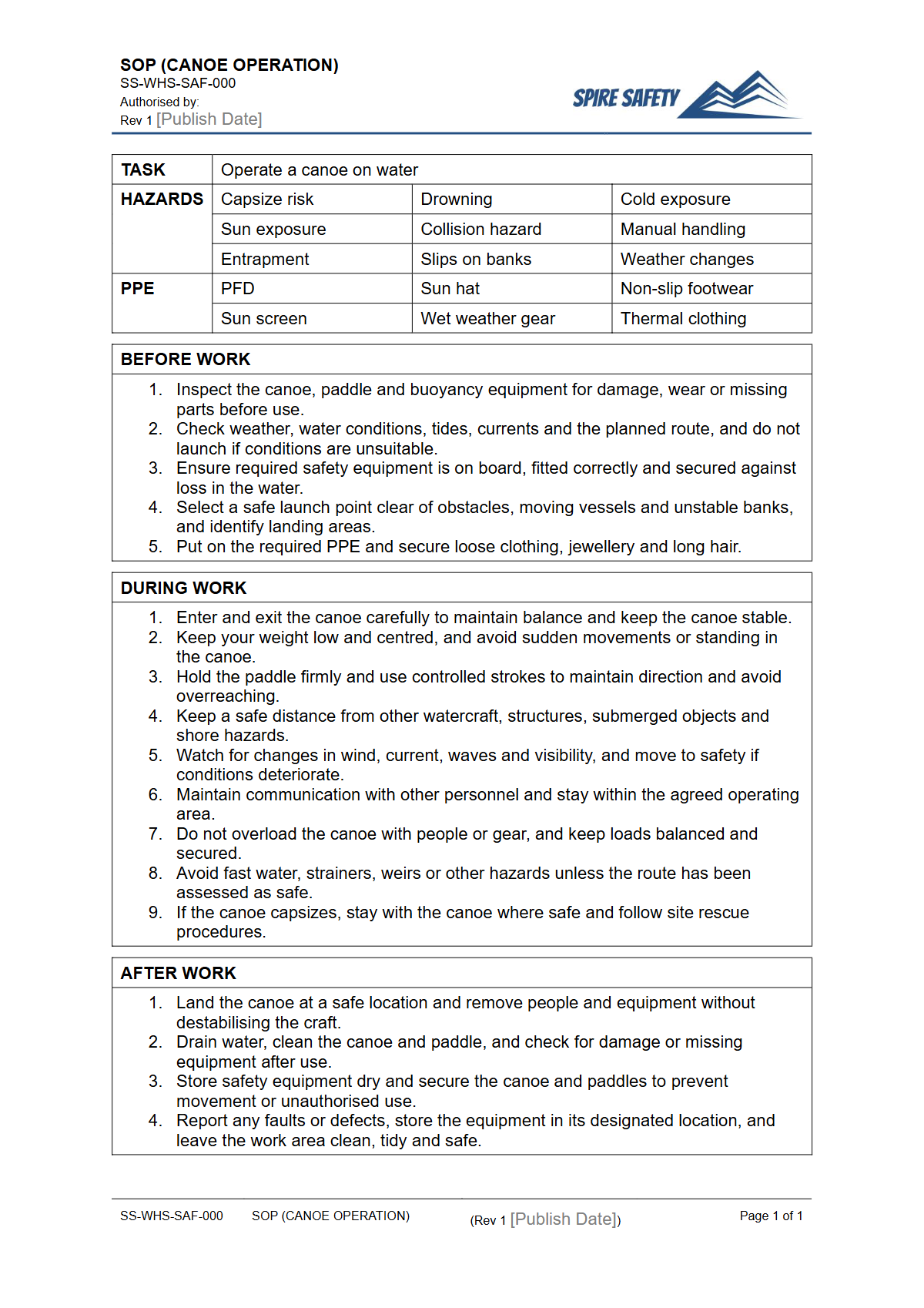
Download our free Safe Operating Procedure (Canoe Operation) template. This DOCX and PDF resource helps outline safety steps for your workplace.
Free Safe Operating Procedure (Canoe Operation) Template
DOCX • 126 KB + PDF
Updated Oct 2026
No signup required
Purpose of the Free Safe Operating Procedure (Canoe Operation) Template
This Safe Operating Procedure (SOP) for canoe operation provides a structured framework for documenting the required safety measures and step-by-step processes for operating canoes in a work or organisational context. Its primary purpose is to manage the significant risks associated with water-based activities, helping to ensure the health and safety of participants, instructors, and the public.
Implementing a formal SOP helps standardise procedures, clarify responsibilities, and demonstrate due diligence in managing foreseeable hazards.
A well-defined SOP is a critical component of your overall safety framework. It formalises the controls identified during the risk assessment process and integrates them into your daily operations.
Establishing such procedures is a cornerstone of effective WHS management systems, creating a safer environment for everyone involved.
Key Risks Addressed
Operating canoes, whether on rivers, lakes, or coastal waters, introduces specific hazards that must be controlled. This template is designed to help you document controls for risks including:
- Drowning and immersion hypothermia
- Capsizing due to instability, weather, or incorrect technique
- Physical exertion leading to fatigue or medical events
- Injuries from manual handling (lifting and carrying canoes)
- Collisions with other vessels or submerged objects
- Environmental hazards such as currents, tides, wind, and sun exposure
Video walkthrough
How to use the Free Safe Operating Procedure (Canoe Operation) Template
Our free Safe Operating Procedure for canoe operation is available for download in both DOCX and PDF formats. The DOCX version is fully editable, allowing you to adapt the content to the specific conditions of your environment, the type of canoes used, and the competency level of your operators.
Simply add your company logo and details, then review and amend each section to reflect your unique operational requirements.
Customisation is Essential
Note: This document is a template and not a complete SOP. We have provided a structured starting point based on Australian WHS principles, but you must customise it by conducting your own risk assessment and consulting with your workers.
The procedures must be specific to your equipment, the water bodies you operate on, local regulations, and the personnel involved. Regular checks, such as WHS compliance auditing, can verify that your customised procedures are being implemented effectively.
When to use it
A Safe Operating Procedure for canoe operation should be developed, implemented, and enforced before any person is permitted to use a canoe under the control of your organisation. This applies to a wide range of situations, from commercial tour operations to school-based outdoor education programs.
It should be used as a primary training document for new staff or participants and as a reference for regular refresher training. It is also a critical document to review after any incident or near-miss to identify areas for improvement.
The SOP should be part of a broader emergency response plan. For example, procedures for dealing with a medical emergency during a canoe trip should link to other critical procedures, such as those covered in our Free Safe Operating Procedure (Defibrillator Operation) Template, ensuring a coordinated and effective response.
Who should use it
This template is designed for any Person Conducting a Business or Undertaking (PCBU) whose operations involve canoeing activities. This includes, but is not limited to:
- Outdoor adventure and tour operators
- School camps and outdoor education providers
- Resorts and holiday parks with watercraft rentals
- Community and sporting clubs
- Environmental monitoring and research groups
Safety managers, activity coordinators, and business owners will find this template invaluable for establishing and documenting a safe system of work. It provides a clear, defensible approach to managing your safety obligations.
For businesses managing large properties with water access, this SOP can be integrated with other site-management procedures, like those in our Ride-On Mower Operation template, to form a comprehensive site safety plan.
If you require expert assistance in developing and implementing site-specific procedures, our team offers specialised WHS consulting to help you meet your obligations. For more templates and safety documents, browse our complete free WHS resources library.
Common mistakes
Common mistakes to avoid
- Using a generic template without detailing specific water body conditions (e.g., river currents, coastal tides, lake hazards).
- Failing to include clear, actionable emergency response plans for capsizing, man overboard, or medical events.
- Neglecting to specify mandatory PPE requirements, particularly the type and correct use of personal flotation devices (PFDs).
- Not integrating competency assessments to verify that operators can physically demonstrate the required skills.
Legal references
Legal considerations
The following legal requirements may be relevant to this type of work.
- Work Health and Safety Act (Harmonised) — Provides the primary duties for protecting workers and other people from work health and safety risks.
- Work Health and Safety Regulations (Harmonised) — Sets out requirements supporting the management of workplace hazards and risks.
The following codes may be relevant to this type of work.
- Managing WHS Risks Code of Practice — Provides practical guidance on identifying hazards, assessing risks and applying effective controls.
- Work Health and Safety Consultation, Cooperation and Coordination Code of Practice — Provides practical guidance on consulting workers and coordinating with other duty holders.
- Managing the Work Environment and Facilities Code of Practice — Provides practical guidance on safe work environments, workplace facilities and related controls.
Did you know
Drowning Statistics
Between 2012 and 2022, over 200 people drowned in Australia while using watercraft like canoes and kayaks, with many incidents being preventable through proper safety procedures and the use of lifejackets.
The 10:20 Protection Rule
In aquatic supervision, the "10:20 Protection Rule" is a key principle: it should take no more than 10 seconds to spot a person in difficulty and no more than 20 seconds to reach them.
FAQ
Frequently asked questions
01What key sections should a Safe Operating Procedure for canoe operation include?
02Is a documented SOP legally required for canoe activities in Australia?
03How often should a canoe operation SOP be reviewed?
04Who is responsible for training workers on this Safe Operating Procedure?
Share this resource
Free Safe Operating Procedure (Canoe Operation) Template
Browse Categories
How To Use It
- 1Download and open in Word or PDF.
- 2Replace the placeholders with your business details.
- 3Get it reviewed by a WHS specialist before rollout.
Need it customised?
Our WHS consultants can adapt this template to your site, run a gap analysis, or audit what you already have in place.
Book a Free Consultation WHS consulting servicesor call 1300 156 382
Related templates
- Free Safe Operating Procedure (Canopy Cleaning) Template
- Free Safe Operating Procedure (Cap Lamp) Template
- Free Safe Operating Procedure (Capping Machine) Template
- Free Safe Operating Procedure (Capstan Winch) Template
- Free Safe Operating Procedure (Car Hoist) Template
- Free Safe Operating Procedure (Car Park Garden Care) Template