
Free Safe Operating Procedure (Car Hoist) Template
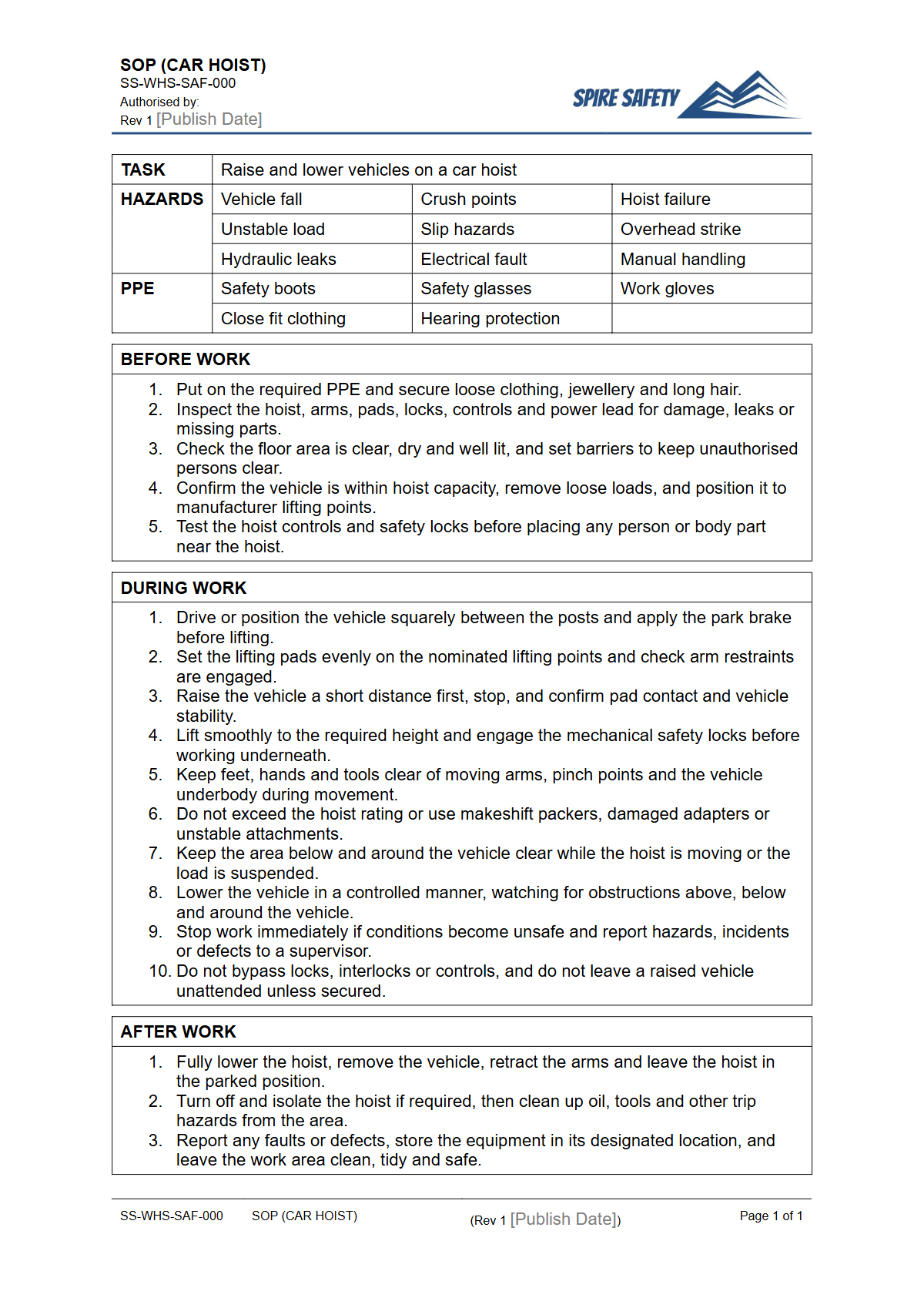
Download our free Safe Operating Procedure (Car Hoist) template. This structured DOCX & PDF helps manage vehicle lifting risks. Formalise your workshop safety.
Free Safe Operating Procedure (Car Hoist) Template
DOCX • 126 KB + PDF
Updated Oct 2026
No signup required
Purpose of the Free Safe Operating Procedure (Car Hoist) Template
Operating a car hoist presents significant risks, including crushing, impact injuries from a falling vehicle, and mechanical or hydraulic failure. A documented Safe Operating Procedure (SOP) is a fundamental tool for managing these hazards.
This free Safe Operating Procedure (Car Hoist) template provides a structured framework for your business to formalise the step-by-step process for using vehicle hoists safely. It serves as a critical administrative control, ensuring that all workers follow a consistent, pre-approved method for every lift.
By clearly defining pre-operational checks, lifting procedures, and emergency responses, this SOP helps to satisfy your primary duty of care under Australian WHS laws. A well-implemented SOP demonstrates a commitment to a safe system of work and is a key component of any effective safety management plan.
Integrating specific procedures like this one into a holistic safety framework is essential for building a proactive safety culture. It helps form the foundation of more comprehensive robust WHS management systems that protect your workers and your business.
Video walkthrough
How to use the Free Safe Operating Procedure (Car Hoist) Template
This template is designed as a starting point, not a finished document. To use it effectively, download the DOCX file and adapt it to the specific make and model of the car hoists used in your workshop.
It is crucial that you consult the manufacturer's operating manual and incorporate its specific instructions and safety warnings. Engage in meaningful consultation with your mechanics and technicians—the people who use the equipment daily—to ensure the procedure is practical and reflects actual on-the-job practices and hazards.
Important: You must customise this template to your specific workplace. Every worksite has unique hazards, equipment, and environmental factors.
We do not guarantee that this document will make you compliant with WHS legislation; its effectiveness depends on how you adapt and implement it. After customisation, the SOP should be used as a primary training document for new and existing staff.
This process is similar for other high-risk plant, such as detailed in our Air Compressor SOP template.
When to use a Car Hoist Safe Operating Procedure
A car hoist SOP should be a living document that is used and referenced regularly within the workshop. It is essential for initial worker training and induction, ensuring every new team member understands the correct procedures before they are authorised to operate a hoist.
It should also be used for regular refresher training to prevent complacency and reinforce safe work habits. The SOP is a critical reference point before starting any non-routine or complex lifting task.
Furthermore, the procedure should be reviewed and updated following any incident or near miss involving a car hoist. It should also be part of a scheduled annual review process.
Regular reviews ensure the SOP remains current with any changes in equipment, workplace procedures, or relevant Australian Standards. Documented procedures like this are a key piece of evidence examined during formal WHS compliance auditing to verify that safe systems of work are in place and being followed.
Who should use this Safe Operating Procedure
This Safe Operating Procedure is intended for all personnel involved with vehicle maintenance and repair. This includes qualified mechanics, apprentices, trade assistants, and workshop supervisors.
Workshop managers and Persons Conducting a Business or Undertaking (PCBUs) should use the SOP to ensure they are meeting their WHS obligations for training, instruction, and supervision. For apprentices and new workers, the SOP is an invaluable learning tool that complements hands-on, supervised training.
Supervisors should use the document to conduct competency assessments and to guide toolbox talks on workshop safety. By making the SOP readily accessible near the equipment, it becomes a constant and reliable reference for all workers, reinforcing the expected standard of safe behaviour.
Just as you would have specific procedures for other workshop equipment, like those outlined in our plasma cutter SOP, this document formalises safety for one of the most common pieces of high-risk machinery. You can explore our complete free WHS resources library for more templates to support your safety management system.
Common mistakes
Common mistakes to avoid
- Failing to perform daily pre-operational checks on safety locks, cables, and hydraulic systems.
- Incorrectly positioning the vehicle's centre of gravity, leading to an unbalanced and unstable lift.
- Exceeding the hoist's rated Safe Working Load (SWL).
- Leaving the load supported only by the hydraulic pressure instead of lowering it onto the mechanical safety locks.
Legal references
Legal considerations
The following legal requirements may be relevant to this type of work.
- Work Health and Safety Act (Harmonised) — Provides the primary duties for protecting workers and other people from work health and safety risks.
- Work Health and Safety Regulations (Harmonised) — Sets out requirements supporting the management of workplace hazards and risks.
The following codes may be relevant to this type of work.
- Managing WHS Risks Code of Practice — Provides practical guidance on identifying hazards, assessing risks and applying effective controls.
- Work Health and Safety Consultation, Cooperation and Coordination Code of Practice — Provides practical guidance on consulting workers and coordinating with other duty holders.
- Managing the Work Environment and Facilities Code of Practice — Provides practical guidance on safe work environments, workplace facilities and related controls.
Did you know
Locks, Not Hydraulics
Most car hoists use mechanical safety locks that engage as the hoist rises. These physical locks, not the hydraulic system, are designed to bear the vehicle's full weight once at the desired height, providing a critical fail-safe.
Inspection Standards
Australian Standard AS/NZS 2550.9 specifies that vehicle hoists require routine inspections by a competent person, as well as more comprehensive periodic inspections to ensure they remain safe for use.
FAQ
Frequently asked questions
01What is a Safe Operating Procedure for a car hoist?
02Is a car hoist SOP legally required in Australia?
03How often should I review my car hoist SOP?
04Who is responsible for writing a car hoist SOP?
Share this resource
Free Safe Operating Procedure (Car Hoist) Template
Browse Categories
How To Use It
- 1Download and open in Word or PDF.
- 2Replace the placeholders with your business details.
- 3Get it reviewed by a WHS specialist before rollout.
Need it customised?
Our WHS consultants can adapt this template to your site, run a gap analysis, or audit what you already have in place.
Book a Free Consultation WHS consulting servicesor call 1300 156 382
Related templates
- Free Safe Operating Procedure (Car Park Garden Care) Template
- Free Safe Operating Procedure (Car Park Gate Operation) Template
- Free Safe Operating Procedure (Car Park Oil Cleanup) Template
- Free Safe Operating Procedure (Car Park Sweeping) Template
- Free Safe Operating Procedure (Car Wash Bay Cleanup) Template
- Free Safe Operating Procedure (Car Wash Detailing) Template