
Free Safe Operating Procedure (Car Wash Bay Cleanup) Template
Need a car wash bay cleanup SOP? Our free template helps document safe work practices for managing water, chemicals, and slip hazards.
Free Safe Operating Procedure (Car Wash Bay Cleanup) Template
DOCX • 126 KB + PDF
Updated Oct 2026
No signup required
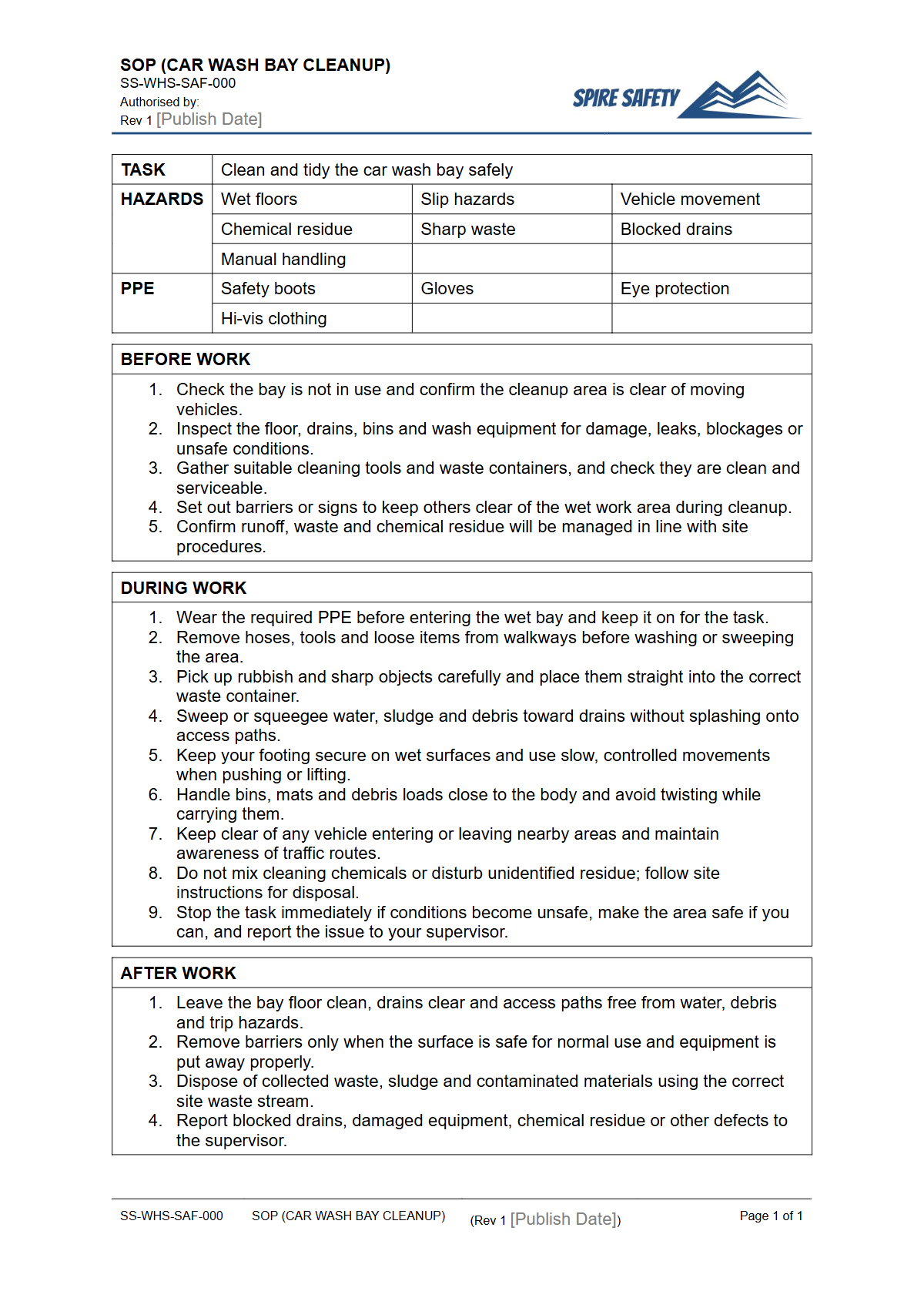
Purpose of the Free Safe Operating Procedure (Car Wash Bay Cleanup) Template
Developing a clear system of work is essential for high-risk tasks. This Free Safe Operating Procedure (Car Wash Bay Cleanup) Template provides a structured starting point for your organisation to document the specific steps, hazards, and controls associated with cleaning vehicle wash bays.
It addresses common risks such as slips from wet surfaces, exposure to cleaning chemicals, and the use of high-pressure water equipment.
A Safe Operating Procedure (SOP) is an administrative control that formalises a logical sequence of steps to perform a task safely. For car wash bay cleanup, this involves managing significant hazards including:
- Slips, trips, and falls: Caused by water, detergent, oil, grease, and uneven or cluttered floor surfaces.
- Chemical exposure: Contact with or inhalation of degreasers, detergents, and other cleaning agents which can cause skin irritation, respiratory issues, or chemical burns.
- High-pressure water equipment: Risks of skin penetration (injection injuries), eye damage from spray, and musculoskeletal strain from handling lances.
- Manual handling: Injuries from moving equipment, dragging heavy hoses, or using manual cleaning tools.
- Electrical hazards: Use of electrical equipment in a wet environment, posing a risk of electric shock if equipment is not suitably rated or maintained.
By using this template to create a site-specific SOP, you provide workers with clear, unambiguous instructions, assist in training and induction, and demonstrate a systematic approach to managing WHS risks. Properly documenting procedures for all workshop equipment is a key part of an effective safety system; for tasks involving access equipment, for instance, a dedicated Step Ladder SOP is also crucial.
Video walkthrough
How to use the Free Safe Operating Procedure (Car Wash Bay Cleanup) Template
This document provides a framework to build upon. It is not a complete, ready-to-use procedure.
Effective implementation requires careful customisation and consultation to ensure it accurately reflects the realities of your workplace.
IMPORTANT: This is a template, not a finished document. To be effective, you must customise it to reflect the specific equipment, chemicals, layout, and work practices at your site.
We are not responsible for any incidents that may occur from the use of this template.
Steps for Customisation:
- Download the Template: Choose between the DOCX format for easy editing or the PDF for reference.
- Conduct a Risk Assessment: Identify all foreseeable hazards associated with the cleanup task in your specific environment. Consider the layout, drainage, ventilation, and types of vehicles being washed.
- Consult with Workers: Involve the employees who perform the cleanup tasks. Their firsthand experience is invaluable for identifying practical risks and effective, workable controls.
- Document Specifics: Replace the generic text with details specific to your site. This includes the exact names and models of high-pressure washers, the specific cleaning chemicals used (and referencing their Safety Data Sheets), and the required Personal Protective Equipment (PPE).
- Outline the Procedure: Write a clear, sequential list of steps for the entire task, from pre-start checks and preparation to the cleaning process itself, and finally, post-cleanup pack-up and checks.
- Review and Approve: Have the draft procedure reviewed by a competent person (e.g., a supervisor or WHS manager) before it is formally approved for use. A well-developed SOP is a cornerstone of robust WHS management systems, ensuring that procedures are integrated with broader safety goals.
- Train and Monitor: Train all relevant workers on the finalised SOP. Supervisors should monitor work to ensure the procedure is being followed correctly. If your operations involve heavy vehicles, you might also need a Body Truck Safe Operating Procedure to cover vehicle movements in and around the wash bay.
When to use it
An SOP for car wash bay cleanup is a dynamic document used throughout the work lifecycle. It should be used:
- As a primary training document for new workers being inducted into the role of cleaning wash bays.
- For refresher training with existing workers to reinforce safe work practices and communicate any updates.
- As a daily reference tool that workers can consult before starting the task to ensure they follow all safety steps.
- During safety observations or supervisor checks to provide a benchmark against which actual work practices can be measured.
- As a key document in incident investigations to determine if the established procedure was followed and if it was adequate.
The SOP is not meant to be filed away and forgotten. It should be readily accessible to workers in the areas where the task is performed.
Furthermore, this SOP should be reviewed as part of regular WHS compliance auditing to ensure it remains current and effective.
Who should use it
Various roles within an organisation have a responsibility related to the development and use of this Safe Operating Procedure:
- Persons Conducting a Business or Undertaking (PCBUs): Have the primary duty of care to ensure the health and safety of workers, which includes providing and maintaining safe systems of work like SOPs.
- WHS Managers and Safety Professionals: Typically lead the development, implementation, and review of SOPs, ensuring they align with legislation and organisational standards.
- Supervisors and Team Leaders: Are responsible for ensuring workers are trained on the SOP and adhere to it during daily tasks. They also play a critical role in providing feedback for procedure reviews.
- Workers: Must follow the instructions outlined in the finalised SOP and should be actively consulted during its creation and revision. They have a responsibility to report any hazards or deficiencies they identify.
For workshops that also handle metal fabrication, a Plasma Cutter SOP ensures those specific hazards are also managed. This document is one of many templates available in our free WHS resources library, covering a wide range of tasks and equipment.
Common mistakes
Common mistakes to avoid
- Using a generic template without customising it for site-specific equipment, chemicals, and layout.
- Failing to consult with the workers who actually perform the cleanup task during the drafting process.
- Not providing or referencing the Safety Data Sheets (SDS) for all chemicals used in the bay.
- Treating the SOP as a one-time document and not reviewing or updating it after changes or incidents.
Legal references
Legal considerations
The following legal requirements may be relevant to this type of work.
- Work Health and Safety Act (Harmonised) — Provides the primary duties for protecting workers and other people from work health and safety risks.
- Work Health and Safety Regulations (Harmonised) — Sets out requirements supporting the management of workplace hazards and risks.
The following codes may be relevant to this type of work.
- Managing WHS Risks Code of Practice — Provides practical guidance on identifying hazards, assessing risks and applying effective controls.
- Work Health and Safety Consultation, Cooperation and Coordination Code of Practice — Provides practical guidance on consulting workers and coordinating with other duty holders.
- Managing the Work Environment and Facilities Code of Practice — Provides practical guidance on safe work environments, workplace facilities and related controls.
Did you know
Slips, Trips, and Falls
Slips, trips, and falls are a leading cause of workplace injuries in Australia, accounting for a significant percentage of serious workers' compensation claims. Maintaining clean, adequately drained floors is a critical control.
High-Pressure Water Dangers
High-pressure water injection injuries can be extremely serious, even if the initial wound appears minor. The fluid can travel deep into tissues, causing severe damage that requires immediate medical attention.
FAQ
Frequently asked questions
01What PPE is required for car wash bay cleanup?
02How often should a Safe Operating Procedure be reviewed?
03Can I use this template for a commercial car wash?
04What's the difference between an SOP and a SWMS?
Share this resource
Free Safe Operating Procedure (Car Wash Bay Cleanup) Template
Browse Categories
How To Use It
- 1Download and open in Word or PDF.
- 2Replace the placeholders with your business details.
- 3Get it reviewed by a WHS specialist before rollout.
Need it customised?
Our WHS consultants can adapt this template to your site, run a gap analysis, or audit what you already have in place.
Book a Free Consultation WHS consulting servicesor call 1300 156 382
Related templates
- Free Safe Operating Procedure (Car Wash Detailing) Template
- Free Safe Operating Procedure (Car Wash Vacuuming) Template
- Free Safe Operating Procedure (Carcass Handling) Template
- Free Safe Operating Procedure (Cardboard Compactor) Template
- Free Safe Operating Procedure (Carding Machine) Template
- Free Safe Operating Procedure (Care Cart Cleaning) Template