
Free Safe Operating Procedure (Car Wash Vacuuming) Template
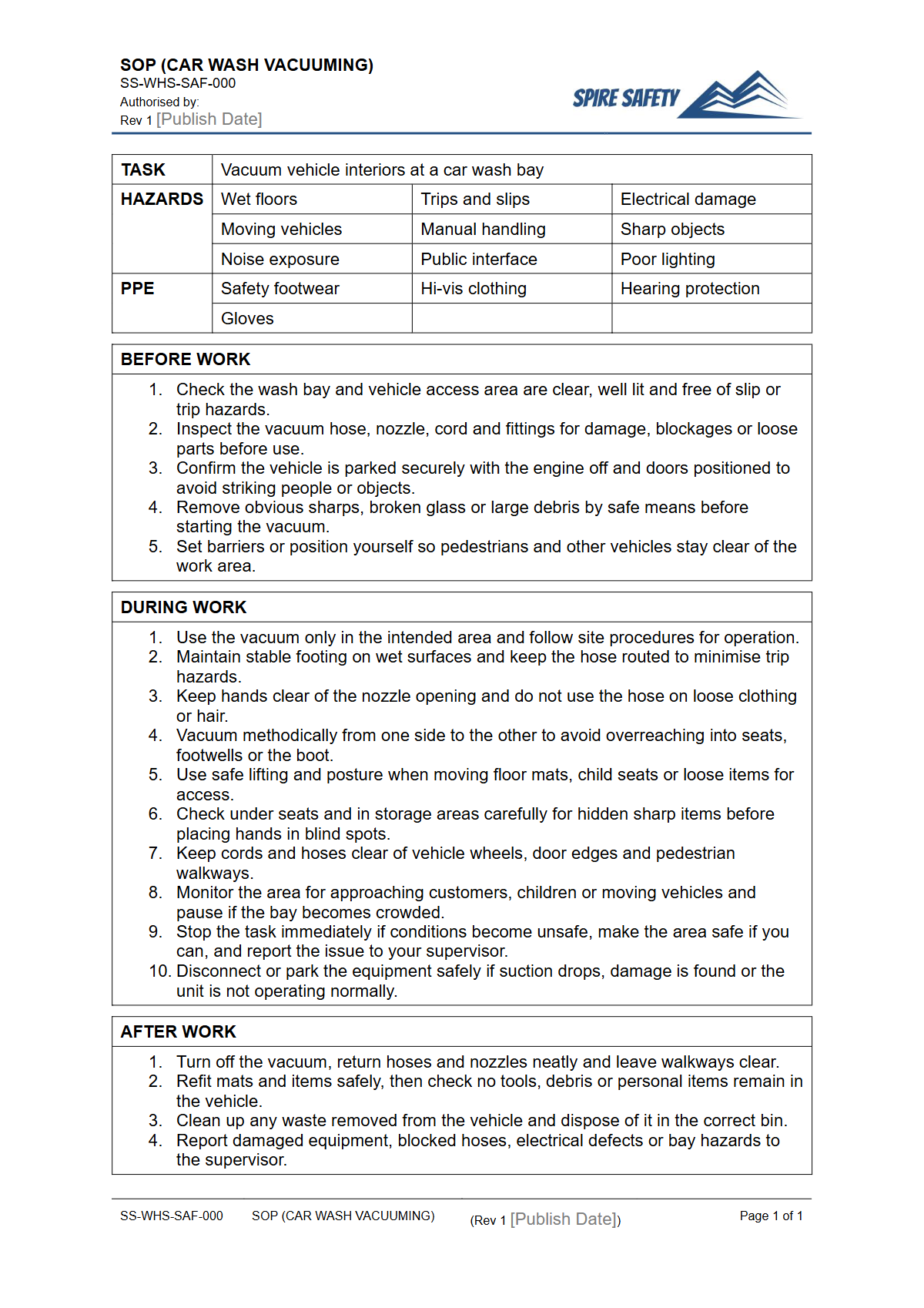
Download our free Safe Operating Procedure for car wash vacuuming. This DOCX and PDF template helps you outline safe work practices for your team.
Free Safe Operating Procedure (Car Wash Vacuuming) Template
DOCX • 126 KB + PDF
Updated Oct 2026
No signup required
Purpose of the Free Safe Operating Procedure (Car Wash Vacuuming) Template
Establishing a clear and safe process for routine tasks is a cornerstone of effective workplace health and safety. This Free Safe Operating Procedure (Car Wash Vacuuming) Template provides a structured framework for documenting the hazards and control measures associated with using commercial vacuums in a car wash environment.
An SOP helps standardise your approach, ensuring every worker understands the accepted method for performing the task safely, minimising risks such as electrical shock, manual handling injuries, and slips, trips, and falls.
Using a formal Safe Operating Procedure helps your business meet its duties under WHS legislation by providing evidence of risk management. It creates a safer work environment, reduces the likelihood of incidents, and provides a clear and consistent training resource for all staff members involved in vehicle cleaning and detailing tasks.
Video walkthrough
How to use the Free Safe Operating Procedure (Car Wash Vacuuming) Template
To get started, download the template in your preferred format (DOCX or PDF). The document is structured to guide you through key sections, including required Personal Protective Equipment (PPE), pre-operational checks, the step-by-step operating sequence, and post-operational tasks.
For a holistic safety approach, it's beneficial to integrate SOPs for all major equipment. For instance, if your facility also uses compressed air for cleaning, our air compressor SOP can be a valuable companion document.
Important: Customise to Your Workplace
This document is a template, not a finished product. Every workplace is unique, with different equipment, layouts, and environmental factors.
You must review, edit, and adapt this SOP to reflect the specific machinery and risks present in your car wash. We recommend conducting a site-specific risk assessment to identify all relevant hazards before finalising the procedure.
This customisation is critical for ensuring the SOP is effective and relevant to your operations.
A thorough SOP goes beyond just the main task. It should cover setup, pack-down, and basic maintenance.
For example, if workers need to access storage shelving to retrieve attachments, a corresponding step ladder SOP would be essential to cover associated risks. A comprehensive approach ensures all aspects of the job are considered.
When to use this Safe Operating Procedure
This Safe Operating Procedure should be a central part of your safety documentation. Use it during worker induction and training to demonstrate the correct, safe method for vacuuming duties.
It serves as an excellent on-the-job reference for workers and a valuable tool for supervisors conducting safety observations or incident investigations. Regular reviews of the SOP ensure it remains current with any changes in equipment or processes. Integrating SOPs into your processes is a key part of building strong WHS management systems.
The SOP also forms a critical piece of evidence during safety reviews. Keeping it updated and ensuring workers are trained on its contents demonstrates a commitment to managing risks proactively.
This can be verified through WHS compliance audits, which check that documented procedures are being followed in practice.
Who is this SOP Template for?
This SOP template is designed for anyone responsible for health and safety in a vehicle washing or detailing business. This includes:
- Business Owners and Managers: To establish and implement formal safety procedures as part of their duty of care.
- WHS/HSE Advisors: As a tool for developing site-specific documentation and risk controls.
- Supervisors and Team Leaders: To train team members and monitor adherence to safe work practices.
- Workers: As a clear guide on how to perform their tasks safely and consistently.
While this SOP covers vacuuming, other common workshop tasks require similar documentation, such as using power tools for maintenance. You can find templates like our free circular saw SOP to expand your safety documentation. By formalising your procedures, you create a safer, more predictable work environment that not only protects your team but also improves operational efficiency. For other procedural documents, explore our complete free WHS resources library.
Common mistakes
Common mistakes to avoid
- Failing to conduct pre-operational checks on the vacuum, including inspecting cords and plugs for damage.
- Using the equipment without the required Personal Protective Equipment (PPE), such as safety glasses or hearing protection.
- Creating trip hazards by running vacuum hoses across busy walkways or work areas.
- Improper manual handling techniques when moving or emptying heavy industrial vacuums.
Legal references
Legal considerations
The following legal requirements may be relevant to this type of work.
- Work Health and Safety Act (Harmonised) — Provides the primary duties for protecting workers and other people from work health and safety risks.
- Work Health and Safety Regulations (Harmonised) — Sets out requirements supporting the management of workplace hazards and risks.
The following codes may be relevant to this type of work.
- Managing WHS Risks Code of Practice — Provides practical guidance on identifying hazards, assessing risks and applying effective controls.
- Work Health and Safety Consultation, Cooperation and Coordination Code of Practice — Provides practical guidance on consulting workers and coordinating with other duty holders.
- Managing the Work Environment and Facilities Code of Practice — Provides practical guidance on safe work environments, workplace facilities and related controls.
Did you know
Electrical Safety
According to Safe Work Australia, contact with electricity is a significant cause of workplace fatalities and serious injuries. Regular inspection and testing of electrical equipment, like vacuums, is a critical control measure.
Noise Exposure
Commercial vacuum cleaners can generate noise levels exceeding 85 decibels (dB), the exposure standard for noise in Australian workplaces. Prolonged exposure without hearing protection can lead to permanent hearing loss.
FAQ
Frequently asked questions
01What is a Safe Operating Procedure (SOP)?
02Why do I need an SOP for something simple like vacuuming?
03Is this template ready to use immediately?
04How often should we review our Car Wash Vacuuming SOP?
Share this resource
Free Safe Operating Procedure (Car Wash Vacuuming) Template
Browse Categories
How To Use It
- 1Download and open in Word or PDF.
- 2Replace the placeholders with your business details.
- 3Get it reviewed by a WHS specialist before rollout.
Need it customised?
Our WHS consultants can adapt this template to your site, run a gap analysis, or audit what you already have in place.
Book a Free Consultation WHS consulting servicesor call 1300 156 382
Related templates
- Free Safe Operating Procedure (Carcass Handling) Template
- Free Safe Operating Procedure (Cardboard Compactor) Template
- Free Safe Operating Procedure (Carding Machine) Template
- Free Safe Operating Procedure (Care Cart Cleaning) Template
- Free Safe Operating Procedure (Cargo Handling) Template
- Free Safe Operating Procedure (Cargo Hold Cleaning) Template