
Free Safe Operating Procedure (Cargo Hold Cleaning) Template
Download our free Safe Operating Procedure (SOP) for Cargo Hold Cleaning.
Free Safe Operating Procedure (Cargo Hold Cleaning) Template
DOCX • 126 KB + PDF
Updated Oct 2026
No signup required
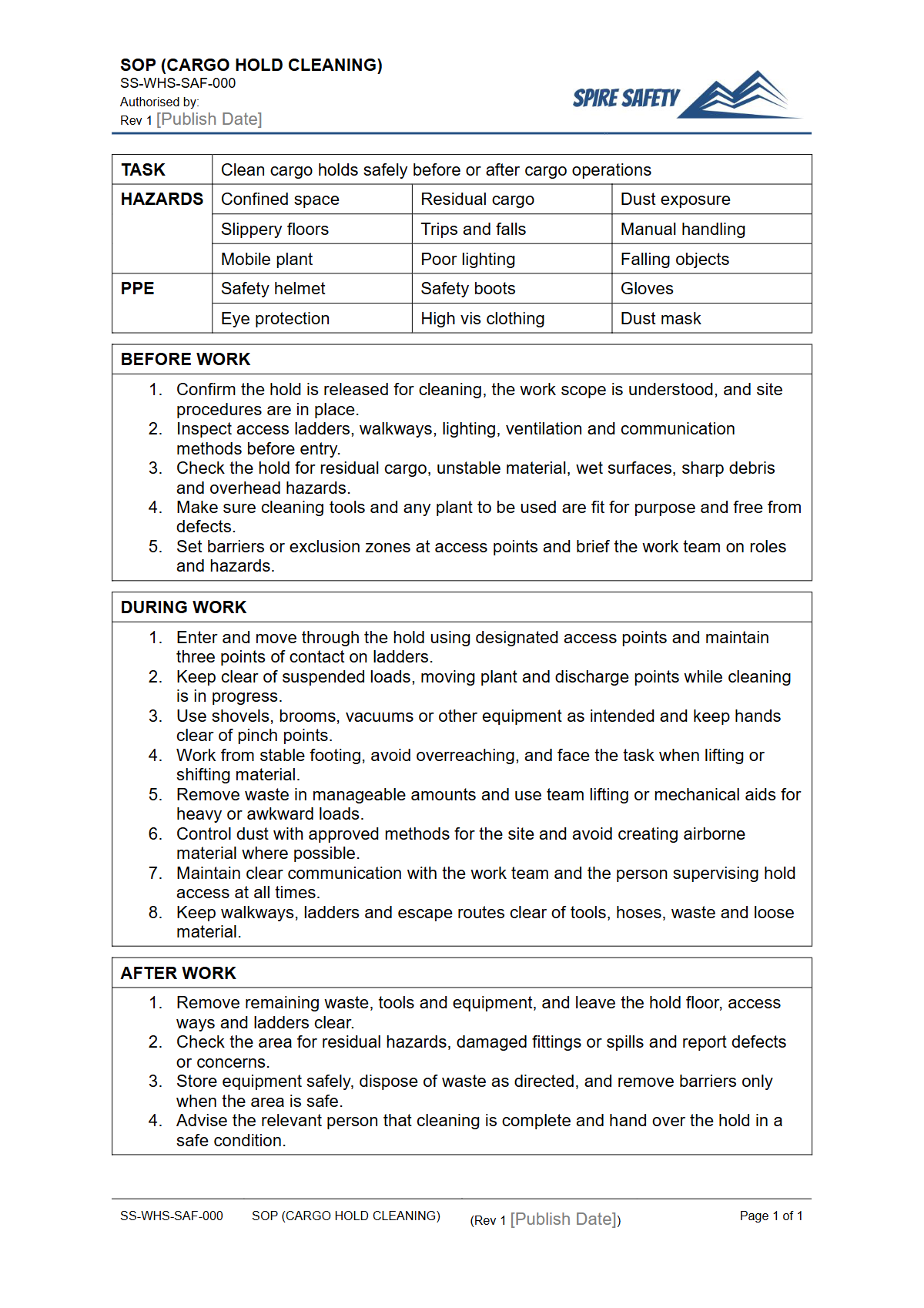
Purpose of the Free Safe Operating Procedure (Cargo Hold Cleaning) Template
Cleaning cargo holds on vessels is a high-risk activity that exposes workers to numerous hazards, including confined spaces, hazardous atmospheres, falls from height, and chemical exposure. This Free Safe Operating Procedure (Cargo Hold Cleaning) Template provides a structured starting point for documenting a safe system of work for this complex task.
It is designed to help your organisation methodically plan the job, identify potential hazards, and implement robust control measures to protect your workers, in alignment with Australian WHS principles.
A well-developed Safe Operating Procedure (SOP) is a critical component of a compliant and effective safety system. It serves as a practical tool for training, supervision, and demonstrating due diligence.
Integrating this procedure into your broader WHS management systems ensures that safety protocols are consistently applied and formally recorded, creating a safer work environment for everyone involved in port and maritime operations.
Video walkthrough
How to use the Free Safe Operating Procedure (Cargo Hold Cleaning) Template
This template is provided as a fully editable DOCX file, allowing for complete customisation. Once downloaded, you must adapt the content to reflect the specific circumstances of your workplace, the types of vessels and cargoes you handle, the equipment used, and the personnel involved.
Generic procedures are not sufficient for managing site-specific risks.
Important: This is a template document that we have created as a starting point. You must customise it with your own company details, site-specific information, and any additional processes or controls relevant to your operations.
A thorough risk assessment should be conducted before finalising and implementing the procedure. You can find more templates and checklists to support your processes in our free WHS resources library.
Key Hazards in Cargo Hold Cleaning
Cargo holds present a unique combination of risks that must be carefully managed. The primary hazard is often the atmosphere within the space, which can be oxygen-deficient or contain toxic or flammable gases from cargo residue or cleaning chemicals.
The SOP must mandate atmosphere testing before entry and continuous monitoring during the work.
Working at height is another significant risk, whether workers are accessing the hold, working on temporary platforms, or using ladders. Your procedure should specify requirements for safe access and egress, fall prevention systems, and the safe use of equipment.
For tasks involving simple access, ensuring procedures are in place, like those outlined in a step ladder SOP, is essential for preventing falls.
The task may also involve heavy machinery for removing dunnage or bulk residues. The movement of plant, such as forklifts or loaders within or near the hold, introduces risks of collision and crush injuries.
If larger equipment is needed for lifting materials, your operational planning must include documents like a Telehandler SOP Template to ensure it is used safely.
Who Should Use This Safe Operating Procedure?
This Safe Operating Procedure is intended for use by Persons Conducting a Business or Undertaking (PCBUs) in the maritime, stevedoring, transport, and logistics industries. It should be developed and implemented by WHS managers, port captains, supervisors, and team leaders who are responsible for planning, authorising, and overseeing cargo hold cleaning operations.
It also serves as a critical reference for the workers carrying out the task, clearly outlining the expected safety standards and behaviours. If the waste from the hold is being transported off-site, you may need to supplement this procedure with a Body Truck SOP for the drivers involved.
Ensuring Effective Implementation
Simply writing an SOP is not enough; it must be effectively put into practice. This begins with comprehensive training for all workers involved, ensuring they understand the hazards, controls, and emergency procedures outlined in the document.
Regular toolbox talks before each job are a good way to reinforce key safety points. Supervisors play a crucial role in monitoring the work on-site to ensure the documented procedure is being followed correctly.
Finally, all safety documents require periodic review to remain effective. This SOP should be reviewed after any incident, when new equipment or cleaning agents are introduced, or on a scheduled basis (e.g., annually).
A formal process of WHS compliance auditing can help verify that the procedures are being correctly implemented in practice and identify areas for improvement across your safety systems.
Common mistakes
Common mistakes to avoid
- Failing to conduct a thorough risk assessment before starting the work.
- Neglecting to test the atmosphere before entry and monitor it continuously.
- Using incorrect or poorly maintained personal protective equipment (PPE).
- Providing inadequate training and supervision for the cleaning crew.
Legal references
Legal considerations
The following legal requirements may be relevant to this type of work.
- Work Health and Safety Act (Harmonised) — Provides the primary duties for protecting workers and other people from work health and safety risks.
- Work Health and Safety Regulations (Harmonised) — Sets out requirements supporting the management of workplace hazards and risks.
The following codes may be relevant to this type of work.
- Managing WHS Risks Code of Practice — Provides practical guidance on identifying hazards, assessing risks and applying effective controls.
- Work Health and Safety Consultation, Cooperation and Coordination Code of Practice — Provides practical guidance on consulting workers and coordinating with other duty holders.
- Managing the Work Environment and Facilities Code of Practice — Provides practical guidance on safe work environments, workplace facilities and related controls.
Did you know
Atmospheric Dangers
Cargo holds are often classified as confined spaces. Even seemingly harmless cargo like grain or wood chips can deplete oxygen or produce toxic gases as they decompose, creating a life-threatening atmosphere.
Residue Reactivity
The cleaning process itself can create hazards. For example, using water to clean holds that previously contained certain metals or chemicals can trigger a chemical reaction that releases flammable or toxic gases.
FAQ
Frequently asked questions
01What is a Safe Operating Procedure for cargo hold cleaning?
02Why is a specific SOP needed for cargo hold cleaning?
03Who is responsible for developing a cargo hold cleaning SOP?
04How often should a cargo hold cleaning SOP be reviewed?
Share this resource
Free Safe Operating Procedure (Cargo Hold Cleaning) Template
Browse Categories
How To Use It
- 1Download and open in Word or PDF.
- 2Replace the placeholders with your business details.
- 3Get it reviewed by a WHS specialist before rollout.
Need it customised?
Our WHS consultants can adapt this template to your site, run a gap analysis, or audit what you already have in place.
Book a Free Consultation WHS consulting servicesor call 1300 156 382
Related templates
- Free Safe Operating Procedure (Cargo Loader) Template
- Free Safe Operating Procedure (Cargo Net Inspection) Template
- Free Safe Operating Procedure (Cargo Restraint Check) Template
- Free Safe Operating Procedure (Carpet Cleaner) Template
- Free Safe Operating Procedure (Carpet Extraction) Template
- Free Safe Operating Procedure (Carpet Shampooing) Template