
Free Safe Operating Procedure (Cargo Net Inspection) Template
Download a free Safe Operating Procedure for cargo net inspection.
Free Safe Operating Procedure (Cargo Net Inspection) Template
DOCX • 126 KB + PDF
Updated Oct 2026
No signup required
Purpose of the Free Safe Operating Procedure (Cargo Net Inspection) Template
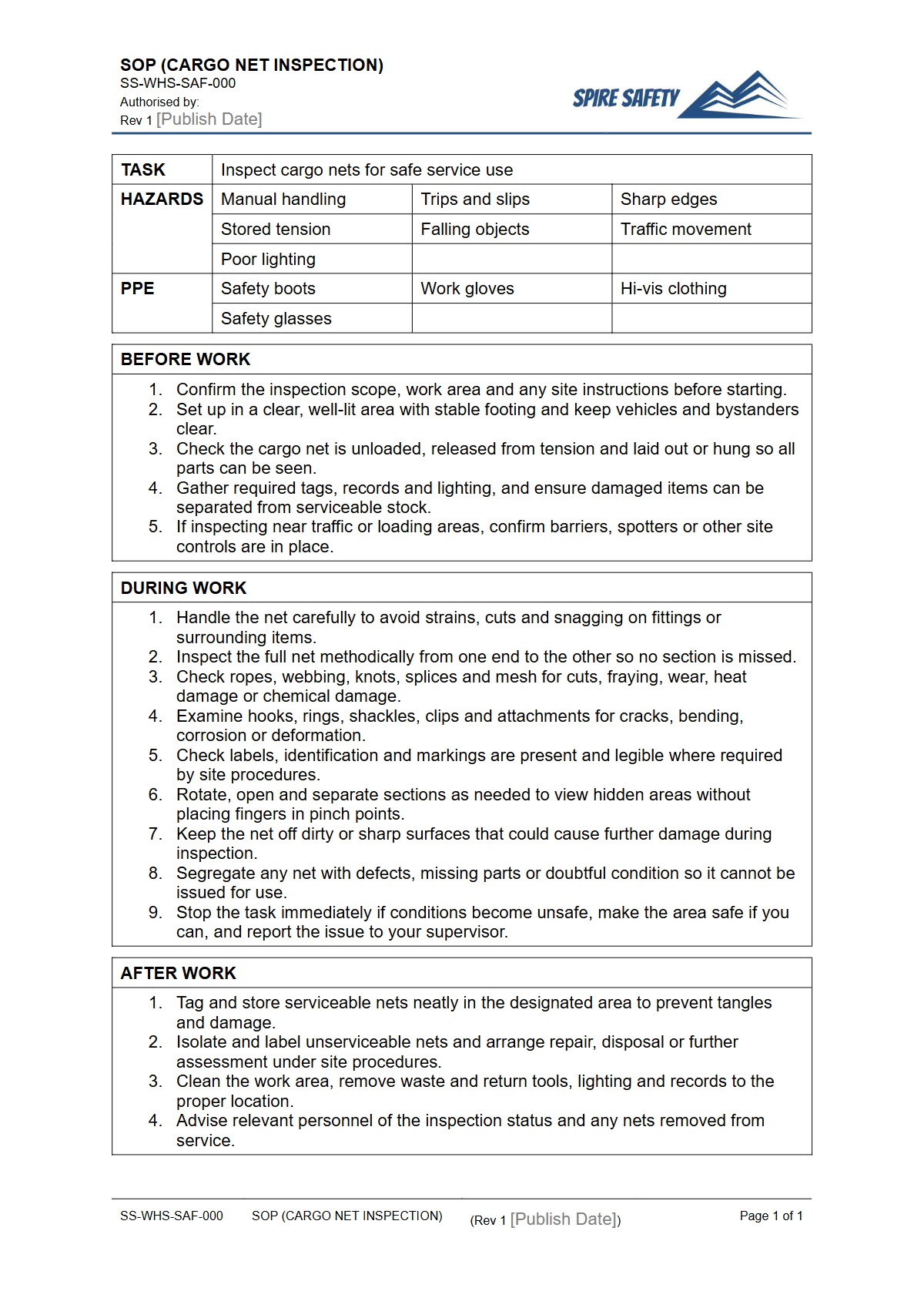
This Free Safe Operating Procedure (Cargo Net Inspection) Template provides a structured framework for businesses to document and standardise the process of inspecting cargo nets. Properly inspecting load restraint equipment is a critical control measure to prevent incidents such as falling objects, load shifts during transit, and potential harm to workers and the public.
A documented SOP ensures that inspections are performed consistently and thoroughly by all personnel, regardless of their experience level.
Using a standardised procedure helps your organisation meet its duty of care under Australian WHS laws by formalising risk management processes. This template acts as a clear, step-by-step guide covering pre-use checks, periodic detailed inspections, and criteria for removing a damaged net from service.
It serves as an essential training tool for new workers and a ready reference for experienced staff. Formalising this process is just as important as having a Safe Operating Procedure for body trucks or any other key plant used in transport and logistics.
Video walkthrough
How to use the Free Safe Operating Procedure (Cargo Net Inspection) Template
This resource is available for immediate download as a DOCX file, allowing for easy editing and customisation to suit your specific operational needs. Once completed, you can save it as a PDF for controlled distribution.
The template includes sections for outlining the inspection scope, required PPE, step-by-step inspection actions, and criteria for passing or failing a net.
Important: This template provides a foundation based on established Australian WHS practice. To be effective, you must customise it to reflect the specific types of cargo nets, associated plant (e.g., cranes, trucks), tasks, and unique environmental conditions of your workplace.
We have included prompts and sections for you to add site-specific information, emergency procedures, and responsible personnel.
An SOP is most effective when it is a living document, reviewed regularly and updated as required. It should form part of your broader safety framework.
Integrating individual procedures like this one into comprehensive WHS management systems ensures a holistic and organised approach to safety across your entire operation.
Integrating the SOP into Your Safety System
Once customised, this SOP should be used as a key document for both operational work and safety management. Use it to induct new employees, conduct refresher training, and as a basis for workplace observations or safety conversations.
The completed inspection records generated from this procedure provide valuable data that can be reviewed during regular WHS compliance audits to verify that safety processes are being followed correctly.
When to use it
A cargo net inspection SOP should be referenced at several key moments to maximise its effectiveness and ensure ongoing safety. Its primary use is as a checklist for pre-use inspections, which should be conducted by the operator before every single use to identify any obvious defects that may have occurred since the last check.
It is also essential for guiding more detailed periodic inspections, which are more thorough and should be scheduled at regular intervals (e.g., monthly or quarterly) as determined by a risk assessment and manufacturer's recommendations.
This document is also a critical tool during worker training and when assessing competency. It provides the benchmark against which a worker's ability to correctly inspect equipment can be measured.
For example, it can be used alongside a SOP for telehandler operations to ensure workers understand how to check all associated lifting gear before commencing a task. Finally, it should be consulted following any incident or near-miss involving a secured load to review procedures and identify opportunities for improvement.
Who should use it
This Safe Operating Procedure is intended for several key roles within an organisation. The primary users are the workers who directly handle and use cargo nets, such as transport drivers, warehouse personnel, riggers, and construction workers.
They will use the SOP to guide their daily pre-use checks. Supervisors and team leaders are also key users, responsible for ensuring their teams are trained on the procedure and adhere to it consistently.
Work Health and Safety (WHS) managers or officers will use the template as a starting point for developing a site-specific document. They are typically responsible for managing the review cycle, updating the procedure in response to regulatory changes or incidents, and integrating it into the overall safety management system.
If your organisation lacks in-house expertise, engaging specialist WHS consulting can provide the necessary guidance to develop and implement robust safety documentation. You can explore our complete free WHS resources library for more templates to support your safety system.
Common mistakes
Common mistakes to avoid
- Overlooking small cuts or abrasions that can significantly weaken the webbing.
- Failing to inspect hardware, including hooks, ratchets, and attachment points, for deformation or corrosion.
- Continuing to use a net that has been involved in a severe shock-loading event without a thorough inspection.
- Not keeping written records of periodic inspections, which can be crucial for demonstrating compliance.
Legal references
Legal considerations
The following legal requirements may be relevant to this type of work.
- Work Health and Safety Act (Harmonised) — Provides the primary duties for protecting workers and other people from work health and safety risks.
- Work Health and Safety Regulations (Harmonised) — Sets out requirements supporting the management of workplace hazards and risks.
The following codes may be relevant to this type of work.
- Managing WHS Risks Code of Practice — Provides practical guidance on identifying hazards, assessing risks and applying effective controls.
- Work Health and Safety Consultation, Cooperation and Coordination Code of Practice — Provides practical guidance on consulting workers and coordinating with other duty holders.
- Managing the Work Environment and Facilities Code of Practice — Provides practical guidance on safe work environments, workplace facilities and related controls.
Did you know
Material Matters
Most synthetic webbing cargo nets are made from polyester, which has low stretch and high resistance to UV radiation and acids. This makes it ideal for most general freight applications.
The Tag is a Legal Document
The identification tag on a cargo net is a critical component. If the tag is missing or unreadable, the net must be removed from service as its load rating and manufacturing details cannot be verified.
FAQ
Frequently asked questions
01What is a Safe Operating Procedure (SOP) for cargo net inspection?
02How often should cargo nets be inspected?
03Who is responsible for inspecting cargo nets?
04Can I use this template for any type of cargo net?
Share this resource
Free Safe Operating Procedure (Cargo Net Inspection) Template
Browse Categories
How To Use It
- 1Download and open in Word or PDF.
- 2Replace the placeholders with your business details.
- 3Get it reviewed by a WHS specialist before rollout.
Need it customised?
Our WHS consultants can adapt this template to your site, run a gap analysis, or audit what you already have in place.
Book a Free Consultation WHS consulting servicesor call 1300 156 382
Related templates
- Free Safe Operating Procedure (Cargo Restraint Check) Template
- Free Safe Operating Procedure (Carpet Cleaner) Template
- Free Safe Operating Procedure (Carpet Extraction) Template
- Free Safe Operating Procedure (Carpet Shampooing) Template
- Free Safe Operating Procedure (Carpet Spot Treatment) Template
- Free Safe Operating Procedure (Carpet Stretcher) Template