
Free Safe Operating Procedure (Cargo Restraint Check) Template
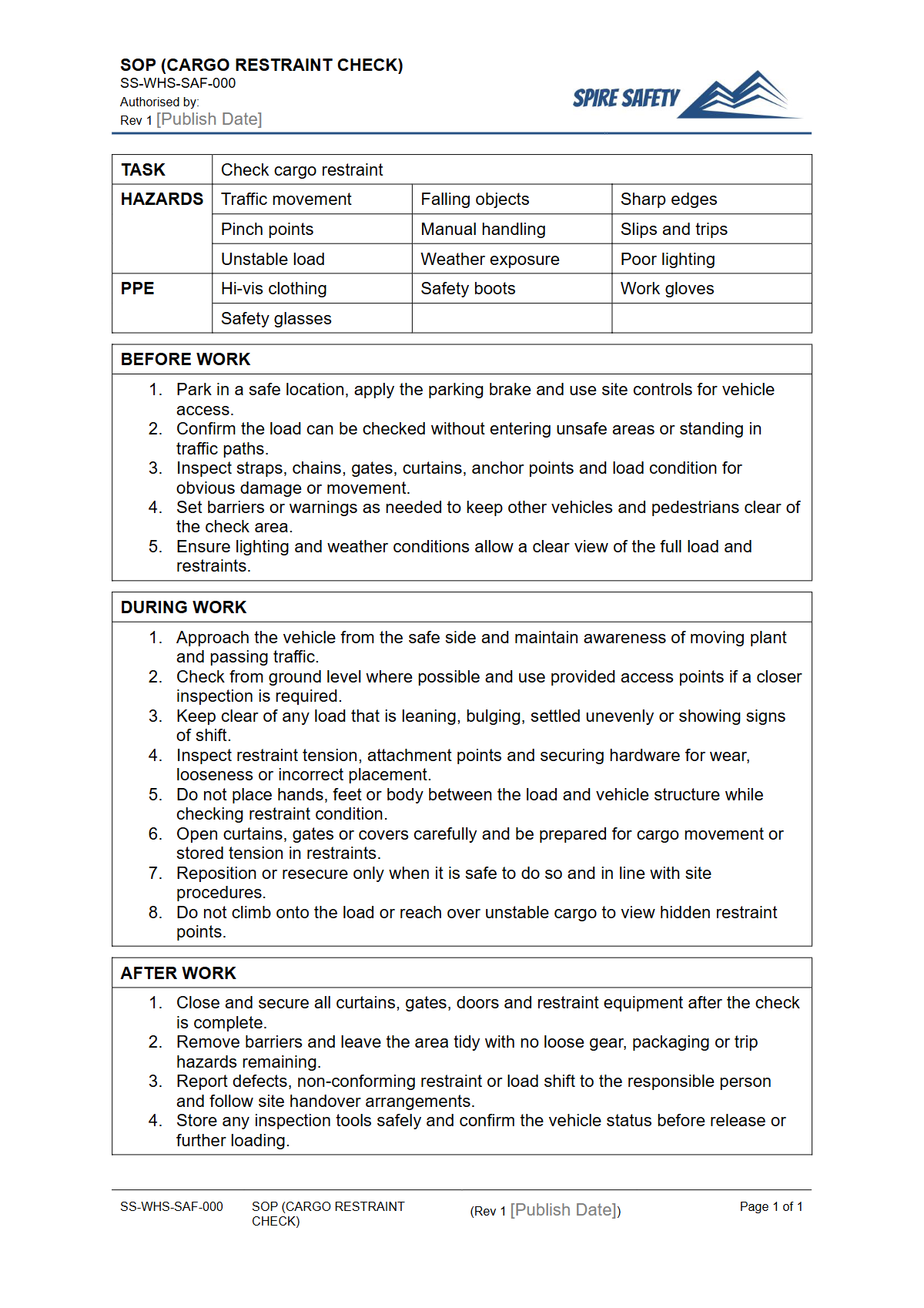
Download our free Safe Operating Procedure (Cargo Restraint Check) Template (DOCX & PDF) to standardise procedures for securing loads on heavy vehicles.
Free Safe Operating Procedure (Cargo Restraint Check) Template
DOCX • 126 KB + PDF
Updated Oct 2026
No signup required
Purpose of the Free Safe Operating Procedure (Cargo Restraint Check) Template
Ensuring cargo is properly secured is a critical task in the transport and logistics industry, preventing incidents that can lead to injury, property damage, and significant legal penalties. This Free Safe Operating Procedure (Cargo Restraint Check) Template provides a structured framework for documenting the step-by-step process for safely inspecting and applying load restraints.
Using a standardised SOP helps ensure that all personnel follow a consistent, safe method every time, reducing the risk of load shifts during transit. It serves as a vital tool for training, reinforcing safe work practices, and demonstrating due diligence under Chain of Responsibility (CoR) laws.
This document is designed to be integrated into your broader safety framework. While it focuses specifically on the restraint check, it should complement other procedures, such as a body truck safe operating procedure, to cover the entire operational cycle of a vehicle.
A documented procedure forms a key part of a risk management approach, helping your organisation identify hazards associated with unsecured loads and implement effective control measures. It is an essential component for any business operating heavy vehicles in Australia, providing a clear reference point for workers and management alike.
Video walkthrough
How to use the Free Safe Operating Procedure (Cargo Restraint Check) Template
This template is a starting point aligned with Australian WHS principles and the National Load Restraint Guide. To use it effectively, download the DOCX file and adapt it to your specific operational context.
This involves a thorough review and customisation process to reflect the unique aspects of your workplace.
Key steps for implementation include:
- Customisation: You must edit the document to include details specific to your vehicles, the types of loads you carry, and the restraint equipment you use (e.g., straps, chains, tensioners, friction mats). Add your company name, logo, and relevant site information.
- Consultation: Involve your workers—the drivers, loaders, and supervisors who perform these tasks daily. Their practical knowledge is invaluable for creating a procedure that is both safe and workable. Consultation is also a key requirement under WHS legislation.
- Review and Approval: Once customised, the SOP should be formally reviewed and approved by a competent person within your organisation, such as a Transport Manager or WHS Officer.
- Training: Use the finalised SOP as a training tool for new and existing employees. Ensure everyone understands their responsibilities and can demonstrate competence in performing the cargo restraint check correctly. A procedure is only effective if it is understood and followed.
Remember, this document is a template. We are not WHS consultants for your business just because you download a template.
Its effectiveness depends entirely on how you adapt and implement it within your comprehensive WHS management system. You must ensure the final document accurately reflects your workplace risks and control measures.
When to use a Safe Operating Procedure for Cargo Restraint
A cargo restraint check SOP should be used as a primary reference before the commencement of any journey involving a loaded heavy vehicle. The checks outlined in the procedure should be performed:
- Before leaving the point of loading.
- After the first few kilometres of travel, as loads can settle and restraints may loosen.
- At regular intervals during long-haul trips.
- After any instance of heavy braking, sharp cornering, or travelling over rough terrain.
- When changing drivers or handing over responsibility for the vehicle and its load.
Regularly applying this SOP helps build a consistent safety culture and ensures that potential issues are identified before they escalate into incidents. These checks can also be a key verification point during internal or external WHS compliance audits, demonstrating a proactive approach to transport safety.
Who should use this SOP?
This Safe Operating Procedure is intended for all personnel involved in the chain of responsibility for transporting goods. This includes:
- Vehicle Operators/Drivers: They are on the front line and often have final responsibility for ensuring the vehicle is safe for the road.
- Loaders and Loading Personnel: Individuals who physically place goods onto the vehicle and may be involved in applying initial restraints.
- Supervisors and Transport Managers: Those responsible for overseeing operations, providing training, and ensuring procedures are followed correctly.
- WHS/Safety Officers: Professionals responsible for developing, implementing, and reviewing safety procedures across the organisation.
Ensuring everyone in the chain understands their role is critical. For complex operations or for businesses needing to develop a suite of safety documents, engaging expert WHS consultants can provide clarity and help establish robust, practical systems.
In addition to this SOP, you may require procedures for specific plant, such as a Telehandler SOP if one is used for loading.
Common mistakes
Common mistakes to avoid
- Using damaged, frayed, or unrated straps and chains.
- Failing to account for dynamic forces generated during braking and cornering.
- Relying solely on the weight of the load for stability ('friction-only' restraint) without appropriate blocking.
- Not re-tensioning restraints after the load has had time to settle shortly after starting a journey.
Legal references
Legal considerations
The following legal requirements may be relevant to this type of work.
- Work Health and Safety Act (Harmonised) — Provides the primary duties for protecting workers and other people from work health and safety risks.
- Work Health and Safety Regulations (Harmonised) — Sets out requirements supporting the management of workplace hazards and risks.
The following codes may be relevant to this type of work.
- Managing WHS Risks Code of Practice — Provides practical guidance on identifying hazards, assessing risks and applying effective controls.
- Work Health and Safety Consultation, Cooperation and Coordination Code of Practice — Provides practical guidance on consulting workers and coordinating with other duty holders.
- Managing the Work Environment and Facilities Code of Practice — Provides practical guidance on safe work environments, workplace facilities and related controls.
Did you know
The 80/20/20 Rule
According to the National Load Restraint Guide, a load restraint system must be able to withstand forces of 0.8g (80%) of the load's weight in a forward direction, and 0.5g (50%) in sideways and rearward directions. For vertical forces, it is 0.2g (20%) of the load's weight.
A Common Cause of Incidents
The National Heavy Vehicle Regulator (NHVR) reports that inadequate load restraint is one of the most common breaches found during roadside intercepts, contributing to numerous road incidents and traffic disruptions each year.
FAQ
Frequently asked questions
01What is the purpose of a cargo restraint check SOP?
02Are lashing capacity and load ratings the same thing?
03How often should cargo restraint equipment be inspected?
04Who is responsible for ensuring cargo is restrained correctly in Australia?
Share this resource
Free Safe Operating Procedure (Cargo Restraint Check) Template
Browse Categories
How To Use It
- 1Download and open in Word or PDF.
- 2Replace the placeholders with your business details.
- 3Get it reviewed by a WHS specialist before rollout.
Need it customised?
Our WHS consultants can adapt this template to your site, run a gap analysis, or audit what you already have in place.
Book a Free Consultation WHS consulting servicesor call 1300 156 382
Related templates
- Free Safe Operating Procedure (Carpet Cleaner) Template
- Free Safe Operating Procedure (Carpet Extraction) Template
- Free Safe Operating Procedure (Carpet Shampooing) Template
- Free Safe Operating Procedure (Carpet Spot Treatment) Template
- Free Safe Operating Procedure (Carpet Stretcher) Template
- Free Safe Operating Procedure (Carton Damage Handling) Template