
Free Safe Operating Procedure (Cargo Loader) Template
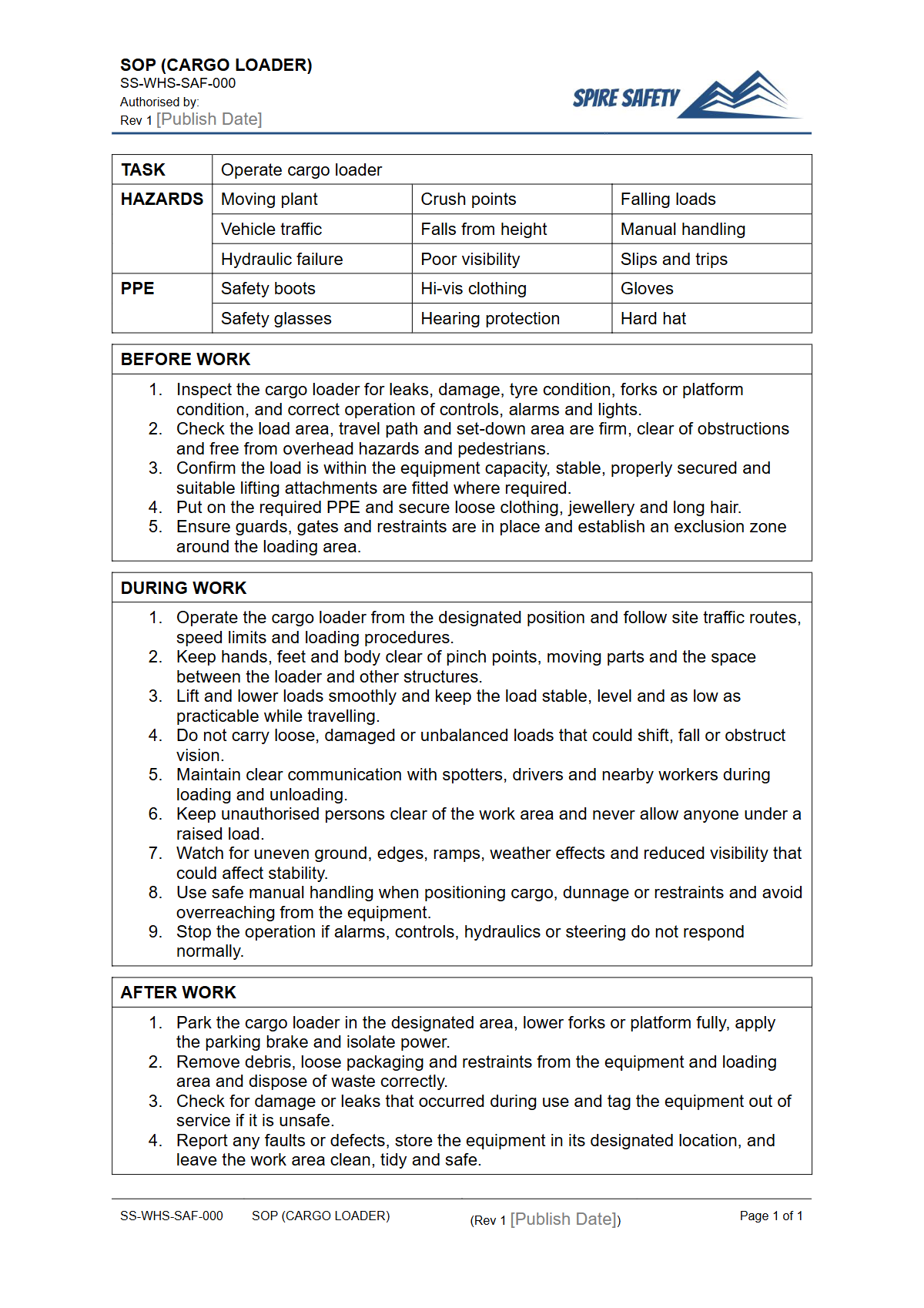
Download our free Safe Operating Procedure (Cargo Loader) template. This customisable DOCX and PDF resource helps you outline safe work practices.
Free Safe Operating Procedure (Cargo Loader) Template
DOCX • 126 KB + PDF
Updated Oct 2026
No signup required
Purpose of the Free Safe Operating Procedure (Cargo Loader) Template
A Safe Operating Procedure (SOP) provides clear, step-by-step instructions on how to perform a task safely. This free Safe Operating Procedure (Cargo Loader) template is a structured starting point for your business to document the process for operating belt loaders, container loaders, and other cargo handling equipment.
Using a documented procedure helps control significant risks, including workers being struck by the loader, collisions with aircraft or other vehicles, falling objects, and musculoskeletal injuries from awkward postures.
By formalising the required steps for pre-start checks, operation, and shutdown, an SOP helps ensure that every operator follows a consistent, safe method. It serves as a critical tool in your risk management process, addressing hazards specific to cargo loading environments.
This procedure is also vital for traffic management plans in busy aprons or loading docks, where interactions with other mobile plant are common. For related equipment, you might also require procedures like our FREE Telehandler SOP (Safe Operating Procedure) Template to manage materials handling risks across your site.
A well-drafted SOP is a fundamental component of a safe system of work. It not only guides workers but also demonstrates a commitment to fulfilling WHS duties.
When operating around other vehicles, it's crucial to have clear protocols, similar to those outlined in our FREE Body Truck SOP (Safe Operating Procedure) Template, to prevent collisions and ensure pedestrian safety.
Video walkthrough
How to use the Free Safe Operating Procedure (Cargo Loader) Template
This document is designed as a template that must be adapted to your specific operational context. To use this Safe Operating Procedure (Cargo Loader) template, download the DOCX file and fill in the details relevant to your organisation, including your company name, the specific make and model of the cargo loader, and site-specific rules or emergency contacts.
IMPORTANT: This is a template only. We are not familiar with your specific site, equipment, and operational context.
You MUST customise this document to reflect the actual risks and control measures in your workplace. A generic procedure is not sufficient to meet your legal obligations.
Always conduct a site-specific risk assessment before finalising and implementing any SOP.
Once customised, the SOP should be integrated into your broader safety framework. It should form part of your induction and training program for all operators.
Ensure the final version is approved by a competent person, made accessible to all relevant workers, and reviewed regularly. Effective implementation is key to ensuring the procedure translates into safe behaviour on the ground, which is a core part of robust WHS management systems.
When to use a Safe Operating Procedure
A Safe Operating Procedure for a cargo loader should be used consistently as part of your daily operations. It is not a document to be filed away and forgotten. Key times for its use include:
- Worker Training and Induction: It should be a central part of training for new operators and a reference for verifying their competency.
- Pre-Operational Checks: Operators should refer to the SOP to complete daily pre-start inspections, ensuring the equipment is safe to use.
- Task Reference: Workers can use it as a quick reference to confirm safe steps, especially for non-routine loading tasks.
- Toolbox Talks and Safety Meetings: Supervisors can use the SOP as a basis for discussions on safe work practices and to address any recent observations or near-misses. Even seemingly simple equipment can pose risks, making it important to have procedures for all tools, as seen in our FREE Step Ladder SOP Template.
- Incident Investigations: Following an incident or near-miss, the SOP should be reviewed to determine if the procedure was followed and if it needs to be updated to prevent a recurrence.
Who should use it
An SOP for a cargo loader is a tool for multiple roles within an organisation, each with different responsibilities:
- Persons Conducting a Business or Undertaking (PCBUs): To help fulfil their primary duty of care to provide and maintain a safe working environment and safe systems of work.
- Managers and Supervisors: To train, instruct, and monitor workers, ensuring they are competent and adhering to established safety protocols.
- Workers and Operators: As a practical guide to perform their work safely and consistently, and to understand the hazards and control measures associated with their tasks.
- WHS and Safety Professionals: To develop, implement, and review safety documentation as part of the overall WHS management system.
Developing and implementing these procedures can sometimes require specialist knowledge. For businesses needing support in creating comprehensive safety systems, our WHS consulting services can provide expert guidance. To find more templates for other plant and equipment, you can browse our complete free WHS resources library.
Common mistakes
Common mistakes to avoid
- Using a generic 'off-the-shelf' SOP without customising it for the specific workplace and equipment.
- Failing to adequately train all operators on the contents of the finalised SOP.
- Neglecting to enforce the use of the SOP, especially for routine pre-start checks.
- Not reviewing or updating the procedure after an incident, near-miss, or change in process.
Legal references
Legal considerations
The following legal requirements may be relevant to this type of work.
- Work Health and Safety Act (Harmonised) — Provides the primary duties for protecting workers and other people from work health and safety risks.
- Work Health and Safety Regulations (Harmonised) — Sets out requirements supporting the management of workplace hazards and risks.
The following codes may be relevant to this type of work.
- Managing WHS Risks Code of Practice — Provides practical guidance on identifying hazards, assessing risks and applying effective controls.
- Work Health and Safety Consultation, Cooperation and Coordination Code of Practice — Provides practical guidance on consulting workers and coordinating with other duty holders.
- Managing the Work Environment and Facilities Code of Practice — Provides practical guidance on safe work environments, workplace facilities and related controls.
Did you know
Vehicle Collisions
In Australia, the Transport, Postal & Warehousing industry has one of the highest rates of work-related fatalities, with vehicle collisions being a leading cause of death.
Plant-Related Injuries
According to Safe Work Australia, between 2015 and 2019, there were over 18,000 serious claims for injuries involving machinery and fixed or mobile plant.
FAQ
Frequently asked questions
01What should be included in a Cargo Loader SOP?
02How often should a Cargo Loader Safe Operating Procedure be reviewed?
03Is training required to operate a cargo loader?
04What are the main hazards when operating a cargo loader?
Share this resource
Free Safe Operating Procedure (Cargo Loader) Template
Browse Categories
How To Use It
- 1Download and open in Word or PDF.
- 2Replace the placeholders with your business details.
- 3Get it reviewed by a WHS specialist before rollout.
Need it customised?
Our WHS consultants can adapt this template to your site, run a gap analysis, or audit what you already have in place.
Book a Free Consultation WHS consulting servicesor call 1300 156 382
Related templates
- Free Safe Operating Procedure (Cargo Net Inspection) Template
- Free Safe Operating Procedure (Cargo Restraint Check) Template
- Free Safe Operating Procedure (Carpet Cleaner) Template
- Free Safe Operating Procedure (Carpet Extraction) Template
- Free Safe Operating Procedure (Carpet Shampooing) Template
- Free Safe Operating Procedure (Carpet Spot Treatment) Template