
Free Safe Operating Procedure (Cardboard Compactor) Template
Get a head start on your safety documentation with our free Safe Operating Procedure (Cardboard Compactor) template. Aligned with Australian WHS standards.
Free Safe Operating Procedure (Cardboard Compactor) Template
DOCX • 126 KB + PDF
Updated Oct 2026
No signup required
Purpose of the Free Safe Operating Procedure (Cardboard Compactor) Template
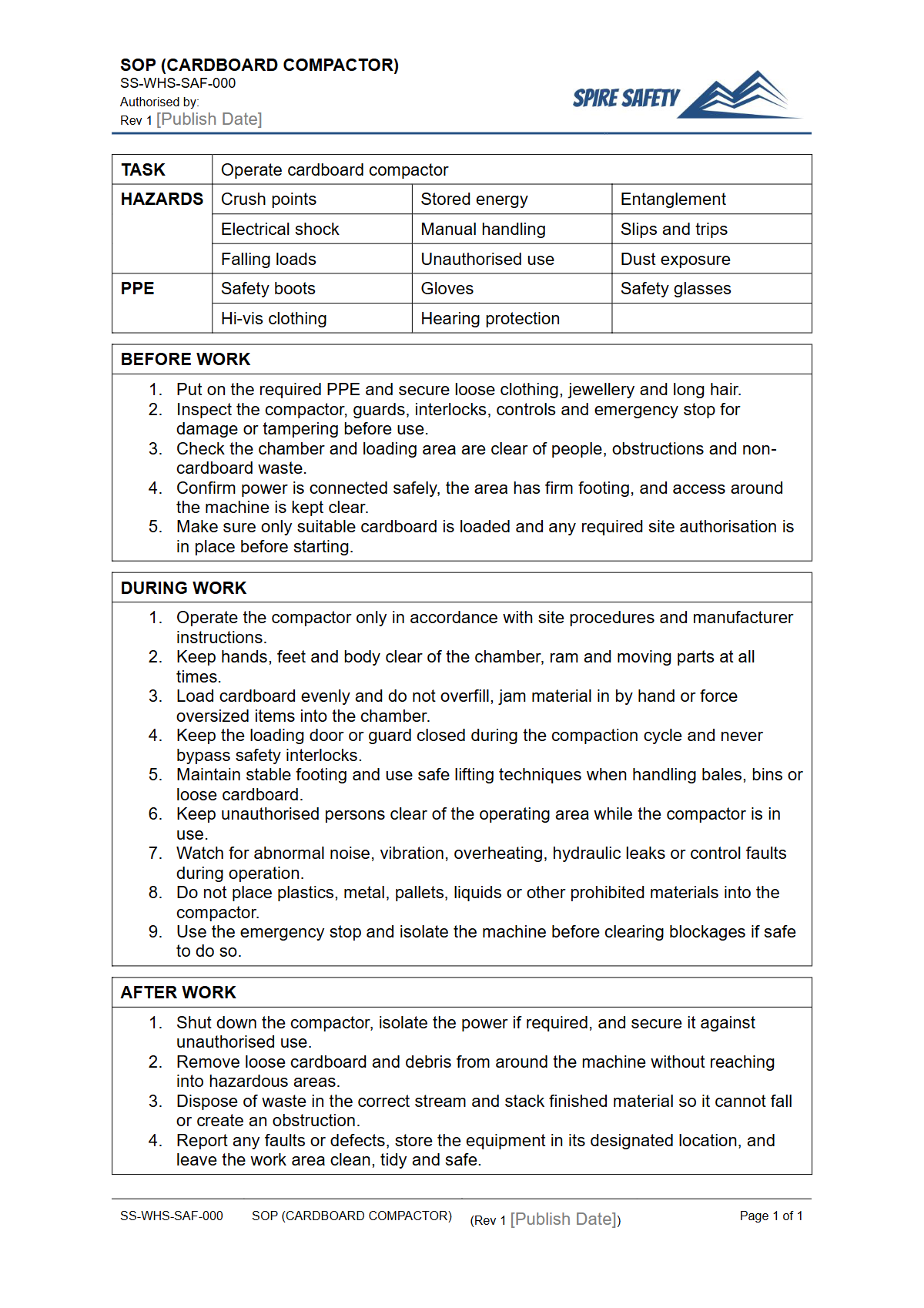
Operating a cardboard compactor, while a routine task in many retail, warehouse, and manufacturing settings, presents significant risks if not managed correctly. This free Safe Operating Procedure (Cardboard Compactor) Template provides a structured starting point for documenting a safe system of work, helping your organisation meet its duty of care under Australian WHS legislation.
An effective SOP is a critical administrative control that formalises the safest way to perform a task, detailing hazards and the control measures required to mitigate them.
The primary purpose of an SOP is to minimise the risk of injury from hazards such as crushing, entanglement, manual handling strains, and electrical shock. By clearly outlining pre-operational checks, step-by-step operating instructions, and emergency procedures, you provide workers with clear, unambiguous guidance.
This not only promotes safe work practices but also serves as a crucial training tool and a benchmark for supervision and performance assessment. It forms a key part of your overall safety management, similar to procedures for other common equipment like our Free Step Ladder SOP Template.
Video walkthrough
How to use the Free Safe Operating Procedure (Cardboard Compactor) Template
Our free Safe Operating Procedure (Cardboard Compactor) Template is provided in both DOCX and PDF formats for your convenience. The DOCX file is fully editable, allowing you to adapt it to your specific operational needs.
To use the template effectively, you should review each section and modify it to reflect the make and model of your compactor, the specific types of waste materials being processed, and the unique environment of your workplace.
Please note: this document is a template and is not a complete safety solution on its own. For it to be effective and support your compliance efforts, we strongly advise you to customise it in consultation with the workers who operate the equipment.
This ensures the procedure is practical, accurate, and reflects how the work is actually done. Integrating these customised SOPs into your broader WHS management systems ensures a consistent and comprehensive approach to workplace safety.
When to use this Safe Operating Procedure
A Safe Operating Procedure for a cardboard compactor should be used as a primary reference document at several key points. It is essential during the induction and training of new employees who will be required to operate the machine.
It ensures they learn the correct, safe method from the very beginning. The SOP should also be used for regular refresher training to prevent complacency and reinforce safe behaviour.
Furthermore, the document should be readily accessible near the equipment for quick reference by any operator. Following an incident, a near-miss, or a change in the equipment or process, the SOP must be reviewed and updated to incorporate any learnings or new control measures. For example, if a new waste stream is introduced, the procedure may need to be updated, much like the process for documenting the safe use of vehicles outlined in a Body Truck SOP.
Who should use it
Multiple roles within an organisation have a responsibility regarding the SOP. A Person Conducting a Business or Undertaking (PCBU) is ultimately responsible for ensuring a safe system of work is provided and maintained.
Managers and Supervisors are responsible for implementing the SOP on the ground, ensuring workers are trained on its contents, and monitoring that the procedures are being followed correctly. They may also lead toolbox talks using the SOP as a guide.
Workers who operate the compactor are the primary end-users of the SOP. They must understand and follow the procedure every time they use the machine.
Health and Safety Representatives (HSRs) should also be familiar with the SOP as part of their role in representing workers on health and safety matters and can play a valuable part in its development and review. Regular reviews of SOP adherence can be a key component of internal safety checks or more formal WHS compliance auditing.
Key Elements of a Cardboard Compactor SOP
A comprehensive SOP for a cardboard compactor should contain several critical sections. This template provides a framework that includes fields for Personal Protective Equipment (PPE) requirements, such as gloves and safety glasses.
It details essential pre-operational checks, like verifying that safety guards, interlocks, and emergency stop buttons are functional before use. The structure is similar to what you might find in an Air Compressor SOP, focusing on proactive checks.
The core of the document is the step-by-step procedure for operation, covering how to safely load materials, initiate the compaction cycle, and what to do when the bale is full. Critically, it must also include procedures for clearing jams and performing maintenance, emphasising lockout/tagout (LOTO) protocols to ensure the machine is de-energised and cannot start unexpectedly.
Finally, it should detail emergency procedures, including who to contact and the location of first aid and fire-fighting equipment. If you need more templates for other plant and equipment, you can explore our entire free WHS resources library.
Common mistakes
Common mistakes to avoid
- Overfilling the compactor chamber, leading to jams and creating unsafe clearing conditions.
- Bypassing safety interlocks on the loading door to speed up the process, exposing workers to the moving ram.
- Failing to correctly isolate and lock out the machine before attempting to clear a blockage or perform maintenance.
- Neglecting to train workers on emergency stop procedures and what to do if clothing or a body part gets caught.
Legal references
Legal considerations
The following legal requirements may be relevant to this type of work.
- Work Health and Safety Act (Harmonised) — Provides the primary duties for protecting workers and other people from work health and safety risks.
- Work Health and Safety Regulations (Harmonised) — Sets out requirements supporting the management of workplace hazards and risks.
The following codes may be relevant to this type of work.
- Managing WHS Risks Code of Practice — Provides practical guidance on identifying hazards, assessing risks and applying effective controls.
- Work Health and Safety Consultation, Cooperation and Coordination Code of Practice — Provides practical guidance on consulting workers and coordinating with other duty holders.
- Managing the Work Environment and Facilities Code of Practice — Provides practical guidance on safe work environments, workplace facilities and related controls.
Did you know
Guarding is Key
A significant number of compactor-related incidents occur because safety guards or door interlocks have been deliberately bypassed or are faulty. Regular inspection of these critical safety features is non-negotiable.
Not Just for Cardboard
While named for cardboard, these machines are often used for other recyclables like plastic wrap. Your SOP should specify exactly which materials are permitted to prevent jams, damage, or unexpected hazards.
FAQ
Frequently asked questions
01Is a Safe Operating Procedure a legal requirement for a cardboard compactor in Australia?
02How often should a cardboard compactor SOP be reviewed?
03Who should be involved in developing the SOP for a cardboard compactor?
04What are the main hazards of a cardboard compactor?
Share this resource
Free Safe Operating Procedure (Cardboard Compactor) Template
Browse Categories
How To Use It
- 1Download and open in Word or PDF.
- 2Replace the placeholders with your business details.
- 3Get it reviewed by a WHS specialist before rollout.
Need it customised?
Our WHS consultants can adapt this template to your site, run a gap analysis, or audit what you already have in place.
Book a Free Consultation WHS consulting servicesor call 1300 156 382
Related templates
- Free Safe Operating Procedure (Carding Machine) Template
- Free Safe Operating Procedure (Care Cart Cleaning) Template
- Free Safe Operating Procedure (Cargo Handling) Template
- Free Safe Operating Procedure (Cargo Hold Cleaning) Template
- Free Safe Operating Procedure (Cargo Loader) Template
- Free Safe Operating Procedure (Cargo Net Inspection) Template