
Free Safe Operating Procedure (Care Cart Cleaning) Template
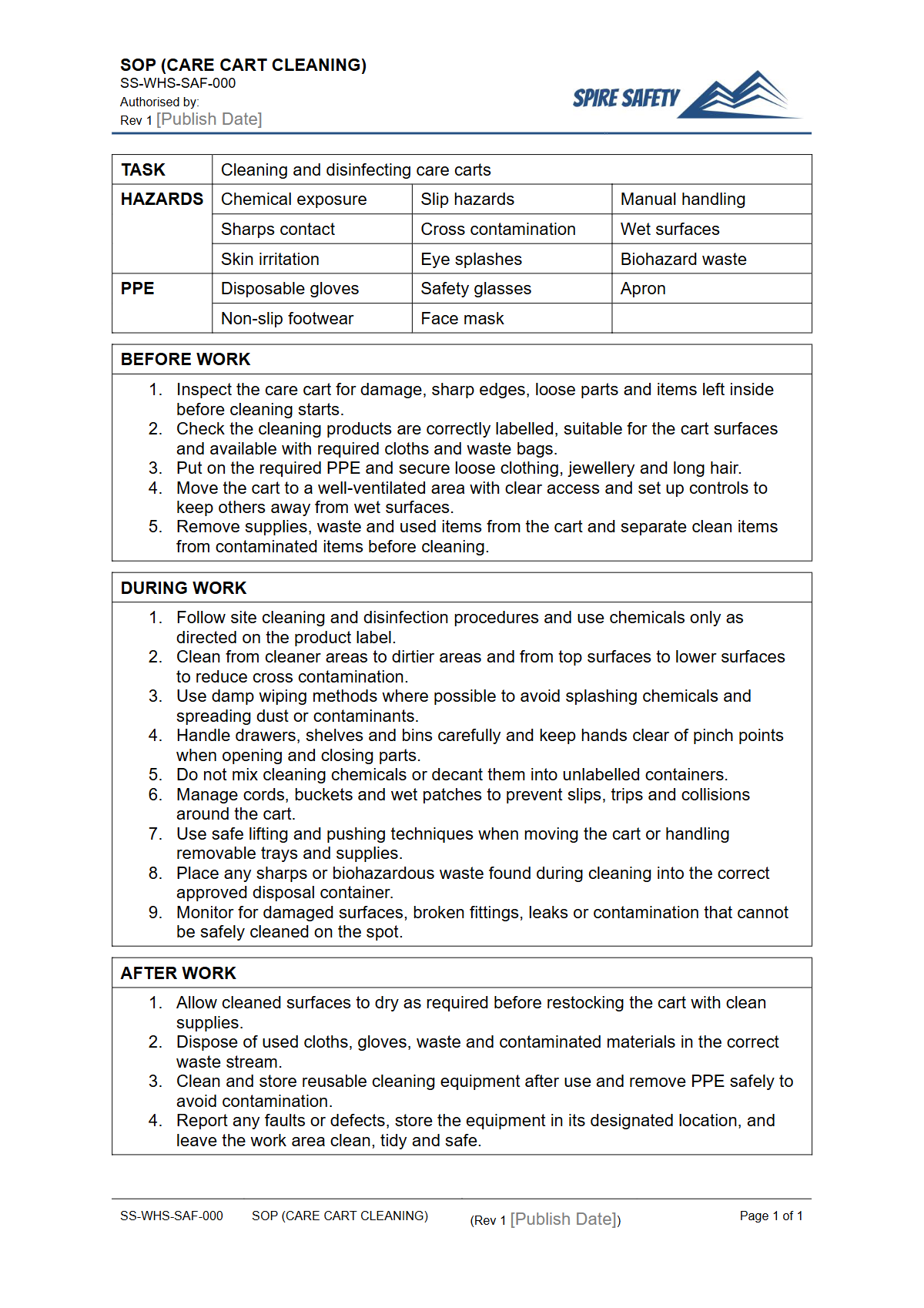
Download our free Safe Operating Procedure (Care Cart Cleaning) template. A structured starting point for defining safe work systems in healthcare settings.
Free Safe Operating Procedure (Care Cart Cleaning) Template
DOCX • 126 KB + PDF
Updated Oct 2026
No signup required
Purpose of the Free Safe Operating Procedure (Care Cart Cleaning) Template
Cleaning and disinfecting care carts, treatment trolleys, and other mobile equipment is a critical task in healthcare, aged care, and clinical environments. While routine, this process involves significant hazards if not managed correctly.
This free Safe Operating Procedure (Care Cart Cleaning) template provides a structured framework for documenting the required steps to perform this task safely. It helps organisations meet their duty of care by controlling risks such as manual handling injuries, exposure to hazardous chemicals, and contact with biological hazards.
Implementing a formal SOP ensures that all workers follow a consistent, pre-approved method, minimising guesswork and standardising safety protocols. This document serves as a foundational component of a robust safety framework, demonstrating a commitment to proactive risk management.
Integrating such procedures into a broader safety program is a key part of developing effective WHS management systems that protect workers and ensure operational consistency.
Video walkthrough
How to use the Free Safe Operating Procedure (Care Cart Cleaning) Template
This document is provided in an editable DOCX format, designed to be a starting point, not a final solution. To make it effective for your workplace, you must customise it with site-specific information.
This includes detailing the exact types of carts used, the specific cleaning and disinfectant products approved for use (including their Safety Data Sheets), and the location of handwashing facilities and spill kits.
Important: We have provided a comprehensive starting point, but every workplace is unique. You must adapt this SOP to your specific equipment, chemicals, environment, and tasks.
A critical step in this process is consultation with the workers who actually perform the job. Their direct experience is invaluable for identifying practical risks and effective controls.
Once customised, the SOP should be used as a tool for training, competency assessment, and on-the-job reference.
When to use this Safe Operating Procedure
A Safe Operating Procedure for care cart cleaning should be used as a primary reference document in several key situations. It is essential during the induction and training of new cleaning staff, support service officers, or clinical personnel responsible for the task.
It ensures they learn the correct, safe method from the very beginning. The SOP should also be used for regular refresher training to reinforce safe work habits and introduce any updates to the procedure.
Supervisors can use it as an observation checklist to verify that work is being performed to standard. It is also a critical document to review after any incident, near-miss, or when a change is introduced, such as a new type of cleaning chemical or cart design.
Documenting procedures for all workplace tasks, from using a step ladder safely to cleaning equipment, is a cornerstone of good WHS practice.
Who should use it
This SOP is intended for use by a range of personnel within a healthcare or similar facility. The primary users are the workers who perform the cleaning task, including cleaners, environmental services staff, and patient care assistants.
It provides them with clear, step-by-step instructions to follow.
Supervisors and team leaders should use the SOP to train their staff and monitor compliance with safe work standards. WHS managers and coordinators will find it useful for developing risk assessments and integrating the procedure into the organisation's overall safety management system.
Conducting regular reviews of these procedures is a key activity in any WHS compliance auditing program, ensuring that documented processes reflect actual practice and remain effective.
For organisations needing expert assistance in developing or refining their procedural documents, Spire Safety offers specialist WHS consulting services to help tailor solutions to your unique operational risks. You can also explore our complete free WHS resources library for more templates and guides.
Common mistakes
Common mistakes to avoid
- Using the template without customising it for site-specific carts, chemicals, and procedures.
- Failing to train workers on the finalised SOP and confirm their understanding.
- Not making the corresponding Safety Data Sheets (SDS) for all chemicals readily available.
- Forgetting to review and update the SOP after an incident or a change in process.
Legal references
Legal considerations
The following legal requirements may be relevant to this type of work.
- Work Health and Safety Act (Harmonised) — Provides the primary duties for protecting workers and other people from work health and safety risks.
- Work Health and Safety Regulations (Harmonised) — Sets out requirements supporting the management of workplace hazards and risks.
The following codes may be relevant to this type of work.
- Managing WHS Risks Code of Practice — Provides practical guidance on identifying hazards, assessing risks and applying effective controls.
- Work Health and Safety Consultation, Cooperation and Coordination Code of Practice — Provides practical guidance on consulting workers and coordinating with other duty holders.
- Managing the Work Environment and Facilities Code of Practice — Provides practical guidance on safe work environments, workplace facilities and related controls.
Did you know
The Importance of Contact Time
For disinfectants to be effective against pathogens, they must remain wet on a surface for a specific duration known as 'contact time'. This is often overlooked but is critical for proper infection control.
Manual Handling Risks
According to Safe Work Australia, manual handling injuries are a leading cause of serious workers' compensation claims. A well-designed SOP helps control these risks by specifying correct posture and handling techniques.
FAQ
Frequently asked questions
01What hazards are involved in cleaning care carts?
02Is a Safe Operating Procedure a legal requirement in Australia?
03How often should an SOP for care cart cleaning be reviewed?
04Can I use this template for other cleaning tasks?
Share this resource
Free Safe Operating Procedure (Care Cart Cleaning) Template
Browse Categories
How To Use It
- 1Download and open in Word or PDF.
- 2Replace the placeholders with your business details.
- 3Get it reviewed by a WHS specialist before rollout.
Need it customised?
Our WHS consultants can adapt this template to your site, run a gap analysis, or audit what you already have in place.
Book a Free Consultation WHS consulting servicesor call 1300 156 382
Related templates
- Free Safe Operating Procedure (Cargo Handling) Template
- Free Safe Operating Procedure (Cargo Hold Cleaning) Template
- Free Safe Operating Procedure (Cargo Loader) Template
- Free Safe Operating Procedure (Cargo Net Inspection) Template
- Free Safe Operating Procedure (Cargo Restraint Check) Template
- Free Safe Operating Procedure (Carpet Cleaner) Template