
Free Safe Operating Procedure (Carding Machine) Template
Download our free Safe Operating Procedure (Carding Machine) template. This user-friendly DOCX and PDF resource helps you outline safe work practices.
Free Safe Operating Procedure (Carding Machine) Template
DOCX • 126 KB + PDF
Updated Oct 2026
No signup required
Purpose of the Free Safe Operating Procedure (Carding Machine) Template
Operating a carding machine involves significant risks, including entanglement in rotating parts, nip points, and exposure to hazardous dust. This Free Safe Operating Procedure (Carding Machine) Template provides a structured framework for documenting the safest way to perform this task.
By clearly outlining steps for pre-operational checks, operation, and shutdown, it helps your organisation manage risks and demonstrate a commitment to worker safety. Implementing robust SOPs is a critical component of a compliant and effective WHS management system.
This document is designed to be adapted to your specific machinery and workplace. It prompts you to identify specific hazards and detail the control measures required to eliminate or minimise them, aligning with Australian WHS principles and the hierarchy of controls.
Using this template helps ensure that safety considerations are integrated into your daily operations, rather than being an afterthought.
Video walkthrough
How to use the Free Safe Operating Procedure (Carding Machine) Template
This template is available for download as a DOCX file, making it easy to edit and customise to your exact requirements. A PDF version is also provided for straightforward distribution and printing once your customisations are complete.
To use this resource effectively, you must conduct a thorough risk assessment of your specific carding machine and its operating environment. Your findings should be used to populate and refine the sections within the template.
Important: We have created this template as a foundational guide. You must customise it with your specific machine models, workplace hazards, control measures, and emergency procedures to ensure it is suitable and sufficient for your operations.
Just as with our FREE Plasma Cutter SOP Template, the value comes from adapting the structure to your real-world context.
What this Safe Operating Procedure covers
Our template provides a comprehensive starting point, covering key areas essential for the safe use of a carding machine:
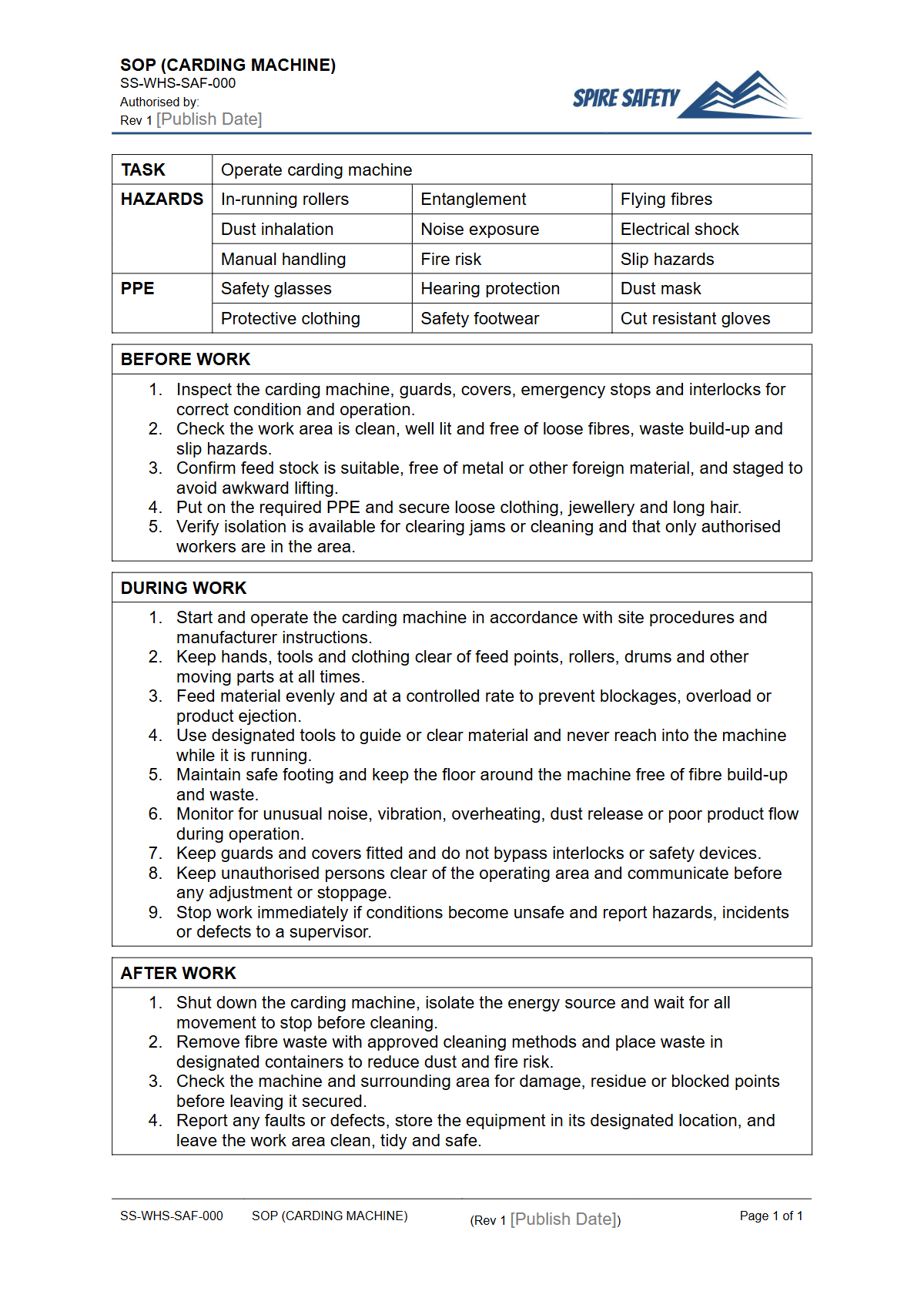
- Required Personal Protective Equipment (PPE): Specifies necessary PPE such as safety glasses, hearing protection, and respiratory protection to guard against dust and noise.
- Pre-operational Safety Checks: Includes a checklist for inspecting machine guards, emergency stops, drive belts, and the general work area before operation begins. This formalises a crucial safety habit.
- Step-by-Step Operating Sequence: Outlines the correct procedure for starting, operating, and monitoring the machine. This section should be detailed with your specific machine's functions and controls.
- Shutdown Procedure: Details the safe sequence for stopping the machine, including isolation and lock-out tag-out (LOTO) steps for maintenance or cleaning.
- Emergency Procedures: Clearly defines actions to be taken in case of an emergency, such as entanglement or fire.
When to use a Safe Operating Procedure
An SOP for a carding machine should be a central document in your operational and safety training. It is essential during the induction of new employees to ensure they understand the risks and correct procedures from day one.
It should also be used for refresher training for existing staff to reinforce safe work habits and introduce any updates to the procedure. Furthermore, the SOP must be reviewed and potentially updated after any incident or near miss involving the machine.
Regular reviews, as part of your WHS compliance auditing schedule, ensure the document remains current and effective.
Who should use this Safe Operating Procedure
This template is intended for use by Persons Conducting a Business or Undertaking (PCBUs), managers, and supervisors responsible for the health and safety of workers. It is a tool for them to develop and implement a formal safe system of work.
Machine operators are the primary end-users of the finalised SOP; they must be trained on its contents and follow the specified procedures every time they use the equipment. Safety officers and WHS committees will also find the template useful for standardising safety documentation across the workplace.
If you require expert assistance in developing and implementing site-specific procedures, consider engaging professional WHS consulting services.
By standardising procedures for all high-risk plant, you create a more predictable and safer working environment. This approach is just as vital for a carding machine as it is for equipment covered in resources like our Free Air Compressor SOP Template. Explore our entire free WHS resources library for more templates to support your safety management efforts.
Common mistakes
Common mistakes to avoid
- Using a generic template without adding site-specific machine details and hazards.
- Failing to consult with and train all operators on the finalised procedure.
- Neglecting to include detailed steps for emergency stops, lock-out tag-out, and cleaning.
- Not reviewing and updating the SOP after a near miss, incident, or change in process.
Legal references
Legal considerations
The following legal requirements may be relevant to this type of work.
- Work Health and Safety Act (Harmonised) — Provides the primary duties for protecting workers and other people from work health and safety risks.
- Work Health and Safety Regulations (Harmonised) — Sets out requirements supporting the management of workplace hazards and risks.
The following codes may be relevant to this type of work.
- Managing WHS Risks Code of Practice — Provides practical guidance on identifying hazards, assessing risks and applying effective controls.
- Work Health and Safety Consultation, Cooperation and Coordination Code of Practice — Provides practical guidance on consulting workers and coordinating with other duty holders.
- Managing the Work Environment and Facilities Code of Practice — Provides practical guidance on safe work environments, workplace facilities and related controls.
Did you know
A Pillar of Industry
Carding machines were central to the mechanisation of the textile industry during the Industrial Revolution, dramatically increasing the speed and scale of yarn production.
Entanglement Dangers
According to Safe Work Australia, machinery-related incidents are a leading cause of workplace injury, with entanglement in moving parts being a common and severe mechanism of harm.
FAQ
Frequently asked questions
01What is a carding machine used for?
02What are the main hazards of operating a carding machine?
03Is a Safe Operating Procedure a legal requirement in Australia?
04How often should we review our Carding Machine SOP?
Share this resource
Free Safe Operating Procedure (Carding Machine) Template
Browse Categories
How To Use It
- 1Download and open in Word or PDF.
- 2Replace the placeholders with your business details.
- 3Get it reviewed by a WHS specialist before rollout.
Need it customised?
Our WHS consultants can adapt this template to your site, run a gap analysis, or audit what you already have in place.
Book a Free Consultation WHS consulting servicesor call 1300 156 382
Related templates
- Free Safe Operating Procedure (Care Cart Cleaning) Template
- Free Safe Operating Procedure (Cargo Handling) Template
- Free Safe Operating Procedure (Cargo Hold Cleaning) Template
- Free Safe Operating Procedure (Cargo Loader) Template
- Free Safe Operating Procedure (Cargo Net Inspection) Template
- Free Safe Operating Procedure (Cargo Restraint Check) Template