
Free Safe Operating Procedure (Carcass Handling) Template
Download our free Safe Operating Procedure (Carcass Handling) template.
Free Safe Operating Procedure (Carcass Handling) Template
DOCX • 126 KB + PDF
Updated Oct 2026
No signup required
Purpose of the Free Safe Operating Procedure (Carcass Handling) Template
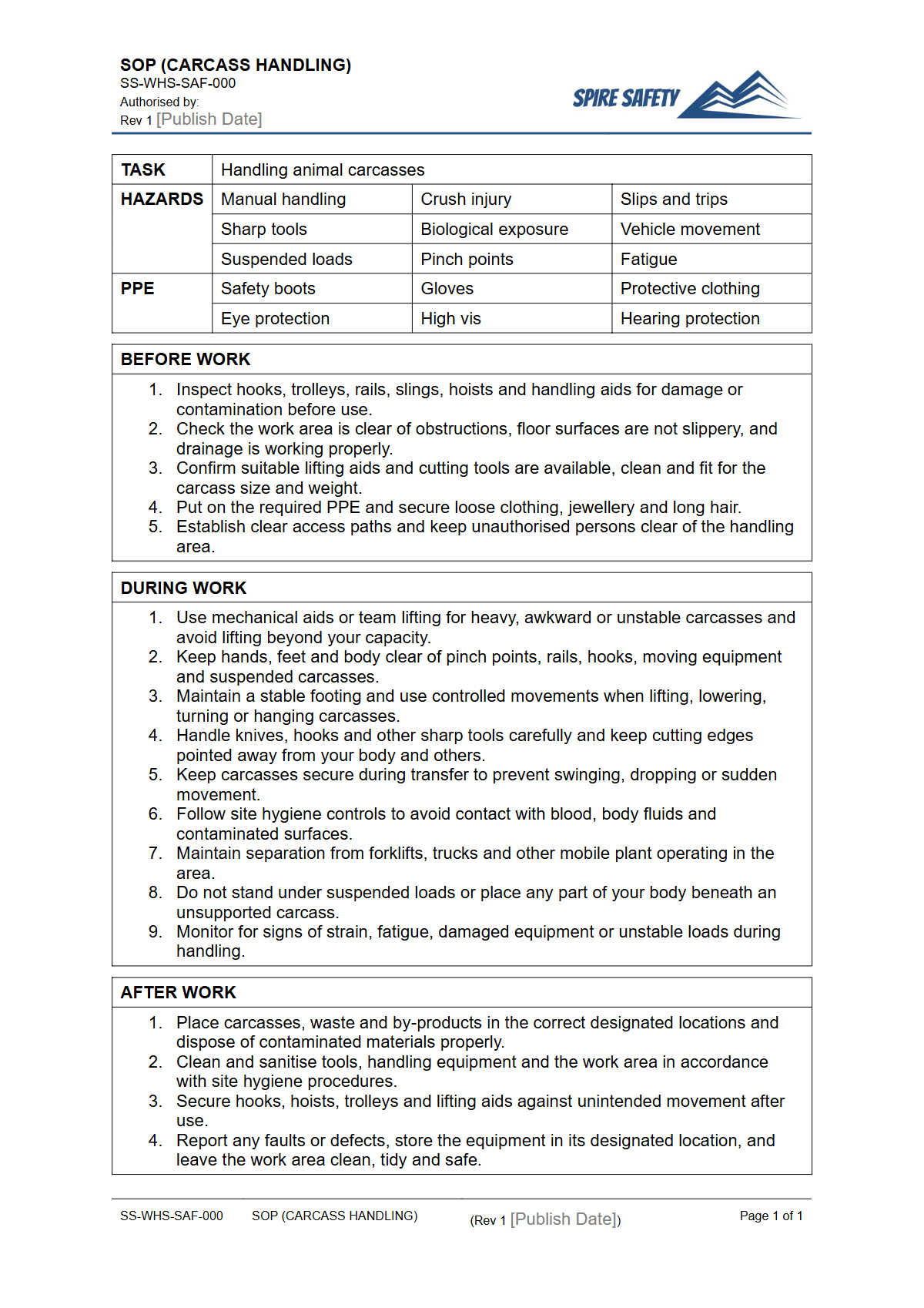
Handling animal carcasses presents a unique set of workplace hazards, from severe musculoskeletal injuries to exposure to biological agents. This free Safe Operating Procedure (Carcass Handling) template provides a structured framework for documenting a safe system of work for these tasks.
It helps Persons Conducting a Business or Undertaking (PCBUs) meet their primary duty of care by outlining controls for common risks, including manual handling, biosecurity threats, slips and trips, and hazards associated with machinery. Using this template helps standardise procedures, facilitate worker training, and demonstrate a commitment to workplace health and safety.
Video walkthrough
How to use the Free Safe Operating Procedure (Carcass Handling) Template
This template is available as an editable DOCX file for easy customisation and a print-ready PDF. To use it, simply download the file and adapt it to the specific context of your operations.
Fill in the details of your workplace, the specific equipment used (such as slings, hoists, or vehicles), required Personal Protective Equipment (PPE), and the step-by-step process your workers must follow. Integrating this SOP into your broader WHS management systems ensures it is part of a holistic approach to safety.
Important: This is a template only. To be effective and support your safety obligations, you must customise it to reflect the specific equipment, processes, and risks in your workplace.
We are not responsible for any incidents arising from the use of this un-customised document.
Key elements of a Carcass Handling Safe Operating Procedure
A comprehensive SOP for this task should clearly address several key areas to be effective. These include:
- Hazard Identification: Document all potential hazards, such as excessive weight (manual handling), zoonotic diseases (biological), sharp bone fragments (cuts), slippery floors (slips), and entanglement risks if using machinery like a FREE Telehandler SOP (Safe Operating Procedure) Template.
- Risk Control Measures: For each hazard, specify the control measures to be implemented. This follows the hierarchy of controls, prioritising elimination or substitution where possible (e.g., using mechanical aids instead of manual lifting).
- Personal Protective Equipment (PPE): List all mandatory PPE, such as heavy-duty gloves, fluid-resistant aprons or coveralls, steel-capped boots, and potentially face shields or respiratory protection, based on your risk assessment.
- Step-by-Step Instructions: Provide clear, sequential instructions for performing the task safely, from pre-start checks of equipment to the final clean-up and disposal procedures. This section might also reference procedures for other equipment, like our FREE Body Truck SOP (Safe Operating Procedure) Template if transport is involved.
- Emergency Procedures: Outline the steps to take in case of an incident, such as first aid for injuries, spill containment, or emergency stop procedures for machinery.
When to use it
A Safe Operating Procedure for carcass handling should be developed and implemented before any worker undertakes the task. It is a critical tool for worker induction and ongoing training, ensuring everyone understands the established safe method.
The SOP should be readily available at the point of work for reference. Furthermore, it should be a key document in any safety review, especially after a near miss or incident, or when new equipment or processes are introduced. Regular reviews are a core component of effective WHS compliance auditing.
Who should use it
This document is designed for any workplace where employees or contractors handle deceased animals. This includes a wide range of industries:
- Agriculture and Farming: For managing on-farm livestock mortalities. For related agricultural machinery, you might also need our FREE Grain Drill SOP (Safe Operating Procedure) Template.
- Abattoirs and Meat Processing: As part of the initial stages of processing.
- Veterinary Clinics: For handling deceased pets and larger animals.
- Wildlife Services and Councils: For the removal of roadkill or deceased wildlife.
- Transportation and Logistics: For companies involved in moving animal carcasses.
Supervisors and WHS managers are responsible for developing, implementing, and reviewing the SOP, while workers must be trained in and adhere to its procedures. If you require expert assistance in developing complex, site-specific procedures, consider our WHS consulting services. For more document templates, browse our complete free WHS resources library.
Common mistakes
Common mistakes to avoid
- Using a generic template without customising it for site-specific equipment and hazards.
- Failing to adequately train workers on the procedures detailed in the SOP.
- Neglecting to specify the correct type and standard of Personal Protective Equipment (PPE).
- Not reviewing and updating the SOP after an incident or when a process changes.
Legal references
Legal considerations
The following legal requirements may be relevant to this type of work.
- Work Health and Safety Act (Harmonised) — Provides the primary duties for protecting workers and other people from work health and safety risks.
- Work Health and Safety Regulations (Harmonised) — Sets out requirements supporting the management of workplace hazards and risks.
The following codes may be relevant to this type of work.
- Managing WHS Risks Code of Practice — Provides practical guidance on identifying hazards, assessing risks and applying effective controls.
- Work Health and Safety Consultation, Cooperation and Coordination Code of Practice — Provides practical guidance on consulting workers and coordinating with other duty holders.
- Managing the Work Environment and Facilities Code of Practice — Provides practical guidance on safe work environments, workplace facilities and related controls.
Did you know
Manual Handling Risk
In the Australian agriculture industry, hazardous manual tasks are a leading cause of serious workers' compensation claims, making mechanical aids for tasks like carcass handling a crucial risk control.
Zoonotic Diseases
Over 60% of known infectious diseases in people are spread from animals. This highlights why biosecurity protocols and correct PPE use are non-negotiable when handling carcasses.
FAQ
Frequently asked questions
01What are the main hazards of handling animal carcasses?
02What PPE is required for handling animal carcasses?
03Is a Safe Operating Procedure a legal requirement in Australia?
04How often should a carcass handling SOP be reviewed?
Share this resource
Free Safe Operating Procedure (Carcass Handling) Template
Browse Categories
How To Use It
- 1Download and open in Word or PDF.
- 2Replace the placeholders with your business details.
- 3Get it reviewed by a WHS specialist before rollout.
Need it customised?
Our WHS consultants can adapt this template to your site, run a gap analysis, or audit what you already have in place.
Book a Free Consultation WHS consulting servicesor call 1300 156 382
Related templates
- Free Safe Operating Procedure (Cardboard Compactor) Template
- Free Safe Operating Procedure (Carding Machine) Template
- Free Safe Operating Procedure (Care Cart Cleaning) Template
- Free Safe Operating Procedure (Cargo Handling) Template
- Free Safe Operating Procedure (Cargo Hold Cleaning) Template
- Free Safe Operating Procedure (Cargo Loader) Template