
Free Safe Operating Procedure (Car Wash Detailing) Template
Download our free Safe Operating Procedure (Car Wash Detailing) template.
Free Safe Operating Procedure (Car Wash Detailing) Template
DOCX • 126 KB + PDF
Updated Oct 2026
No signup required
Purpose of the Free Safe Operating Procedure (Car Wash Detailing) Template
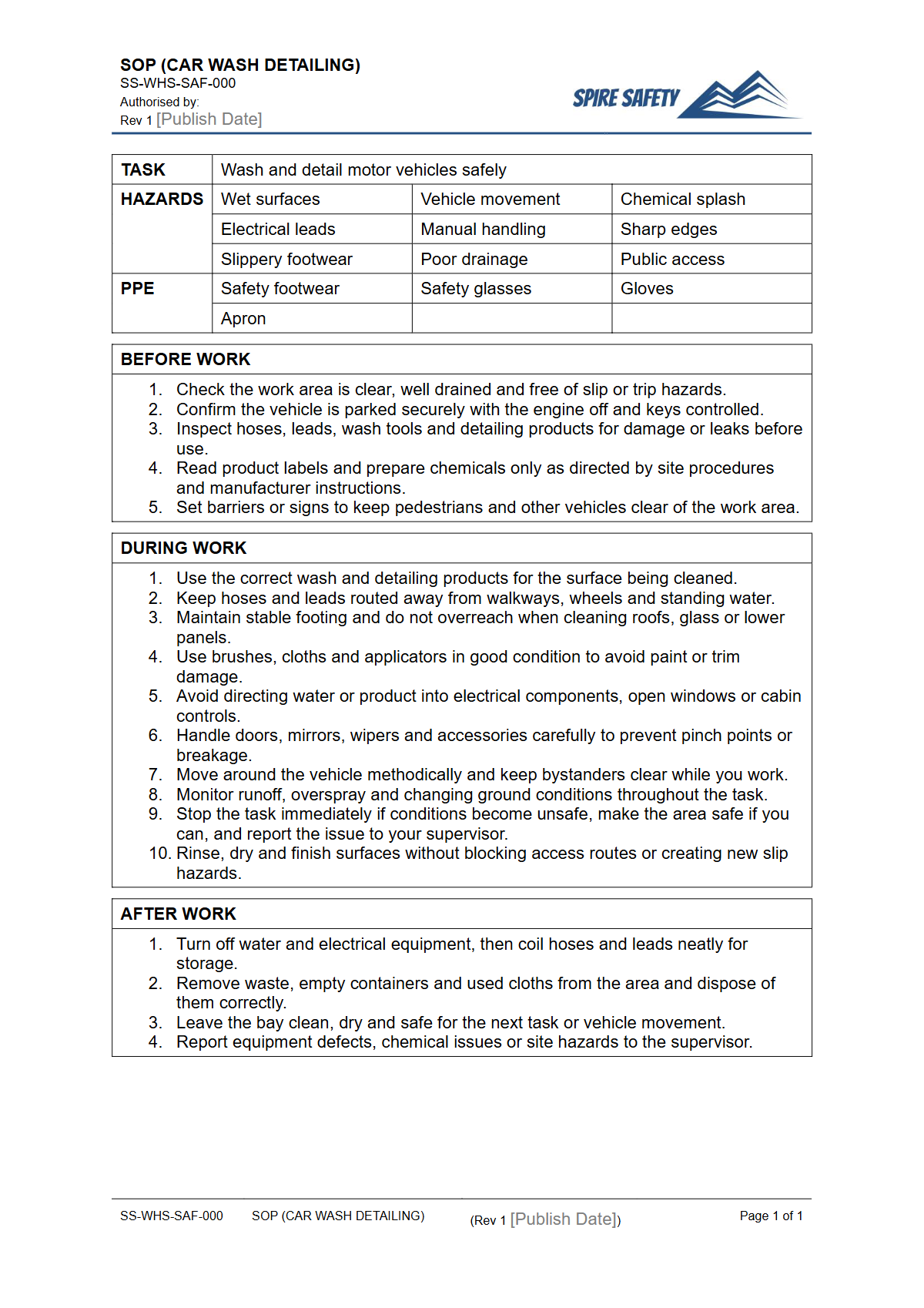
This free Safe Operating Procedure (Car Wash Detailing) template provides a structured starting point for documenting the safety requirements for cleaning and detailing vehicles. A Safe Operating Procedure (SOP), also known as a Safe Work Procedure (SWP), outlines a logical sequence of steps to perform a task safely.
Its primary purpose is to minimise the risk of injury or illness to workers by controlling identified hazards.
In a car wash or detailing environment, workers face numerous hazards, including exposure to hazardous chemicals, slips and trips on wet surfaces, manual handling injuries from moving equipment, and electrical risks associated with pressure washers and vacuums. This SOP template helps you formalise controls for these risks, ensuring tasks are performed consistently and safely every time.
Formalising procedures is a key part of building robust WHS management systems that protect both workers and the business.
Video walkthrough
How to use the Free Safe Operating Procedure (Car Wash Detailing) Template
To effectively implement this Safe Operating Procedure for car wash detailing, you must adapt it to your specific operational context. The document is provided as a starting point in both DOCX and PDF formats, allowing for easy customisation.
IMPORTANT: This is a template only. We have no way of knowing the specific equipment, chemicals, processes, or environment of your workplace.
It is your responsibility as the PCBU (Person Conducting a Business or Undertaking) to ensure this document is customised to reflect the specific hazards and control measures relevant to your site. You must consult with your workers and conduct a site-specific risk assessment before use.
Follow these steps to implement the SOP:
- Download the template and consult with the workers who perform car detailing tasks. Their input is crucial for creating a practical and effective procedure.
- Conduct a thorough risk assessment for your specific car wash bay or detailing area. Identify all equipment used, such as pressure washers, vacuums, and polishers. If your workshop uses compressed air for drying or tool operation, you may also need a free Air Compressor SOP.
- Customise the template with specific details, including the makes and models of your equipment, the names of chemicals used (referencing their Safety Data Sheets), required Personal Protective Equipment (PPE), and emergency procedures.
- Ensure the completed SOP is reviewed and approved by a competent person, such as a workshop manager or WHS advisor.
- Train all relevant employees on the final SOP and keep documented records of this training. The SOP should be readily accessible to workers at all times.
When to use it
A Safe Operating Procedure for car wash detailing should be an integral part of daily operations. It is not a document to be filed away and forgotten.
It should be actively used as a reference before, during, and after detailing tasks are performed. Key times to use the SOP include when inducting and training new employees, providing refresher training for existing staff, or planning for a non-routine detailing job that may present new hazards. It also serves as a critical reference document during routine safety inspections and formal WHS compliance auditing.
Who should use it
This SOP is designed for use by any person or organisation involved in the commercial cleaning and detailing of vehicles. This includes a range of personnel with different responsibilities.
Business owners and managers (PCBUs) should use it to fulfil their primary duty of care. Supervisors and team leaders should use it to instruct workers and monitor safe work practices.
WHS managers and representatives can integrate it into the broader safety management system. Most importantly, the workers who actually perform the car detailing must use it as a guide to ensure they carry out their work without risk to their health and safety. The procedures are particularly important when tasks involve additional risks, such as using ladders to access the roofs of larger vehicles, which would be covered by a free Step Ladder SOP.
Developing a suite of task-specific procedures ensures every aspect of your operation is covered. Just as you would detail procedures for specialised fabrication tools in a plasma cutter SOP, you must be equally specific about your detailing equipment and chemicals to ensure worker safety.
If you need assistance developing customised procedures for your business, consider engaging professional WHS consulting services. You can also explore our entire free WHS resources library for more templates and guides.
Common mistakes
Common mistakes to avoid
- Using a generic template without customising it for specific chemicals, equipment, and workshop layout.
- Failing to provide adequate PPE or not training staff on how to use and maintain it correctly.
- Neglecting to train workers on the completed SOP and keep records of the training.
- Not reviewing or updating the SOP after an incident or when new equipment or processes are introduced.
Legal references
Legal considerations
The following legal requirements may be relevant to this type of work.
- Work Health and Safety Act (Harmonised) — Provides the primary duties for protecting workers and other people from work health and safety risks.
- Work Health and Safety Regulations (Harmonised) — Sets out requirements supporting the management of workplace hazards and risks.
The following codes may be relevant to this type of work.
- Managing WHS Risks Code of Practice — Provides practical guidance on identifying hazards, assessing risks and applying effective controls.
- Work Health and Safety Consultation, Cooperation and Coordination Code of Practice — Provides practical guidance on consulting workers and coordinating with other duty holders.
- Managing the Work Environment and Facilities Code of Practice — Provides practical guidance on safe work environments, workplace facilities and related controls.
Did you know
Common Injuries
Slips, trips, and falls on wet surfaces are one of the most common causes of injury in the vehicle washing and detailing industry, according to workplace safety data.
Water Usage
Professional car washes can be more water-efficient than home washing. Some high-efficiency systems use as little as 60 litres per vehicle, compared to over 400 litres for a typical home wash with a running hose.
FAQ
Frequently asked questions
01What is a Safe Operating Procedure (SOP) for car detailing?
02Are SOPs legally required for car wash businesses in Australia?
03How often should a car wash SOP be reviewed?
04What PPE is typically required for car detailing?
Share this resource
Free Safe Operating Procedure (Car Wash Detailing) Template
Browse Categories
How To Use It
- 1Download and open in Word or PDF.
- 2Replace the placeholders with your business details.
- 3Get it reviewed by a WHS specialist before rollout.
Need it customised?
Our WHS consultants can adapt this template to your site, run a gap analysis, or audit what you already have in place.
Book a Free Consultation WHS consulting servicesor call 1300 156 382
Related templates
- Free Safe Operating Procedure (Car Wash Vacuuming) Template
- Free Safe Operating Procedure (Carcass Handling) Template
- Free Safe Operating Procedure (Cardboard Compactor) Template
- Free Safe Operating Procedure (Carding Machine) Template
- Free Safe Operating Procedure (Care Cart Cleaning) Template
- Free Safe Operating Procedure (Cargo Handling) Template