
Free Safe Operating Procedure (Car Park Sweeping) Template
Need to document the safety steps for car park sweeping? Our free template provides a structured format. Download your free Safe Operating Procedure now.
Free Safe Operating Procedure (Car Park Sweeping) Template
DOCX • 126 KB + PDF
Updated Oct 2026
No signup required
Purpose of the Free Safe Operating Procedure (Car Park Sweeping) Template
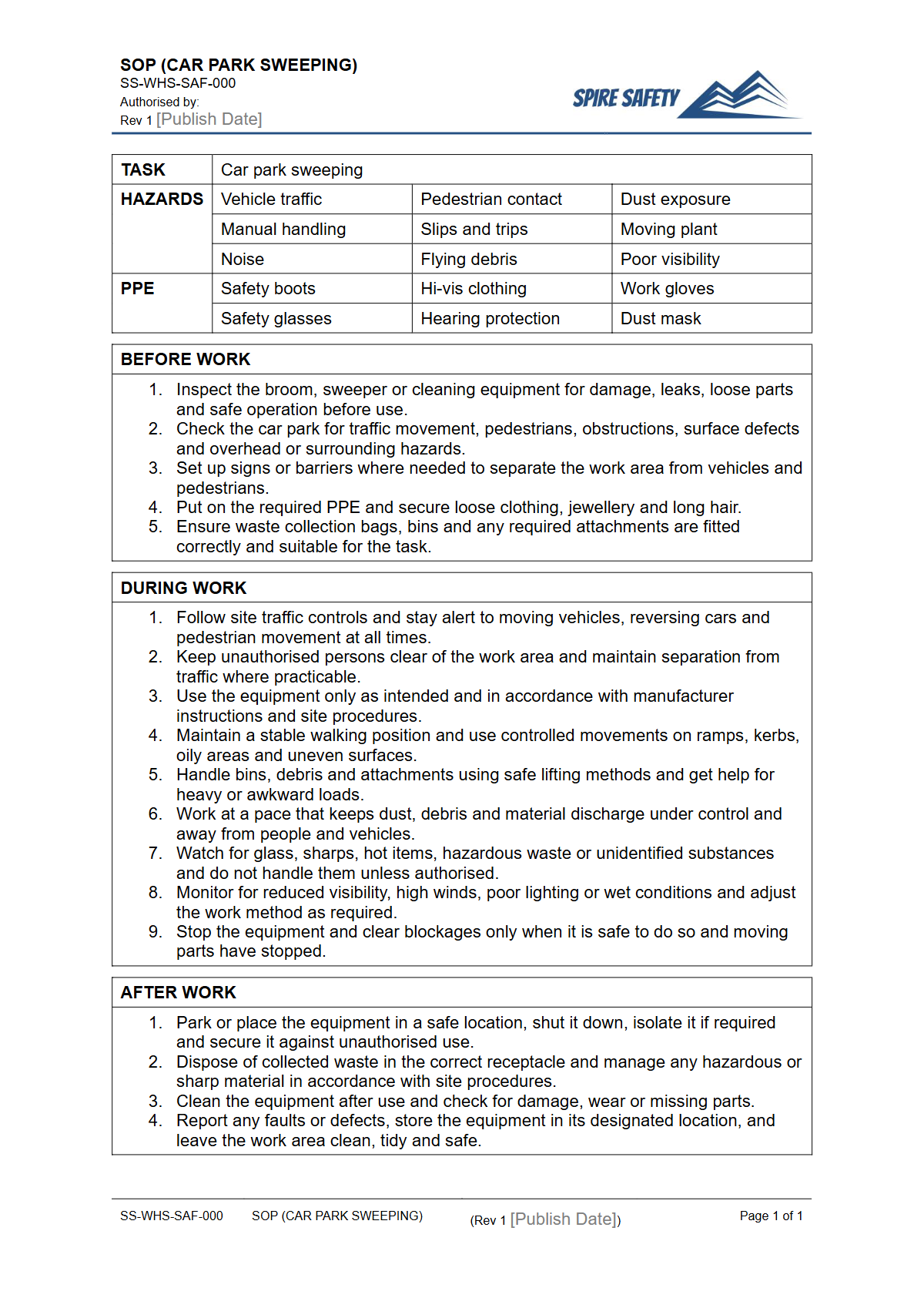
This Free Safe Operating Procedure (Car Park Sweeping) Template provides a foundation for documenting the safety protocols for cleaning car parks using mechanical sweepers. Implementing a formal SOP helps manage significant risks such as interactions with vehicle and pedestrian traffic, exposure to dust and noise, ergonomic strains from operating equipment, and slip or trip hazards.
A well-defined procedure ensures tasks are performed consistently and safely, forming a critical part of your overall safety framework. Formalising your processes is a key step in developing robust WHS management systems.
Key hazards addressed include:
- Vehicle and pedestrian traffic management
- Operator competency and training
- Pre-start checks and equipment maintenance
- Exposure to airborne contaminants (dust, silica, exhaust fumes)
- Noise exposure from machinery
- Manual handling and ergonomic risks
- Slip, trip, and fall hazards from debris or wet surfaces
Video walkthrough
How to use the Free Safe Operating Procedure (Car Park Sweeping) Template
This document is a starting point. To make it effective, you must adapt it to the specific context of your workplace.
Download the DOCX file and systematically work through each section, adding details relevant to your site, the specific models of sweepers in use, and your established traffic management plans. Worker consultation is a mandatory part of this process; the people performing the task have invaluable insights into the real-world risks and most effective controls.
It is crucial to remember that this document is a template. We have designed it as a starting point, and you must customise it to reflect the specific equipment, environment, and risks present in your workplace.
Once customised, ensure all relevant workers are trained on the final SOP and that their understanding is verified. Periodic reviews and updates are essential to maintain its relevance and effectiveness, a process often validated through WHS compliance auditing.
When to use this Safe Operating Procedure
A Safe Operating Procedure for car park sweeping should be used as a primary reference document for several key activities. It is essential for inducting and training new employees or contractors tasked with sweeping duties.
It should also be used for pre-start meetings or toolbox talks to refresh workers' knowledge of the risks and controls before they begin work. In the event of an incident or near-miss, the SOP serves as a benchmark for investigating what went wrong. For associated tasks in the same environment, you might also require procedures like our free step ladder SOP template.
Who should use this SOP
This Safe Operating Procedure is intended for a range of personnel within an organisation. Persons Conducting a Business or Undertaking (PCBUs) and managers are responsible for ensuring such procedures are developed, implemented, and maintained.
Supervisors must use it to train and oversee workers, ensuring the documented steps are followed correctly. Most importantly, operators and cleaning staff who perform the sweeping task must use the SOP as their guide for working safely.
Safety professionals can also use this template as part of their toolkit for developing site-wide safety documentation, including procedures like a Scraper SOP for related cleaning activities.
Key Safety Considerations
Beyond the basic steps, an effective SOP for car park sweeping must detail specific safety controls. For controlling dust, specify the use of water suppression systems on the sweeper and appropriate respiratory protective equipment (RPE) like P2 masks, especially in poorly ventilated underground car parks.
The procedure should also detail the safe methods for cleaning equipment filters, which may involve using an air compressor safely in a designated outdoor area. For large, ride-on sweepers that share characteristics with other vehicles, the pre-start inspection and operational rules may align with those found in a free SOP for body trucks, covering brakes, steering, lights, and warning devices.
Review and Record Keeping
An SOP is a living document. Your procedure should specify a review date, typically annually or after any significant change.
Changes that trigger a review include the introduction of new equipment, a change in the car park layout, or following an incident. Keep a version control table in the document to track changes, dates, and authorisers.
Ensuring records of training on the SOP are maintained is also a critical compliance step. For more templates and guidance documents, explore our complete free WHS resources library.
Common mistakes
Common mistakes to avoid
- Using the template without customising it for the specific sweeper model and site conditions.
- Failing to include procedures for managing interactions with live traffic and pedestrians.
- Neglecting to provide adequate training or confirm workers understand the SOP's contents.
- Forgetting to schedule and document regular pre-start checks and maintenance for the sweeper.
Legal references
Legal considerations
The following legal requirements may be relevant to this type of work.
- Work Health and Safety Act (Harmonised) — Provides the primary duties for protecting workers and other people from work health and safety risks.
- Work Health and Safety Regulations (Harmonised) — Sets out requirements supporting the management of workplace hazards and risks.
The following codes may be relevant to this type of work.
- Managing WHS Risks Code of Practice — Provides practical guidance on identifying hazards, assessing risks and applying effective controls.
- Work Health and Safety Consultation, Cooperation and Coordination Code of Practice — Provides practical guidance on consulting workers and coordinating with other duty holders.
- Managing the Work Environment and Facilities Code of Practice — Provides practical guidance on safe work environments, workplace facilities and related controls.
Did you know
Hidden Dust Dangers
Sweeping concrete surfaces, especially in enclosed car parks, can generate respirable crystalline silica dust. Long-term inhalation of this dust can lead to serious lung diseases like silicosis.
Slips, Trips, and Falls
According to Safe Work Australia, slips, trips, and falls are a leading cause of serious workplace injuries, making debris and floor surface management during cleaning a critical safety focus.
FAQ
Frequently asked questions
01What are the main hazards involved in car park sweeping?
02How often should a car park sweeping SOP be reviewed?
03Who must be consulted when writing an SOP for car park sweeping?
04What PPE is typically required for car park sweeping?
Share this resource
Free Safe Operating Procedure (Car Park Sweeping) Template
Browse Categories
How To Use It
- 1Download and open in Word or PDF.
- 2Replace the placeholders with your business details.
- 3Get it reviewed by a WHS specialist before rollout.
Need it customised?
Our WHS consultants can adapt this template to your site, run a gap analysis, or audit what you already have in place.
Book a Free Consultation WHS consulting servicesor call 1300 156 382
Related templates
- Free Safe Operating Procedure (Car Wash Bay Cleanup) Template
- Free Safe Operating Procedure (Car Wash Detailing) Template
- Free Safe Operating Procedure (Car Wash Vacuuming) Template
- Free Safe Operating Procedure (Carcass Handling) Template
- Free Safe Operating Procedure (Cardboard Compactor) Template
- Free Safe Operating Procedure (Carding Machine) Template