
Free Safe Operating Procedure (Canopy Cleaning) Template
Download our free Safe Operating Procedure (Canopy Cleaning) template.
Free Safe Operating Procedure (Canopy Cleaning) Template
DOCX • 126 KB + PDF
Updated Oct 2026
No signup required
Purpose of the Free Safe Operating Procedure (Canopy Cleaning) Template
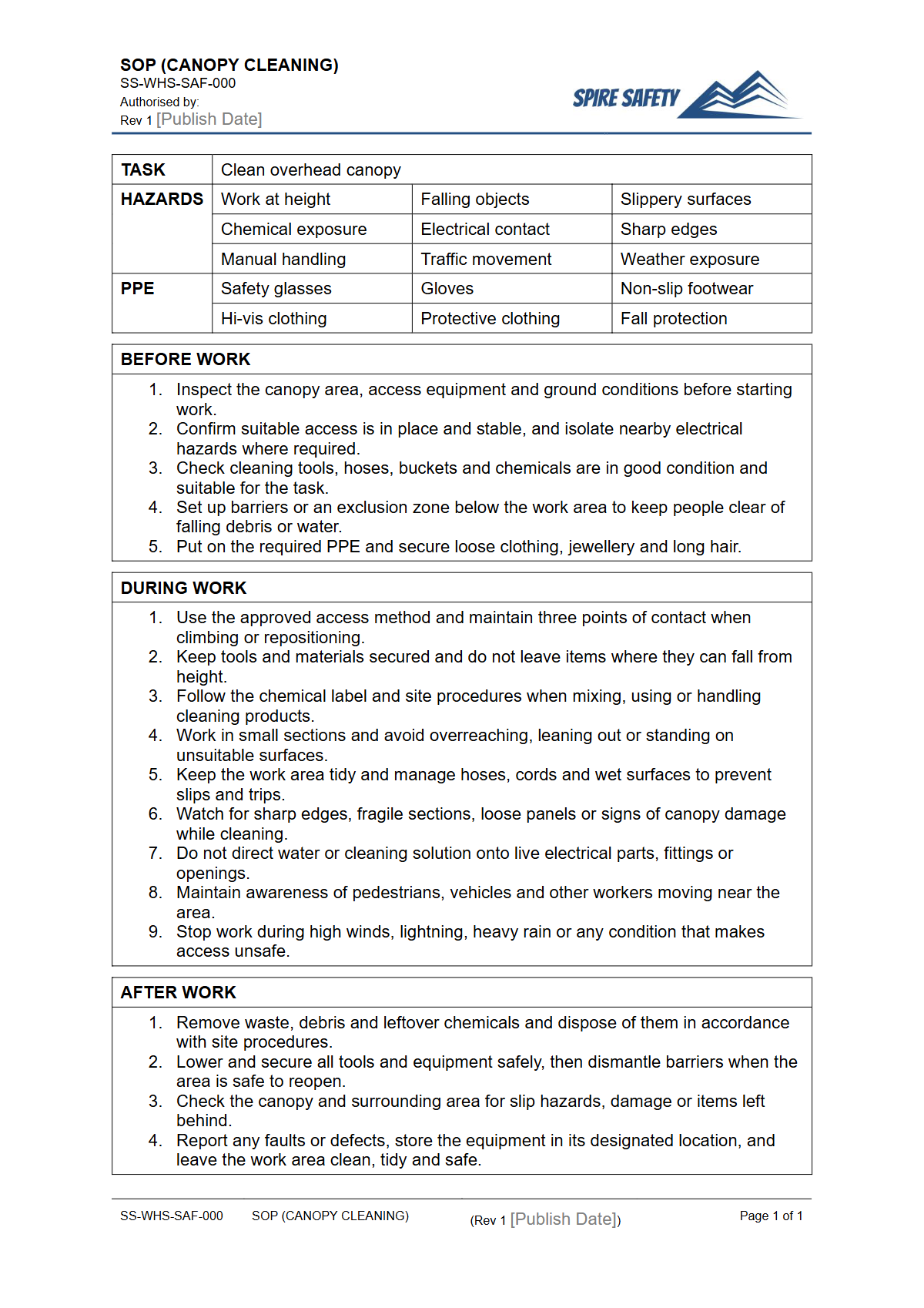
This Safe Operating Procedure (Canopy Cleaning) Template provides a structured framework for documenting a safe system of work for cleaning commercial kitchen exhaust hoods, filters, and ductwork. Kitchen canopy cleaning is a high-risk task involving hazards like chemical exposure, electrical risks, working at heights, and potential for slips, trips, and falls.
A documented SOP is a critical tool for any person conducting a business or undertaking (PCBU) to meet their primary duty of care under WHS legislation. It helps standardise procedures, train workers effectively, and minimise the risk of injury or property damage.
Proper cleaning is not just about hygiene; it is a vital fire prevention measure. Grease and oil residue that accumulates in exhaust systems is highly flammable.
This template prompts you to consider all stages of the task, from initial preparation and hazard identification through to the cleaning process and final clean-up, ensuring a comprehensive approach to safety management. An effective safety system also involves clear procedures for other high-risk tasks, such as those detailed in our plasma cutter SOP for workshop environments.
Video walkthrough
How to use the Free Safe Operating Procedure (Canopy Cleaning) Template
To implement this Safe Operating Procedure for canopy cleaning, download the DOCX or PDF file and begin customising it to your specific workplace. The document is organised into logical sections including required PPE, pre-operational checks, step-by-step procedures, and emergency protocols.
You should review each section and add, remove, or modify content to match the specific equipment, chemicals, and environment at your site. For example, detail the exact make and model of your canopy system and specify the Safety Data Sheets (SDS) for the cleaning agents being used.
It is crucial to understand that this template is a starting point. We have provided a comprehensive framework aligned with Australian WHS principles, but you must adapt the content to reflect the unique conditions of your workplace.
Involve your workers in the customisation process; their hands-on experience is invaluable for identifying practical hazards and effective controls. Once finalised, use the SOP as a central document for training and competency assessments. This process of customisation and implementation is a key component of robust WHS management systems.
When to use a Safe Operating Procedure
An SOP for canopy cleaning should be developed and implemented before any worker undertakes the task for the first time. It forms the basis of their induction and training for this specific activity.
The document should be readily accessible in the work area for easy reference during the job. It should also be used as a checklist for supervisors monitoring the task and as a benchmark during safety audits.
The SOP should be reviewed regularly—at least annually, or whenever there is a change in equipment, chemicals, procedures, or after an incident occurs—to ensure it remains current and effective.
Risk Assessment
Before using this SOP, a comprehensive risk assessment must be conducted to identify all foreseeable hazards associated with the canopy cleaning process. This involves evaluating risks related to chemical handling, electrical safety, manual tasks, and working at heights.
Control measures identified in the risk assessment should be incorporated directly into the SOP. For instance, if cleaning requires workers to leave the ground, the risk assessment will inform the safe use of equipment as detailed in a specific step ladder SOP.
Who should use this SOP
This Safe Operating Procedure should be used by all personnel involved in the cleaning and maintenance of commercial kitchen canopies. This includes in-house maintenance staff, hospitality workers assigned cleaning duties, and external cleaning contractors.
Managers and supervisors must also use the SOP to ensure they are providing adequate training, instruction, and supervision. By ensuring everyone follows the same documented procedure, organisations can significantly reduce procedural violations and maintain a consistent standard of safety.
If you require expert assistance in developing and implementing your safety procedures, consider our WHS consulting services.
Documenting safe procedures for all high-risk activities is a cornerstone of good safety management. Beyond this specific task, you can find templates for a wide range of equipment and processes in our free WHS resources library, helping you build a comprehensive safety system for your organisation.
Common mistakes
Common mistakes to avoid
- Failing to properly isolate electrical components like fans and lights before starting work.
- Using incorrect or overly aggressive cleaning chemicals that can damage stainless steel or other canopy components.
- Cleaning only the visible hood and filters while neglecting the connecting ductwork and exhaust fan, where fire risk is highest.
- Inadequate 'wet floor' signage and barriers, creating a slip hazard for other people in the area.
Legal references
Legal considerations
The following legal requirements may be relevant to this type of work.
- Work Health and Safety Act (Harmonised) — Provides the primary duties for protecting workers and other people from work health and safety risks.
- Work Health and Safety Regulations (Harmonised) — Sets out requirements supporting the management of workplace hazards and risks.
The following codes may be relevant to this type of work.
- Managing WHS Risks Code of Practice — Provides practical guidance on identifying hazards, assessing risks and applying effective controls.
- Work Health and Safety Consultation, Cooperation and Coordination Code of Practice — Provides practical guidance on consulting workers and coordinating with other duty holders.
- Managing the Work Environment and Facilities Code of Practice — Provides practical guidance on safe work environments, workplace facilities and related controls.
Did you know
Critical Fire Risk
A significant percentage of commercial kitchen fires start in the exhaust system. This is often due to the ignition of grease and fat deposits that have built up over time, making regular cleaning a critical fire prevention control.
Australian Standard
Australian Standard AS 1851-2012 provides detailed requirements for the routine service of fire protection systems and equipment, which includes kitchen exhaust hoods and associated ductwork.
FAQ
Frequently asked questions
01What are the main hazards of canopy cleaning?
02How often should a kitchen canopy be cleaned?
03Is a Safe Operating Procedure for canopy cleaning a legal requirement?
04What personal protective equipment (PPE) is needed for canopy cleaning?
Share this resource
Free Safe Operating Procedure (Canopy Cleaning) Template
Browse Categories
How To Use It
- 1Download and open in Word or PDF.
- 2Replace the placeholders with your business details.
- 3Get it reviewed by a WHS specialist before rollout.
Need it customised?
Our WHS consultants can adapt this template to your site, run a gap analysis, or audit what you already have in place.
Book a Free Consultation WHS consulting servicesor call 1300 156 382
Related templates
- Free Safe Operating Procedure (Cap Lamp) Template
- Free Safe Operating Procedure (Capping Machine) Template
- Free Safe Operating Procedure (Capstan Winch) Template
- Free Safe Operating Procedure (Car Hoist) Template
- Free Safe Operating Procedure (Car Park Garden Care) Template
- Free Safe Operating Procedure (Car Park Gate Operation) Template