
Free Safe Operating Procedure (Capping Machine) Template
Download our free Safe Operating Procedure (Capping Machine) Template.
Free Safe Operating Procedure (Capping Machine) Template
DOCX • 126 KB + PDF
Updated Oct 2026
No signup required
Purpose of the Free Safe Operating Procedure (Capping Machine) Template
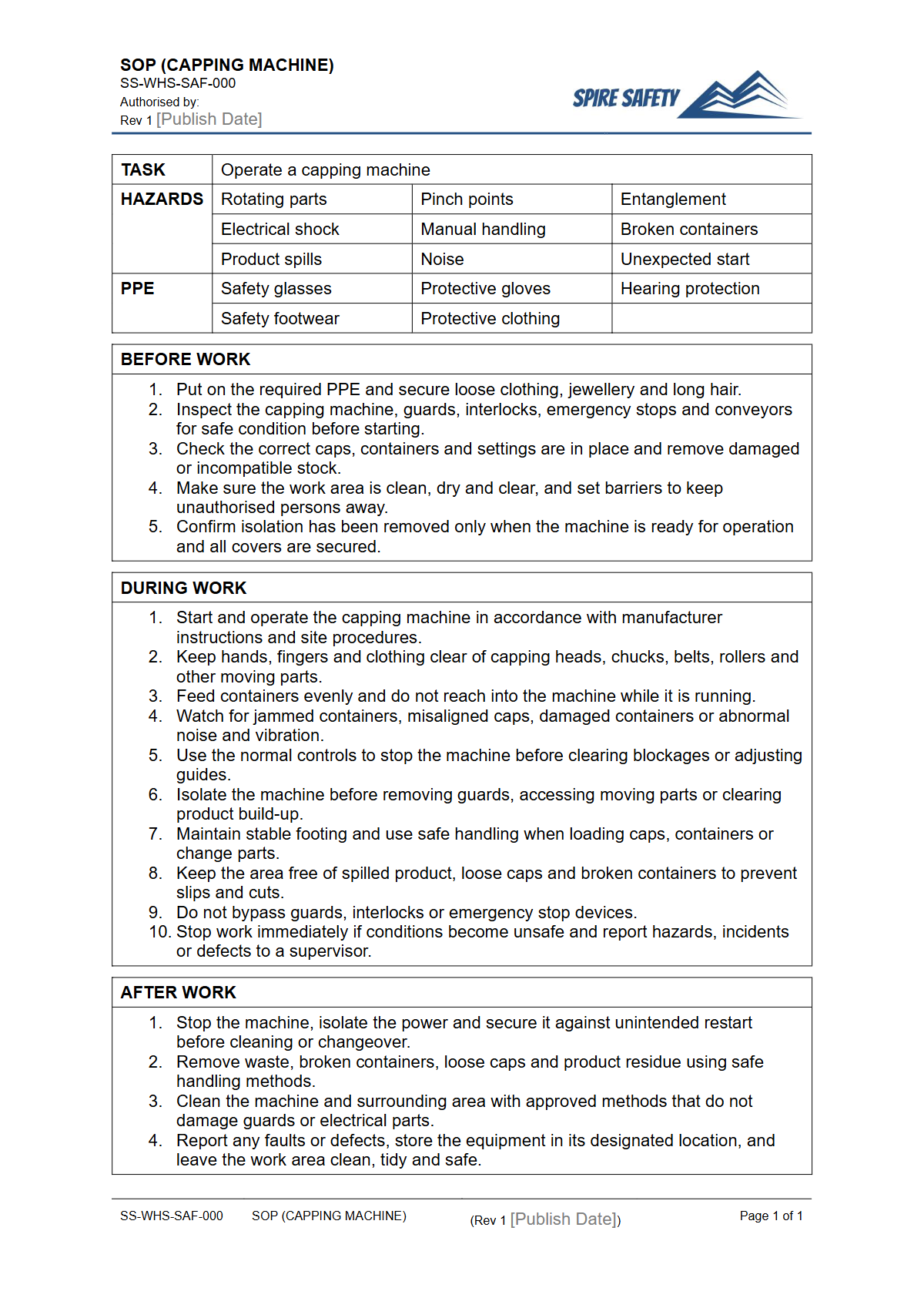
Operating any form of machinery, including capping machines used in bottling and packaging lines, introduces risks that must be managed. This Free Safe Operating Procedure (Capping Machine) Template provides a structured framework for documenting the safest way to perform tasks associated with this equipment.
A well-drafted Safe Operating Procedure (SOP) is a fundamental administrative control measure that helps your organisation meet its primary duty of care under Australian WHS laws.
The main purpose of this document is to clearly outline step-by-step instructions, identify potential hazards like pinch points, entanglement risks, and electrical dangers, and specify the required control measures. Implementing robust SOPs is a critical component of effective WHS management systems, ensuring that all workers follow a consistent, safe, and pre-approved process.
This reduces the likelihood of incidents, injuries, and equipment damage.
Video walkthrough
How to use the Free Safe Operating Procedure (Capping Machine) Template
Downloading this template is just the first step. To make it an effective workplace tool, you must adapt it to your specific operational context.
This Safe Operating Procedure for a Capping Machine is designed as a comprehensive starting point, not a finished document. After downloading the DOCX or PDF, you should gather your team, including machine operators, supervisors, and safety personnel, to collaboratively complete and refine the content.
The process should involve a thorough risk assessment of your specific capping machine and its environment. Identify all tasks from setup and operation to cleaning, maintenance, and emergency shutdowns.
Document the associated hazards and the control measures in place, such as machine guarding, isolation procedures, and required Personal Protective Equipment (PPE). The process for managing other equipment, such as that outlined in our free Air Compressor SOP Template, follows a similar customisation pathway to ensure relevance and effectiveness.
Customisation is Key
This document is a template and must be customised to suit the specific make, model, and operating conditions of the capping machine in your workplace. We recommend thorough consultation with operators and conducting a site-specific risk assessment before finalising and implementing the procedure.
A generic SOP that doesn't reflect your reality offers little practical protection.
When to use a Safe Operating Procedure
An SOP for a capping machine should be a living document integrated into your daily operations. Its primary use is as a practical guide for workers before and during the task. It is an essential tool for:
- Worker Training: Use the SOP as the foundation for training new operators and conducting refresher courses for existing staff.
- Pre-Task Planning: Operators should review the SOP before commencing work to refresh their understanding of the safe process and required controls.
- Supervision and Monitoring: Supervisors can use the SOP as a benchmark to ensure tasks are being performed correctly and safely.
- Incident Investigation: If an incident occurs, the SOP is a critical reference document for investigating what went wrong and identifying where processes may need improvement.
These principles apply across all types of equipment, from simple tools to complex plant like that covered in our Brake Press SOP.
Who should use this document
Multiple roles within an organisation have a responsibility related to the development and use of a Safe Operating Procedure:
- Workers and Operators: The primary users. They must be trained on the SOP and follow its instructions to ensure their own safety and the safety of others.
- Supervisors and Team Leaders: Responsible for ensuring operators are trained, competent, and adhere to the SOP. They often lead the on-the-ground implementation and review process.
- Health and Safety Representatives (HSRs): Should be consulted during the development and review of the SOP to ensure worker perspectives are included.
- Managers and Persons Conducting a Business or Undertaking (PCBUs): Hold the ultimate responsibility for providing safe systems of work, which includes ensuring adequate SOPs are developed, implemented, and maintained. An external check through WHS compliance auditing can verify that these systems are in place and effective.
For more tailored guidance on developing these and other safety documents, engaging professional general WHS consulting services can provide expert input. If your workplace uses a wide variety of equipment, such as that detailed in our Plasma Cutter SOP, a systematic approach to documentation is crucial.
You can explore more templates in our free WHS resources library to build a comprehensive set of procedures for your business.
Common mistakes
Common mistakes to avoid
- Using a generic SOP template without customising it for the specific machine and workplace.
- Failing to consult with the machine operators who have hands-on experience with the equipment.
- Not providing adequate training to all relevant workers on the finalised SOP.
- Neglecting to review and update the SOP after an incident, process change, or on a regular schedule.
Legal references
Legal considerations
The following legal requirements may be relevant to this type of work.
- Work Health and Safety Act (Harmonised) — Provides the primary duties for protecting workers and other people from work health and safety risks.
- Work Health and Safety Regulations (Harmonised) — Sets out requirements supporting the management of workplace hazards and risks.
The following codes may be relevant to this type of work.
- Managing WHS Risks Code of Practice — Provides practical guidance on identifying hazards, assessing risks and applying effective controls.
- Work Health and Safety Consultation, Cooperation and Coordination Code of Practice — Provides practical guidance on consulting workers and coordinating with other duty holders.
- Managing the Work Environment and Facilities Code of Practice — Provides practical guidance on safe work environments, workplace facilities and related controls.
Did you know
Machine Guarding
According to Safe Work Australia, a significant number of serious injuries are caused by inadequate machine guarding. Properly designed and maintained guards are a critical physical barrier between workers and hazardous machine parts.
Pinch Points
Pinch points are areas on a machine where a part of the body can be caught between moving parts. Automated equipment like capping machines often has multiple pinch points that must be identified and controlled.
FAQ
Frequently asked questions
01What is a Safe Operating Procedure (SOP)?
02Is this Capping Machine SOP template ready to use immediately?
03Who is responsible for writing a Safe Operating Procedure?
04How often should we review our Capping Machine SOP?
Share this resource
Free Safe Operating Procedure (Capping Machine) Template
Browse Categories
How To Use It
- 1Download and open in Word or PDF.
- 2Replace the placeholders with your business details.
- 3Get it reviewed by a WHS specialist before rollout.
Need it customised?
Our WHS consultants can adapt this template to your site, run a gap analysis, or audit what you already have in place.
Book a Free Consultation WHS consulting servicesor call 1300 156 382
Related templates
- Free Safe Operating Procedure (Capstan Winch) Template
- Free Safe Operating Procedure (Car Hoist) Template
- Free Safe Operating Procedure (Car Park Garden Care) Template
- Free Safe Operating Procedure (Car Park Gate Operation) Template
- Free Safe Operating Procedure (Car Park Oil Cleanup) Template
- Free Safe Operating Procedure (Car Park Sweeping) Template