
Free Safe Operating Procedure (Cap Lamp) Template
Download our free Safe Operating Procedure (Cap Lamp) Template to formalise inspection, use, and maintenance.
Free Safe Operating Procedure (Cap Lamp) Template
DOCX • 126 KB + PDF
Updated Oct 2026
No signup required
Purpose of the Free Safe Operating Procedure (Cap Lamp) Template
Effectively managing safety in low-light or dark environments is critical for preventing incidents. Our Free Safe Operating Procedure (Cap Lamp) Template provides a structured framework for documenting the correct inspection, use, and maintenance of personal lighting equipment.
Using a formal SOP ensures that all workers follow a consistent, safe method, reducing the risk of accidents caused by equipment failure or improper use. This document helps formalise training, sets clear expectations for workers, and demonstrates a commitment to proactive risk management.
Implementing documented procedures for all equipment, no matter how simple it seems, is a cornerstone of a robust safety framework. A well-defined SOP for cap lamps integrates seamlessly into broader WHS management systems, reinforcing safe work practices across your entire organisation.
Video walkthrough
How to use the Free Safe Operating Procedure (Cap Lamp) Template
This template is designed as a comprehensive starting point. It covers essential areas including pre-operational checks, step-by-step instructions for operation, and post-use maintenance and storage.
To use it, simply download the DOCX file and adapt it to your specific operational context. You will need to insert details relevant to your site, including the specific models of cap lamps in use, your charging station protocols, and any site-specific hazards (such as explosive atmospheres).
Important: This is a template only. To be effective, you must customise this document to reflect the unique equipment, risks, and procedures of your workplace.
We are not responsible for any deficiencies in the final, modified document. This SOP should be reviewed and approved by a competent person before implementation.
For other task-specific procedures, you might find our FREE Trencher SOP Template a useful reference for heavy equipment.
When to use a Cap Lamp SOP
A Safe Operating Procedure for cap lamps should be implemented in any work environment where they are issued as standard personal protective equipment (PPE) or task-specific tools. This is especially critical in high-risk industries and environments where reliable personal lighting is essential for safety.
Common scenarios include:
- Underground mining and tunnelling operations
- Confined space entry and work
- Night-time construction, roadwork, and maintenance
- Emergency response and rescue services
- Inspections in unlit areas like ceiling cavities, basements, or large vessels
- Agricultural activities conducted before dawn or after dusk
These procedures are just as vital as those for heavy machinery. For example, the same level of procedural discipline required by a FREE Dozer SOP Template should be applied to the personal equipment that keeps the operator safe.
Who should use it
This template is intended for use by anyone with responsibilities under WHS legislation. This includes:
- WHS Managers and Advisors: To develop and standardise safety documentation as part of the overall safety management system.
- Supervisors and Team Leaders: To induct new workers, deliver toolbox talks, and enforce safe work practices on site.
- Workers: As a clear guide and reference for the correct and safe way to use their issued equipment.
The document also serves as an important piece of evidence during safety assessments. An auditor conducting a WHS compliance auditing service will look for evidence that risks associated with all workplace equipment have been systematically addressed through documented procedures and training.
What the SOP Template Covers
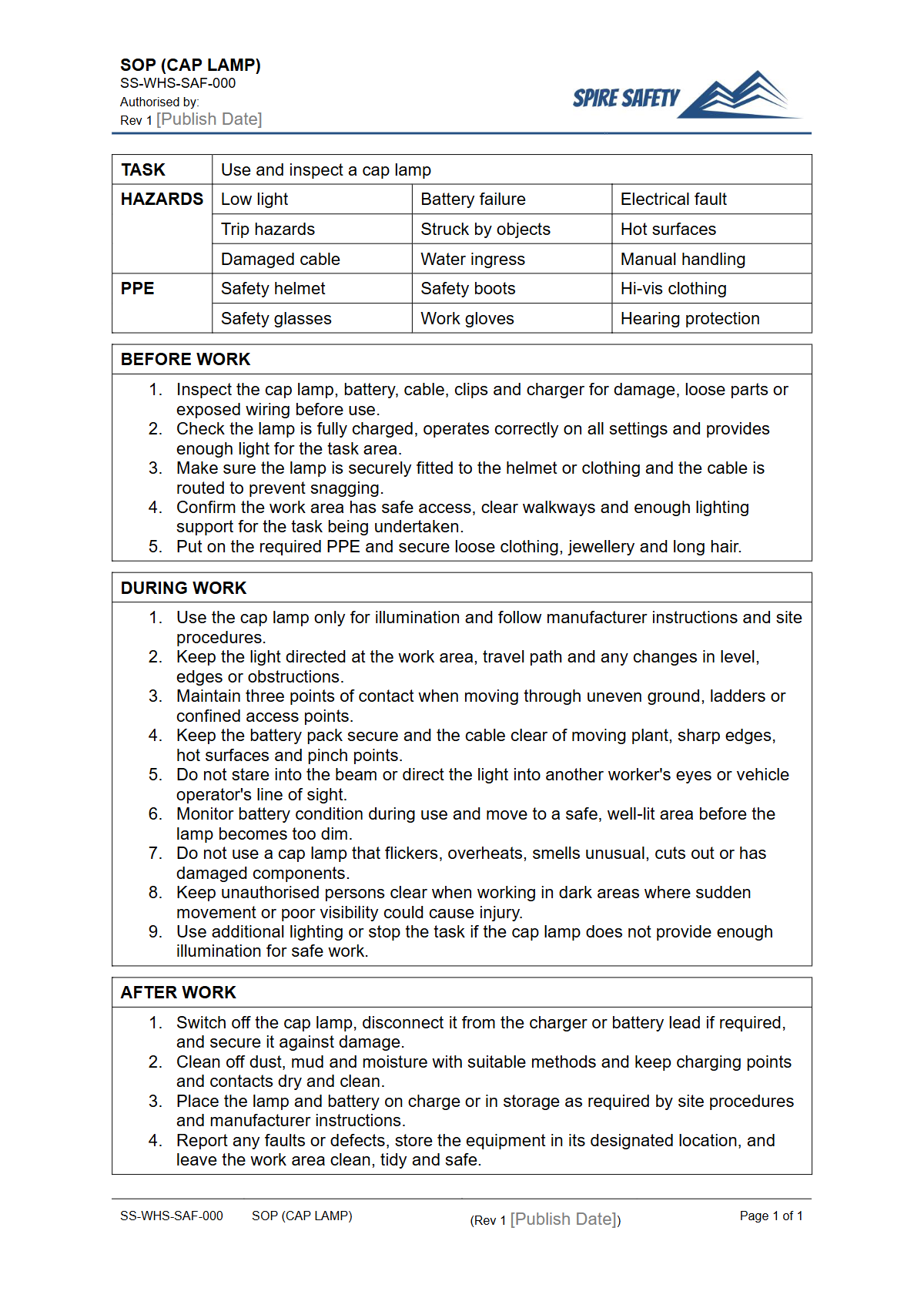
Our template provides a logical flow to guide the user safely through the task. Key sections include:
- Associated Risks and Hazards: Lists potential dangers such as battery failure, electric shock from chargers, or using non-rated equipment in hazardous zones.
- Pre-Operational Checks: A checklist of actions to perform before use, such as inspecting the casing for damage, checking battery level, and ensuring the lens is clean. Using equipment in poor visibility often involves other risks, such as working at height, which is covered in our FREE Step Ladder SOP Template.
- Operational Steps: A sequential guide to wearing and using the lamp correctly, including how to adjust the beam and respond to a malfunction.
- Post-Operational Checks: Instructions for cleaning, charging, and correctly storing the lamp to ensure it is ready for the next user.
By customising this template, you create a practical tool that helps meet your duty of care and keeps your team safe. Feel free to explore our complete free WHS resources library for more templates and checklists to support your safety goals.
Common mistakes
Common mistakes to avoid
- Failing to conduct a pre-use inspection, leading to battery failure mid-task.
- Using a non-intrinsically safe lamp in a classified hazardous area, creating an ignition risk.
- Neglecting to clean the lens, resulting in poor light output and reduced visibility.
- Improperly storing the lamp or connecting it to a faulty charger, causing battery damage.
Legal references
Legal considerations
The following legal requirements may be relevant to this type of work.
- Work Health and Safety Act (Harmonised) — Provides the primary duties for protecting workers and other people from work health and safety risks.
- Work Health and Safety Regulations (Harmonised) — Sets out requirements supporting the management of workplace hazards and risks.
The following codes may be relevant to this type of work.
- Managing WHS Risks Code of Practice — Provides practical guidance on identifying hazards, assessing risks and applying effective controls.
- Work Health and Safety Consultation, Cooperation and Coordination Code of Practice — Provides practical guidance on consulting workers and coordinating with other duty holders.
- Managing the Work Environment and Facilities Code of Practice — Provides practical guidance on safe work environments, workplace facilities and related controls.
Did you know
The Miner's Friend
The modern cap lamp evolved from the Davy lamp, invented in 1815 to detect flammable gases in coal mines and provide a safe source of light. Early versions used flame, while today's lamps use intrinsically safe LED technology.
Intrinsic Safety
Cap lamps intended for use in potentially explosive atmospheres (like mines or sewers) must be 'intrinsically safe'. This means their electrical energy is too low to create a spark that could ignite gas or dust.
FAQ
Frequently asked questions
01What key information must be included in a Safe Operating Procedure for a cap lamp?
02Are cap lamps classified as Personal Protective Equipment (PPE)?
03How often do cap lamps need to be inspected?
04Why is an SOP needed for something as simple as a cap lamp?
Share this resource
Free Safe Operating Procedure (Cap Lamp) Template
Browse Categories
How To Use It
- 1Download and open in Word or PDF.
- 2Replace the placeholders with your business details.
- 3Get it reviewed by a WHS specialist before rollout.
Need it customised?
Our WHS consultants can adapt this template to your site, run a gap analysis, or audit what you already have in place.
Book a Free Consultation WHS consulting servicesor call 1300 156 382
Related templates
- Free Safe Operating Procedure (Capping Machine) Template
- Free Safe Operating Procedure (Capstan Winch) Template
- Free Safe Operating Procedure (Car Hoist) Template
- Free Safe Operating Procedure (Car Park Garden Care) Template
- Free Safe Operating Procedure (Car Park Gate Operation) Template
- Free Safe Operating Procedure (Car Park Oil Cleanup) Template