
Free Safe Operating Procedure (Can Opener Use) Template
Download our free Safe Operating Procedure (Can Opener Use) template. A structured starting point for managing kitchen safety. Get your DOCX and PDF now.
Free Safe Operating Procedure (Can Opener Use) Template
DOCX • 126 KB + PDF
Updated Oct 2026
No signup required
Purpose of the Free Safe Operating Procedure (Can Opener Use) Template
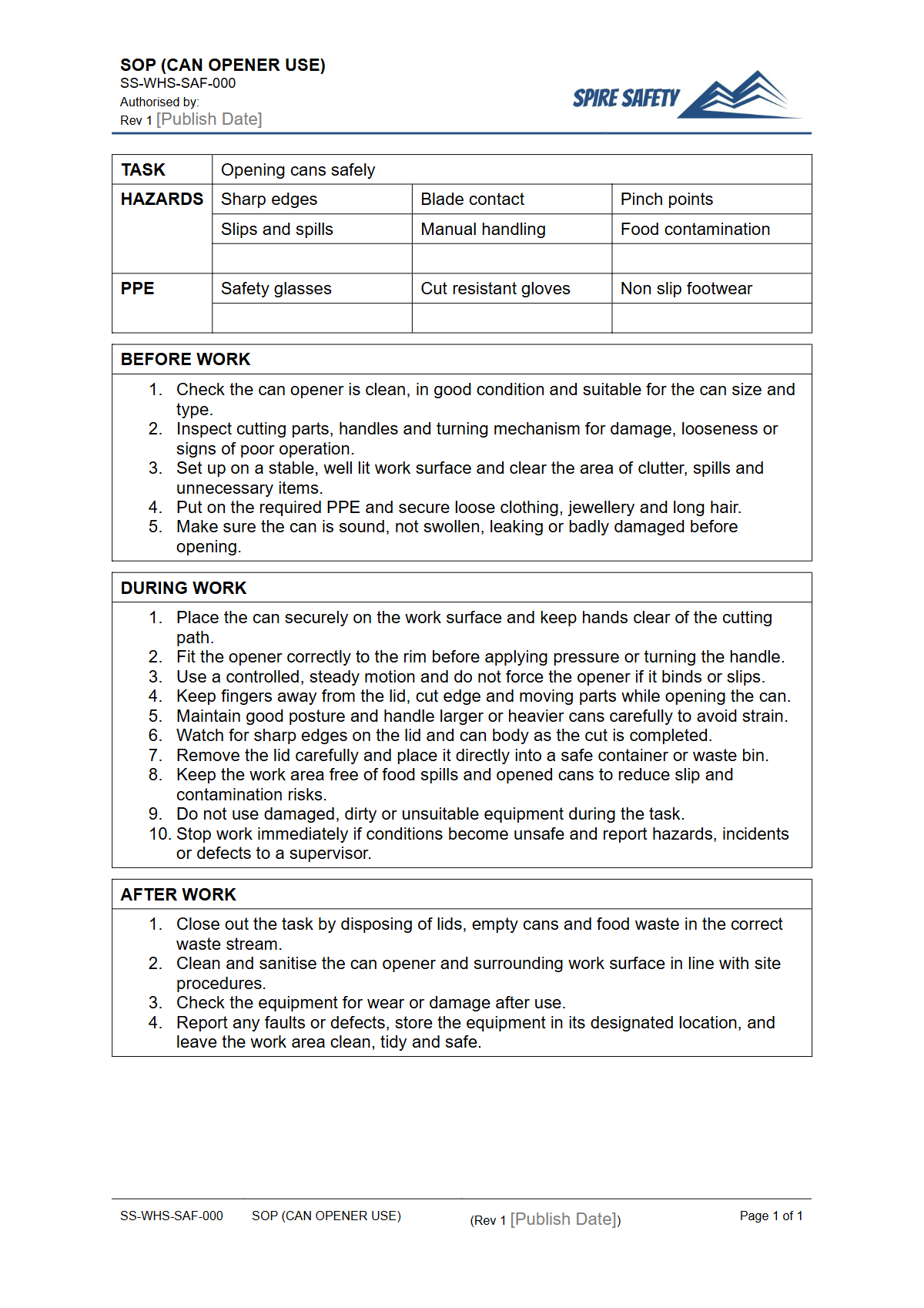
This free Safe Operating Procedure (Can Opener Use) template provides a structured starting point for documenting the safe use of manual and electric can openers in your workplace. Establishing clear, documented procedures is fundamental to managing workplace risks.
While often overlooked, simple tools can pose significant hazards if used incorrectly, much like how a failure to follow procedure can make everyday equipment unsafe, as outlined in our SOP for step ladder use. This template helps you formalise instructions to prevent common injuries like cuts and strains.
The primary purpose of an SOP for this task is to establish a clear, repeatable, and safe method for operating can openers within a commercial or workplace kitchen. By documenting the process, you standardise safe work practices, provide a clear basis for staff training, and demonstrate a commitment to risk management.
Formal procedures like this are a cornerstone of robust WHS management systems, helping to fulfil your duty of care under Australian WHS legislation.
Video walkthrough
How to use the Free Safe Operating Procedure (Can Opener Use) Template
To get the most from this resource, download the DOCX file and adapt it to the specific context of your organisation. It is crucial that you customise the document to reflect your exact equipment, work environment, and required personal protective equipment (PPE), such as cut-resistant gloves.
Important: We have provided a framework based on common WHS practice, but you must complete the risk assessment and procedure steps for it to be effective in your workplace. The steps for a large bench-mounted industrial opener will differ significantly from a small handheld one, just as procedures vary for different workshop tools like those in our circular saw SOP template. Fill in the specific details relevant to your site, consult with your workers, and gain approval from a supervisor before implementing the procedure.
Before You Write the SOP
Before finalising your Safe Operating Procedure, a thorough risk assessment should be conducted. This process involves identifying all potential hazards associated with the task, assessing the level of risk, and determining effective control measures.
Hazards may include sharp edges on cans and lids, pinch points on the device, mechanical or electrical faults, and ergonomic strain from repetitive use. If you require assistance with formalising your risk management processes, our team offers expert WHS consulting services.
When to Use This SOP
This SOP should be used in any workplace environment where can openers are operated as part of a work task. This includes, but is not limited to:
- Commercial kitchens in restaurants, cafes, and hotels
- Catering and food production facilities
- Workplace lunchrooms and break areas
- Aged care and healthcare facility kitchens
The procedure should be integrated into worker induction and training programs and be readily accessible near the work area for easy reference.
Who Should Use This Template
This template is designed for use by individuals responsible for workplace safety and operational management. This typically includes:
- Work Health and Safety (WHS) Managers and Advisors
- Hospitality and Kitchen Managers
- Supervisors and Team Leaders
- Business owners responsible for safety
They can use this document to develop a finalised SOP, which is then used to train all workers who perform the task, including new, young, or inexperienced employees. Having a library of documented procedures for all equipment is a sign of a mature safety culture, and you can find more templates in our free WHS resources library.
Maintaining and Reviewing the Procedure
A Safe Operating Procedure is a living document. It should be reviewed regularly—typically every one to two years—or whenever there is a change in equipment, processes, or after an incident occurs.
Regular checks should also be made to ensure the can opener itself is clean, sharp, and in good working order, similar to the maintenance checks required for equipment like those in our air compressor SOP template. To verify that your safety procedures are being correctly implemented and followed by staff, consider a formal WHS compliance auditing program.
Common mistakes
Common mistakes to avoid
- Failing to clean the can opener regularly, leading to food contamination and poor performance.
- Using a dull or damaged can opener, which requires excessive force and can slip, causing injury.
- Not having a specific, safe procedure for disposing of sharp lids, leaving them as a hazard in bins.
- Assuming the task is 'common sense' and therefore not providing proper training to new or young workers.
Legal references
Legal considerations
The following legal requirements may be relevant to this type of work.
- Work Health and Safety Act (Harmonised) — Provides the primary duties for protecting workers and other people from work health and safety risks.
- Work Health and Safety Regulations (Harmonised) — Sets out requirements supporting the management of workplace hazards and risks.
The following codes may be relevant to this type of work.
- Managing WHS Risks Code of Practice — Provides practical guidance on identifying hazards, assessing risks and applying effective controls.
- Work Health and Safety Consultation, Cooperation and Coordination Code of Practice — Provides practical guidance on consulting workers and coordinating with other duty holders.
- Managing the Work Environment and Facilities Code of Practice — Provides practical guidance on safe work environments, workplace facilities and related controls.
Did you know
Kitchen Hazards
According to Safe Work Australia, cuts and lacerations are among the most common types of injuries in the accommodation and food services industry, often resulting from knives, slicers, and sharp can lids.
A Late Invention
The can was invented in 1810, but the first practical can opener was not invented until nearly 50 years later, in 1858. Before that, people used whatever tools they could, including hammers and chisels.
FAQ
Frequently asked questions
01What are the main hazards of using a can opener?
02Why do I need an SOP for something as simple as a can opener?
03How often should an SOP for a can opener be reviewed?
04Does this template cover both electric and manual can openers?
Share this resource
Free Safe Operating Procedure (Can Opener Use) Template
Browse Categories
How To Use It
- 1Download and open in Word or PDF.
- 2Replace the placeholders with your business details.
- 3Get it reviewed by a WHS specialist before rollout.
Need it customised?
Our WHS consultants can adapt this template to your site, run a gap analysis, or audit what you already have in place.
Book a Free Consultation WHS consulting servicesor call 1300 156 382
Related templates
- Free Safe Operating Procedure (Cane Pruning) Template
- Free Safe Operating Procedure (Canoe Operation) Template
- Free Safe Operating Procedure (Canopy Cleaning) Template
- Free Safe Operating Procedure (Cap Lamp) Template
- Free Safe Operating Procedure (Capping Machine) Template
- Free Safe Operating Procedure (Capstan Winch) Template