
Free Safe Operating Procedure (Cane Pruning) Template
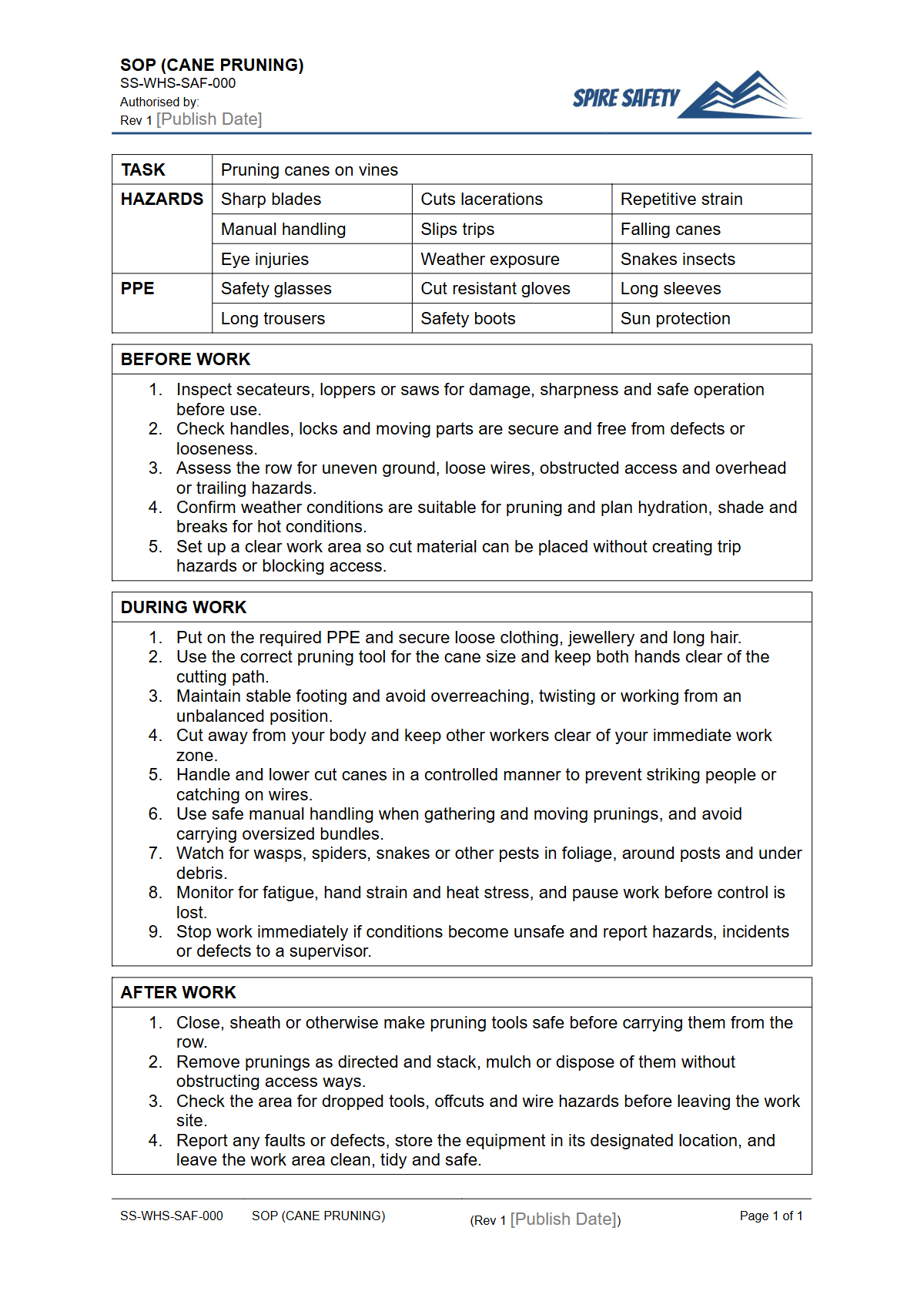
Download our free Safe Operating Procedure (Cane Pruning) template. This DOCX and PDF resource helps you outline safe work steps for agricultural tasks.
Free Safe Operating Procedure (Cane Pruning) Template
DOCX • 126 KB + PDF
Updated Oct 2026
No signup required
Purpose of the Free Safe Operating Procedure (Cane Pruning) Template
This Free Safe Operating Procedure (Cane Pruning) Template provides a structured framework for documenting the steps required to safely perform cane pruning in vineyards, orchards, and other agricultural settings. An SOP is a step-by-step guide that formalises a safe system of work, helping to ensure tasks are completed consistently and with the lowest practicable level of risk.
This document assists in managing common hazards associated with cane pruning, such as musculoskeletal injuries from repetitive movements, cuts from secateurs or saws, slips and falls on uneven terrain, and exposure to environmental elements.
By clearly defining the process, this SOP template helps organisations meet their duty of care to provide adequate information, training, and instruction to workers. Formalising procedures for manual tasks is just as critical as it is for operating heavy machinery.
Just as complex equipment like a grain drill requires clear SOPs, so too do skilled manual tasks to minimise the risk of injury and ensure quality outcomes.
Video walkthrough
How to use the Free Safe Operating Procedure (Cane Pruning) Template
This resource is provided as a fully editable Microsoft Word (DOCX) document and a printable PDF. It is designed to be a comprehensive starting point, not a finished document.
Before implementation, it is essential that you adapt the content to your specific operational context. This includes detailing the exact types of tools used (e.g., manual secateurs, loppers, powered secateurs), the specific personal protective equipment (PPE) required, and any site-specific hazards present in your workplace.
Important: We strongly recommend that a person with appropriate knowledge and experience, such as a supervisor or WHS advisor, completes the template in consultation with the workers who will be performing the task. Their direct experience is invaluable for identifying practical hazards and effective controls.
Properly documented procedures form a vital component of robust WHS management systems, linking risk assessments to daily work practices.
When to use it
A Safe Operating Procedure for cane pruning should be used as a primary reference document for all personnel involved in the task. Its key applications include inducting new or seasonal workers, providing pre-start or toolbox talk briefings before work commences, and serving as a basis for refresher training.
It is also a critical tool for supervisors to monitor that work is being performed as required. Following any incident or near miss related to pruning, the SOP should be reviewed and updated to incorporate any learnings and prevent recurrence.
The principles of creating and using task-specific safety documents apply across a wide range of activities. Whether the task involves horticulture or simply using common equipment, a clear procedure is essential, for example, when using a step ladder safely on-site.
Who should use it
This SOP is intended for use by multiple groups within an agricultural business. The primary users are the workers and horticulturalists who physically perform the pruning tasks.
It provides them with a clear, authoritative guide on the expected safe work method. Supervisors, leading hands, and managers should use the SOP to train, supervise, and mentor their teams, ensuring a consistent standard of safety and performance is maintained.
Work Health and Safety (WHS) personnel can also use the document as part of risk assessments, training needs analysis, and incident investigations.
Periodic checks are crucial to ensure that the procedures outlined in the SOP are being followed correctly in practice. A formal WHS compliance audit can provide independent verification that your documented systems are being effectively implemented in the field.
Key Elements of an Effective Cane Pruning SOP
A comprehensive SOP for cane pruning goes beyond just the cutting motion. This template prompts you to consider the entire work cycle to ensure all risks are managed. Key sections to customise include:
- Required PPE: Specify items based on a risk assessment, such as cut-resistant gloves, safety glasses or goggles, long-sleeved clothing, and sturdy, non-slip footwear.
- Pre-Operational Checks: Detail the checks workers must perform before starting, such as inspecting tools for sharpness and damage, checking battery charge on powered equipment, and assessing the work area for hazards like uneven ground or overhead risks.
- Step-by-Step Procedure: Outline the core task, focusing on safe techniques. This includes maintaining an ergonomic posture, using the correct cutting method, and safely handling and removing pruned canes.
- Post-Task Activities: Include instructions for cleaning, maintaining, and storing tools correctly, as well as any site clean-up requirements.
The safety of hand-held equipment is a critical consideration in any work environment. Safe tool handling is paramount, whether you are using secateurs for pruning or a circular saw for construction tasks.
Integrating SOPs into Your Safety Framework
A Safe Operating Procedure is most effective when it is part of an integrated WHS management system. It should not be a standalone document that is created and forgotten.
To be effective, the SOP must be supported by practical training, ongoing supervision, and a commitment from management. It should be readily accessible to workers at the location where the work is performed, not just filed away in an office.
This document should directly relate to your broader risk assessments for horticultural tasks.
If you need assistance integrating procedures like this one into a cohesive safety strategy for your organisation, our WHS consulting services can provide expert, practical guidance tailored to your industry.
Common mistakes
Common mistakes to avoid
- Using a generic template without customising it for site-specific hazards and equipment.
- Failing to train workers on the SOP and confirm they understand the procedures.
- Neglecting to include instructions for tool maintenance and pre-start checks.
- Storing the SOP in an office instead of making it easily accessible to workers at the point of use.
Legal references
Legal considerations
The following legal requirements may be relevant to this type of work.
- Work Health and Safety Act (Harmonised) — Provides the primary duties for protecting workers and other people from work health and safety risks.
- Work Health and Safety Regulations (Harmonised) — Sets out requirements supporting the management of workplace hazards and risks.
The following codes may be relevant to this type of work.
- Managing WHS Risks Code of Practice — Provides practical guidance on identifying hazards, assessing risks and applying effective controls.
- Work Health and Safety Consultation, Cooperation and Coordination Code of Practice — Provides practical guidance on consulting workers and coordinating with other duty holders.
- Managing the Work Environment and Facilities Code of Practice — Provides practical guidance on safe work environments, workplace facilities and related controls.
Did you know
Ergonomic Risk
Repetitive tasks like pruning are a leading cause of musculoskeletal disorders (MSDs) in agriculture. Varying tasks, taking regular breaks, and using well-maintained, ergonomic tools can significantly reduce this risk.
Australian Viticulture
Australia has over 145,000 hectares of vineyards, and manual cane pruning remains a critical and highly skilled task for ensuring the health and productivity of the vines each season.
FAQ
Frequently asked questions
01What is the difference between an SOP and a SWMS?
02How often should a Safe Operating Procedure for cane pruning be reviewed?
03Does this template cover the use of powered secateurs?
04What kind of PPE is needed for cane pruning?
Share this resource
Free Safe Operating Procedure (Cane Pruning) Template
Browse Categories
How To Use It
- 1Download and open in Word or PDF.
- 2Replace the placeholders with your business details.
- 3Get it reviewed by a WHS specialist before rollout.
Need it customised?
Our WHS consultants can adapt this template to your site, run a gap analysis, or audit what you already have in place.
Book a Free Consultation WHS consulting servicesor call 1300 156 382
Related templates
- Free Safe Operating Procedure (Canoe Operation) Template
- Free Safe Operating Procedure (Canopy Cleaning) Template
- Free Safe Operating Procedure (Cap Lamp) Template
- Free Safe Operating Procedure (Capping Machine) Template
- Free Safe Operating Procedure (Capstan Winch) Template
- Free Safe Operating Procedure (Car Hoist) Template