
Free Safe Operating Procedure (Calendar Machine) Template
Download our free Safe Operating Procedure (Calendar Machine) template.
Free Safe Operating Procedure (Calendar Machine) Template
DOCX • 126 KB + PDF
Updated Oct 2026
No signup required
Purpose of the Free Safe Operating Procedure (Calendar Machine) Template
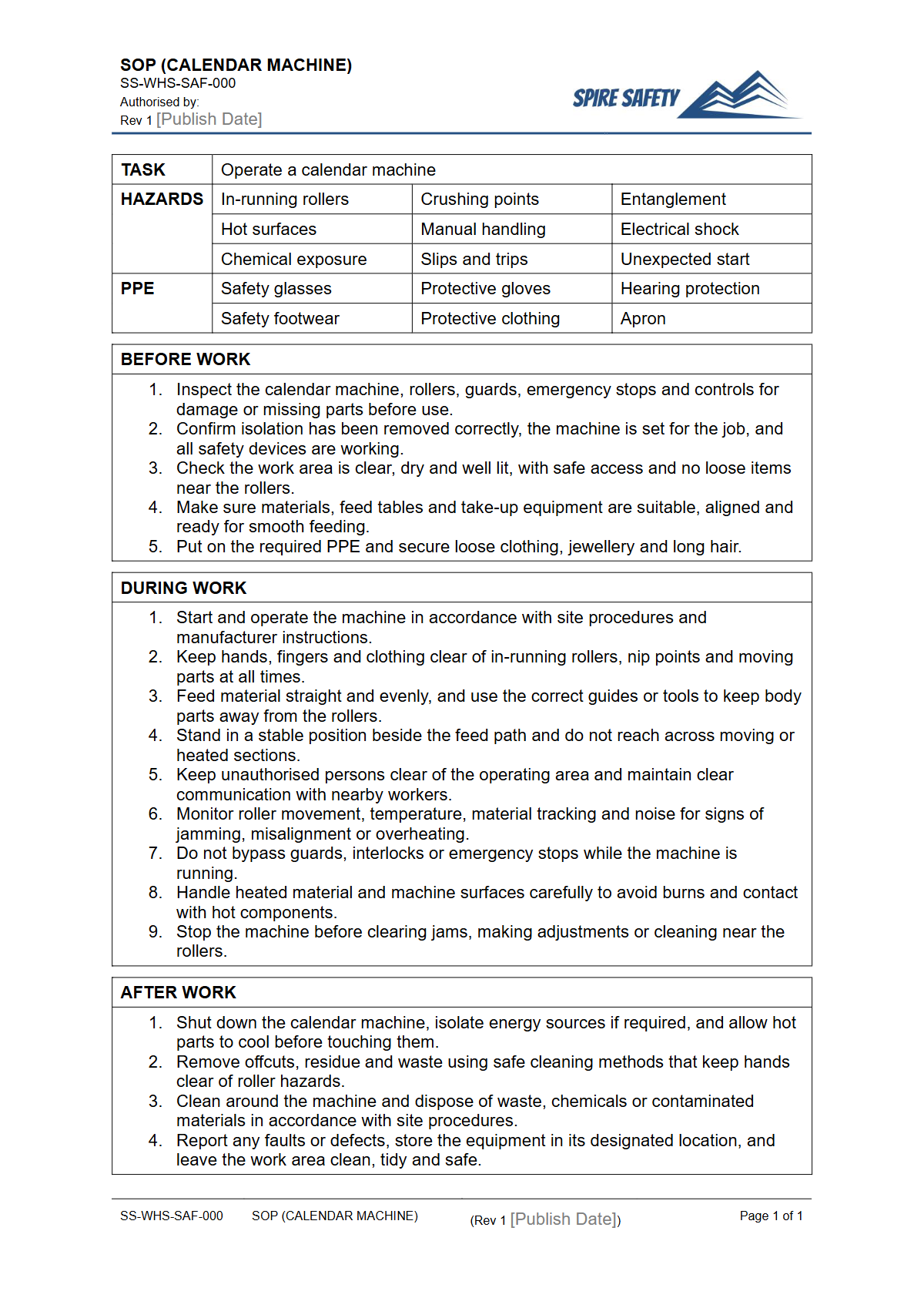
Operating industrial machinery like a calendar machine introduces significant workplace hazards, including crushing, entanglement, and burn risks. This Free Safe Operating Procedure (Calendar Machine) Template provides a structured framework to help your organisation document the required steps for safe operation.
By establishing a clear, step-by-step guide, you can standardise practices, ensure workers are aware of the hazards, and implement necessary control measures. A documented SOP is a fundamental tool for worker training and for demonstrating that you have a formal system for managing high-risk tasks.
The primary goal of this Safe Operating Procedure is to minimise the risk of injury by detailing pre-operational checks, operational steps, and shutdown procedures. It formalises safety requirements, such as the use of personal protective equipment (PPE), machine guarding, and emergency protocols.
This process is similar to managing risks for other high-pressure equipment, as detailed in our Free Brake Press SOP Template. Implementing a robust SOP helps you meet your duty of care under Australian WHS legislation by providing clear instruction and supervision for your workers.
Video walkthrough
How to use the Free Safe Operating Procedure (Calendar Machine) Template
This template is designed as a comprehensive starting point, aligned with Australian WHS principles. To make it effective, you must adapt it to the unique context of your workplace.
Start by downloading the DOCX file and adding your company branding. Next, walk through each section and replace the generic placeholder text with information specific to your equipment and operational environment.
This includes detailing the exact make and model of your calendar machine, specific energy isolation points, and site-specific emergency contacts.
Important Note: This document is a template only. We cannot guarantee it will be suitable for your specific circumstances.
You must customise it to reflect the actual machines, risks, and control measures in your workplace. Consult with machine operators, supervisors, and safety professionals during the customisation process to ensure the final SOP is accurate, practical, and comprehensive. A well-developed SOP forms a critical part of your overall safety framework, which can be strengthened through a complete WHS management system.
What is a Safe Operating Procedure?
A Safe Operating Procedure (SOP) is a written document that provides detailed, sequential instructions on how to perform a specific task safely. It breaks down a job into its core components and identifies the hazards associated with each step.
For every hazard, the SOP specifies the control measures required to eliminate or minimise the risk. It serves as a vital tool for training, a reference for experienced operators, and a key piece of evidence in demonstrating a systematic approach to safety management.
When to use a Calendar Machine SOP
A Safe Operating Procedure for a calendar machine should be developed and implemented before any worker is permitted to operate the equipment. It is an essential document for inducting and training new operators, ensuring they understand the risks and safety protocols from the outset.
The SOP should also be used for refresher training to prevent complacency among experienced staff. Furthermore, it should be reviewed and potentially updated following any near miss or incident, when new calendar machinery is introduced, or if the process itself is modified.
Regular reviews ensure the procedure remains relevant and effective. This type of proactive review is a cornerstone of effective safety management, which can be verified through periodic WHS compliance auditing.
Who should use this Safe Operating Procedure
This SOP is intended for use by multiple roles within an organisation. WHS managers and supervisors are responsible for developing, customising, and implementing the procedure.
They must ensure it is readily accessible to operators and that its instructions are followed consistently. Machine operators are the primary end-users; they must be trained on the SOP and use it as a guide for their daily tasks.
Team leaders can also use the document to conduct pre-start checks and toolbox talks, reinforcing safe work behaviour. For similar guidance on other industrial tools, you might find our FREE Plasma Cutter SOP Template helpful for building out your safety documentation.
Ultimately, anyone involved in the lifecycle of the calendar machine—from installation and operation to maintenance and cleaning—should be familiar with the contents of the SOP. The principles of documenting safe procedures apply to a wide range of plant and equipment.
For instance, even common auxiliary equipment should have its own procedure, as shown in our Free Air Compressor SOP Template. You can find many other useful documents in our free WHS resources library to support your safety management efforts.
Common mistakes
Common mistakes to avoid
- Using a generic template without customising it for the specific machine model and workplace.
- Failing to involve experienced operators in the drafting and review process.
- Not providing practical, hands-on training to supplement the written SOP document.
- Neglecting to review and update the SOP after a near miss, incident, or change in process.
Legal references
Legal considerations
The following legal requirements may be relevant to this type of work.
- Work Health and Safety Act (Harmonised) — Provides the primary duties for protecting workers and other people from work health and safety risks.
- Work Health and Safety Regulations (Harmonised) — Sets out requirements supporting the management of workplace hazards and risks.
The following codes may be relevant to this type of work.
- Managing WHS Risks Code of Practice — Provides practical guidance on identifying hazards, assessing risks and applying effective controls.
- Work Health and Safety Consultation, Cooperation and Coordination Code of Practice — Provides practical guidance on consulting workers and coordinating with other duty holders.
- Managing the Work Environment and Facilities Code of Practice — Provides practical guidance on safe work environments, workplace facilities and related controls.
Did you know
What's in a Name?
The term 'calendar' for this type of machine comes from the French word 'calandre', which translates to 'roller'.
The Danger Zone
The high-pressure 'nip point' where the rollers meet is one of the most severe entanglement and crushing hazards in the manufacturing and textile industries.
FAQ
Frequently asked questions
01What are the main hazards of operating a calendar machine?
02Is a Safe Operating Procedure a legal requirement in Australia?
03How often should I review a calendar machine SOP?
04Can this template be used for other types of roller machines?
Share this resource
Free Safe Operating Procedure (Calendar Machine) Template
Browse Categories
How To Use It
- 1Download and open in Word or PDF.
- 2Replace the placeholders with your business details.
- 3Get it reviewed by a WHS specialist before rollout.
Need it customised?
Our WHS consultants can adapt this template to your site, run a gap analysis, or audit what you already have in place.
Book a Free Consultation WHS consulting servicesor call 1300 156 382
Related templates
- Free Safe Operating Procedure (Call Bell Cord Check) Template
- Free Safe Operating Procedure (Call Bell Testing) Template
- Free Safe Operating Procedure (Can Opener Use) Template
- Free Safe Operating Procedure (Cane Pruning) Template
- Free Safe Operating Procedure (Canoe Operation) Template
- Free Safe Operating Procedure (Canopy Cleaning) Template