
Free Safe Operating Procedure (Call Bell Testing) Template
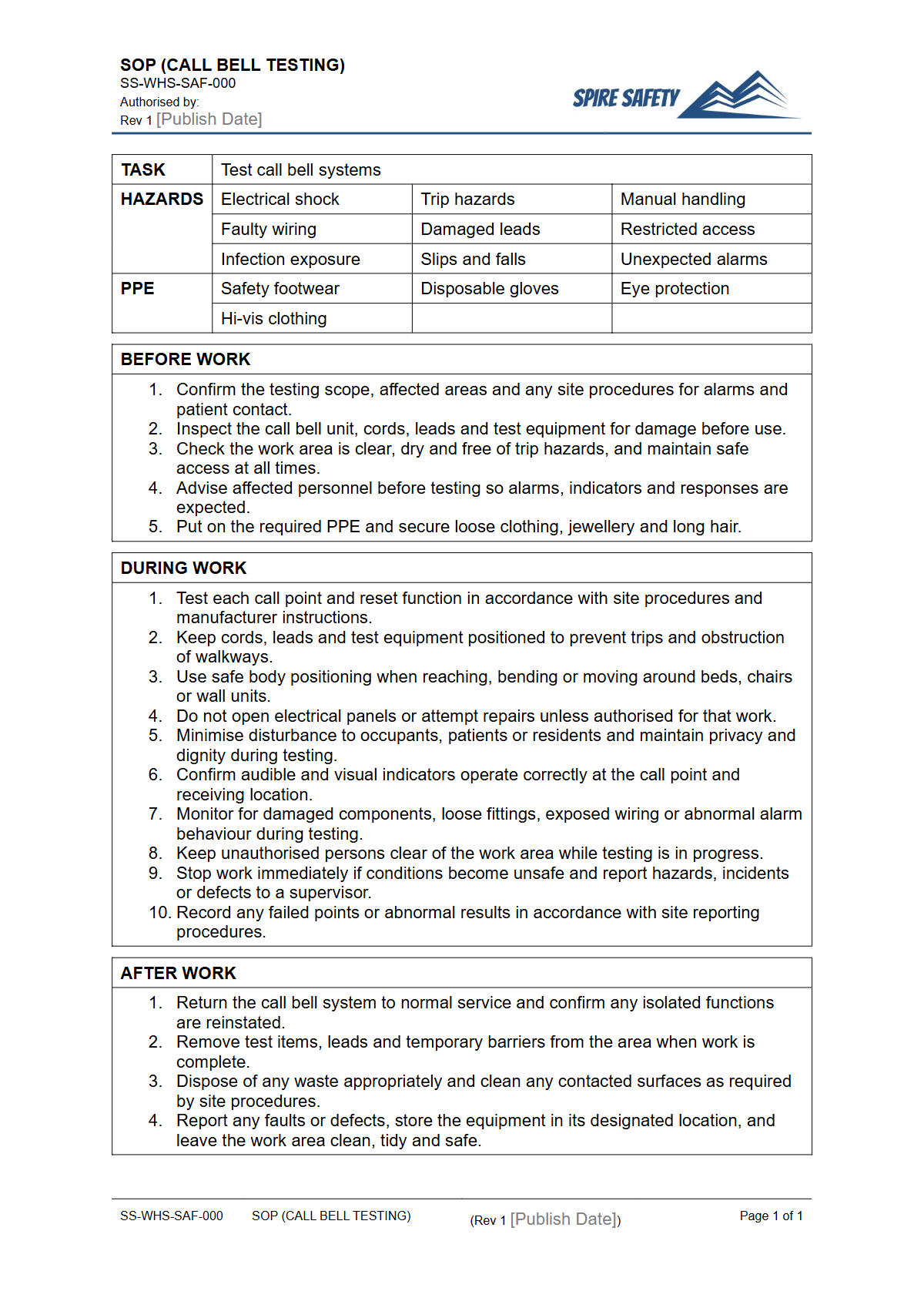
Download our Free Safe Operating Procedure (Call Bell Testing) Template to document clear, repeatable steps for ensuring your call systems are functional.
Free Safe Operating Procedure (Call Bell Testing) Template
DOCX • 126 KB + PDF
Updated Oct 2026
No signup required
Purpose of the Free Safe Operating Procedure (Call Bell Testing) Template
In environments like aged care facilities, hospitals, and assisted living residences, a functional call bell system is a critical lifeline, not a convenience. This Free Safe Operating Procedure (Call Bell Testing) Template provides a structured framework for documenting the process of regularly verifying these systems.
A documented SOP ensures that testing is performed consistently and correctly, regardless of who performs the task. This systematic approach is vital for resident and patient safety, providing assurance that help can be summoned effectively in an emergency.
Using a formal SOP demonstrates a commitment to proactive risk management and is a key component of robust WHS management systems. It helps standardise procedures across different staff members or shifts, reduces the likelihood of missed steps, and creates an auditable record of safety-critical maintenance. This is essential for meeting regulatory requirements and upholding your duty of care to vulnerable individuals.
Video walkthrough
How to use the Free Safe Operating Procedure (Call Bell Testing) Template
This document is a comprehensive starting point for developing a procedure specific to your workplace. To use the Free Safe Operating Procedure (Call Bell Testing) Template, download the DOCX or PDF file and begin by filling in your organisation's details.
Walk through each section and adapt the content to match the specific type of call bell system you use (e.g., hard-wired, wireless, integrated nurse call systems) and the physical layout of your facility.
Include details such as the location of all call points (including in bathrooms and common areas), the central monitoring station, and any visual or audible indicators that must be checked. If testing requires accessing hard-to-reach ceiling-mounted annunciators or reset panels, ensure the procedure references other relevant safety documents, such as a step ladder SOP.
Important: This is a template only. We have provided a solid foundation, but you must customise this Safe Operating Procedure to reflect the unique hazards, equipment, and control measures of your specific workplace.
You are responsible for ensuring the final document is suitable for your operational context.
When to use it
A Safe Operating Procedure for call bell testing should be implemented as part of a regular, scheduled maintenance program. The frequency of testing—whether daily, weekly, or monthly—should be determined by a risk assessment, manufacturer recommendations, and any applicable industry standards or regulations, such as the Aged Care Quality Standards.
The SOP should be used every time this scheduled testing occurs to ensure consistency.
Beyond routine checks, this procedure should also be used after any repairs, modifications, or power outages that may have affected the system's functionality. It also serves as a crucial reference document during safety inductions for new maintenance or care staff and as a benchmark during internal and external safety audits.
Having a documented process is invaluable for demonstrating due diligence during WHS compliance auditing activities.
Who should use it
This SOP is designed for use by any personnel tasked with the maintenance and testing of facility equipment. This typically includes maintenance staff, facility managers, and in some cases, designated care staff or team leaders.
The procedure provides them with clear, step-by-step instructions to follow, minimising ambiguity and ensuring all critical checks are completed.
WHS managers and coordinators should also use this template as part of their role in developing and implementing the organisation's overall safety framework. It provides a reliable method for controlling risks associated with equipment failure. Ensuring such operational controls are in place is a fundamental aspect of systems aligned with international standards, a process often guided by ISO 45001 consulting.
A thorough risk assessment should precede the finalisation of any SOP. This process identifies all potential hazards associated with the task, from electrical risks to ergonomic strains.
If you require assistance in developing comprehensive safety documentation, consider seeking expert WHS consulting to ensure your procedures are robust and fit for purpose.
If this document isn't exactly what you need, feel free to browse our complete free WHS resources library for a wide range of other templates, checklists, and forms to support your safety management system.
Common mistakes
Common mistakes to avoid
- Testing only the call button and not confirming the signal is received at the central panel and that all audible/visual alerts are working.
- Failing to keep accurate, consistent records of all tests, including failed tests and the corrective actions taken.
- Neglecting to test all call points, including those in less-frequently used areas like bathrooms or common rooms.
- Not having a clear, documented procedure for what staff should do immediately upon discovering a faulty call bell.
Legal references
Legal considerations
The following legal requirements may be relevant to this type of work.
- Work Health and Safety Act (Harmonised) — Provides the primary duties for protecting workers and other people from work health and safety risks.
- Work Health and Safety Regulations (Harmonised) — Sets out requirements supporting the management of workplace hazards and risks.
The following codes may be relevant to this type of work.
- Managing WHS Risks Code of Practice — Provides practical guidance on identifying hazards, assessing risks and applying effective controls.
- Work Health and Safety Consultation, Cooperation and Coordination Code of Practice — Provides practical guidance on consulting workers and coordinating with other duty holders.
- Managing the Work Environment and Facilities Code of Practice — Provides practical guidance on safe work environments, workplace facilities and related controls.
Did you know
A Life-Saving Innovation
The first electric nurse call system was patented in the 1890s, evolving from a series of mechanical bells and pull-cords. Today's systems are complex communication platforms critical to patient safety and workflow management in healthcare settings.
Beyond the Button
Modern call bell systems can integrate with a huge range of sensors, including bed exit alarms, fall detection mats, and seizure monitors. This turns them into a comprehensive patient monitoring and alert network, making regular system-wide testing even more critical.
FAQ
Frequently asked questions
01What is a call bell system and why is testing so important?
02How often should call bells be tested in an Australian facility?
03Who is responsible for testing call bells?
04What should be included in a call bell testing log?
Share this resource
Free Safe Operating Procedure (Call Bell Testing) Template
Browse Categories
How To Use It
- 1Download and open in Word or PDF.
- 2Replace the placeholders with your business details.
- 3Get it reviewed by a WHS specialist before rollout.
Need it customised?
Our WHS consultants can adapt this template to your site, run a gap analysis, or audit what you already have in place.
Book a Free Consultation WHS consulting servicesor call 1300 156 382
Related templates
- Free Safe Operating Procedure (Can Opener Use) Template
- Free Safe Operating Procedure (Cane Pruning) Template
- Free Safe Operating Procedure (Canoe Operation) Template
- Free Safe Operating Procedure (Canopy Cleaning) Template
- Free Safe Operating Procedure (Cap Lamp) Template
- Free Safe Operating Procedure (Capping Machine) Template