
Free Safe Operating Procedure (Cable Termination) Template
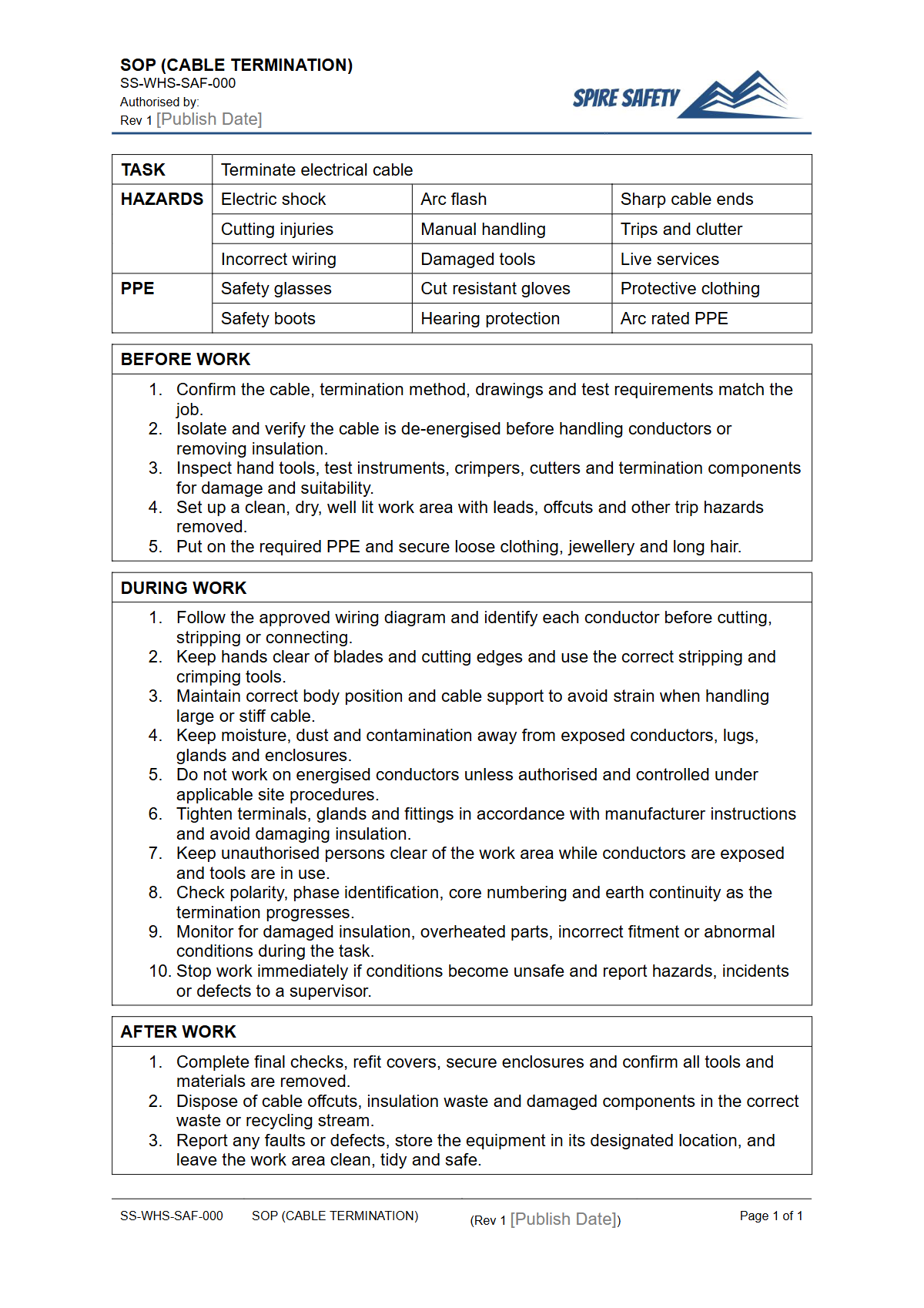
Download our free Safe Operating Procedure (Cable Termination) template. This DOCX and PDF resource provides a structured starting point for electrical safety.
Free Safe Operating Procedure (Cable Termination) Template
DOCX • 126 KB + PDF
Updated Oct 2026
No signup required
Purpose of the Free Safe Operating Procedure (Cable Termination) Template
Cable termination is a high-risk activity that requires precision, skill, and a deep understanding of electrical safety principles. Our Free Safe Operating Procedure (Cable Termination) Template provides a structured framework to help organisations document a safe and consistent method for this critical task.
The purpose of an SOP is to standardise procedures, minimise risk, and provide clear instructions to competent workers. By outlining hazards such as electric shock, arc flash, and fire, and detailing the necessary control measures, this template serves as a vital tool in your electrical safety management system.
Video walkthrough
How to use the Free Safe Operating Procedure (Cable Termination) Template
This resource is available as a fully editable DOCX file and a print-ready PDF. To use it, simply download the file and adapt the content to your specific operational context.
The template includes sections for outlining required PPE, pre-start checks, step-by-step instructions for the termination process, and emergency response actions. Integrating customised SOPs like this one is a key part of building robust WHS management systems that protect workers and ensure operational consistency.
Important: This document is a template only. We have provided a comprehensive starting point, but you must customise it to reflect the specific equipment, materials, personnel, and unique risks of your workplace.
The final SOP should be reviewed and approved by a competent person before implementation.
When to use a Cable Termination SOP
A formal Safe Operating Procedure for cable termination should be used for any task involving the connection of electrical cables to terminals, equipment, or other cables. This applies across numerous industries, including construction, manufacturing, mining, utilities, and data centres.
Whether for new installations, routine maintenance, fault finding, or equipment upgrades, an SOP ensures the work is performed to a consistent safety standard every time. For tasks that involve working at heights, this procedure should be used in conjunction with other task-specific documents, such as our free Step Ladder SOP.
Who should use it
This template is designed for use by WHS managers, supervisors, and business owners responsible for developing and implementing safe work systems. The procedure itself should be followed by competent persons only—typically licensed electricians or trained electrical workers with the requisite skills and experience to perform the task safely. If your organisation needs assistance defining competency requirements or developing safety documentation, you may benefit from seeking expert WHS consulting.
Key Hazards and Control Measures
Cable termination presents several significant hazards that must be effectively controlled. This template prompts you to identify and address risks including:
- Electric Shock & Arc Flash: Controlled through isolation, lockout-tagout (LOTO) procedures, and verifying de-energisation with appropriate test equipment.
- Fire & Explosions: Mitigated by ensuring correct, secure connections that prevent overheating and using components rated for the application.
- Cuts & Lacerations: Managed by using correct and well-maintained stripping tools and wearing appropriate cut-resistant gloves.
- Musculoskeletal Injury: Addressed through ergonomic workstation setup and planning to avoid sustained awkward postures.
In environments where metalwork occurs alongside electrical work, it's crucial to have clear procedures for all high-risk equipment. For example, our free Plasma Cutter SOP helps manage the unique risks of that task.
Training and Competency
An SOP is not a substitute for proper training. All personnel required to perform cable termination must be demonstrably competent.
This includes holding relevant electrical licenses, understanding the specific termination techniques for different cable and connector types, and being fully trained on the finalised SOP. Records of training and competency assessments should be maintained.
This document is one of many tools available in our free WHS resources library to help support your safety objectives.
Common mistakes
Common mistakes to avoid
- Failing to correctly de-energise, lock out, and test the circuit before starting work.
- Using incorrect tools or connectors for the specific type and size of cable being terminated.
- Neglecting to wear appropriate electrical PPE, such as insulated gloves and arc-rated eye protection.
- Not ensuring the connection is mechanically secure and electrically sound, leading to overheating and potential failure.
Legal references
Legal considerations
The following legal requirements may be relevant to this type of work.
- Work Health and Safety Act (Harmonised) — Provides the primary duties for protecting workers and other people from work health and safety risks.
- Work Health and Safety Regulations (Harmonised) — Sets out requirements supporting the management of workplace hazards and risks.
The following codes may be relevant to this type of work.
- Managing WHS Risks Code of Practice — Provides practical guidance on identifying hazards, assessing risks and applying effective controls.
- Work Health and Safety Consultation, Cooperation and Coordination Code of Practice — Provides practical guidance on consulting workers and coordinating with other duty holders.
- Managing the Work Environment and Facilities Code of Practice — Provides practical guidance on safe work environments, workplace facilities and related controls.
Did you know
Loose Connections
A significant percentage of electrical fires are caused by faulty or loose electrical connections. Proper termination technique is a critical fire prevention measure in any installation.
Test Before You Touch
The 'test before you touch' principle is fundamental in electrical safety. Always using a properly functioning and rated voltage tester to verify de-energisation can prevent catastrophic injury.
FAQ
Frequently asked questions
01Is an SOP legally required for cable termination in Australia?
02What are the biggest hazards in cable termination?
03Who is considered a 'competent person' to perform cable termination?
04How often should our cable termination SOP be reviewed?
Share this resource
Free Safe Operating Procedure (Cable Termination) Template
Browse Categories
How To Use It
- 1Download and open in Word or PDF.
- 2Replace the placeholders with your business details.
- 3Get it reviewed by a WHS specialist before rollout.
Need it customised?
Our WHS consultants can adapt this template to your site, run a gap analysis, or audit what you already have in place.
Book a Free Consultation WHS consulting servicesor call 1300 156 382
Related templates
- Free Safe Operating Procedure (Cable Winch) Template
- Free Safe Operating Procedure (Cage Cleaning) Template
- Free Safe Operating Procedure (Calendar Machine) Template
- Free Safe Operating Procedure (Call Bell Cord Check) Template
- Free Safe Operating Procedure (Call Bell Testing) Template
- Free Safe Operating Procedure (Can Opener Use) Template