
Free Safe Operating Procedure (Cable Puller) Template
Download our free Safe Operating Procedure (Cable Puller) template.
Free Safe Operating Procedure (Cable Puller) Template
DOCX • 126 KB + PDF
Updated Oct 2026
No signup required
Purpose of the Free Safe Operating Procedure (Cable Puller) Template
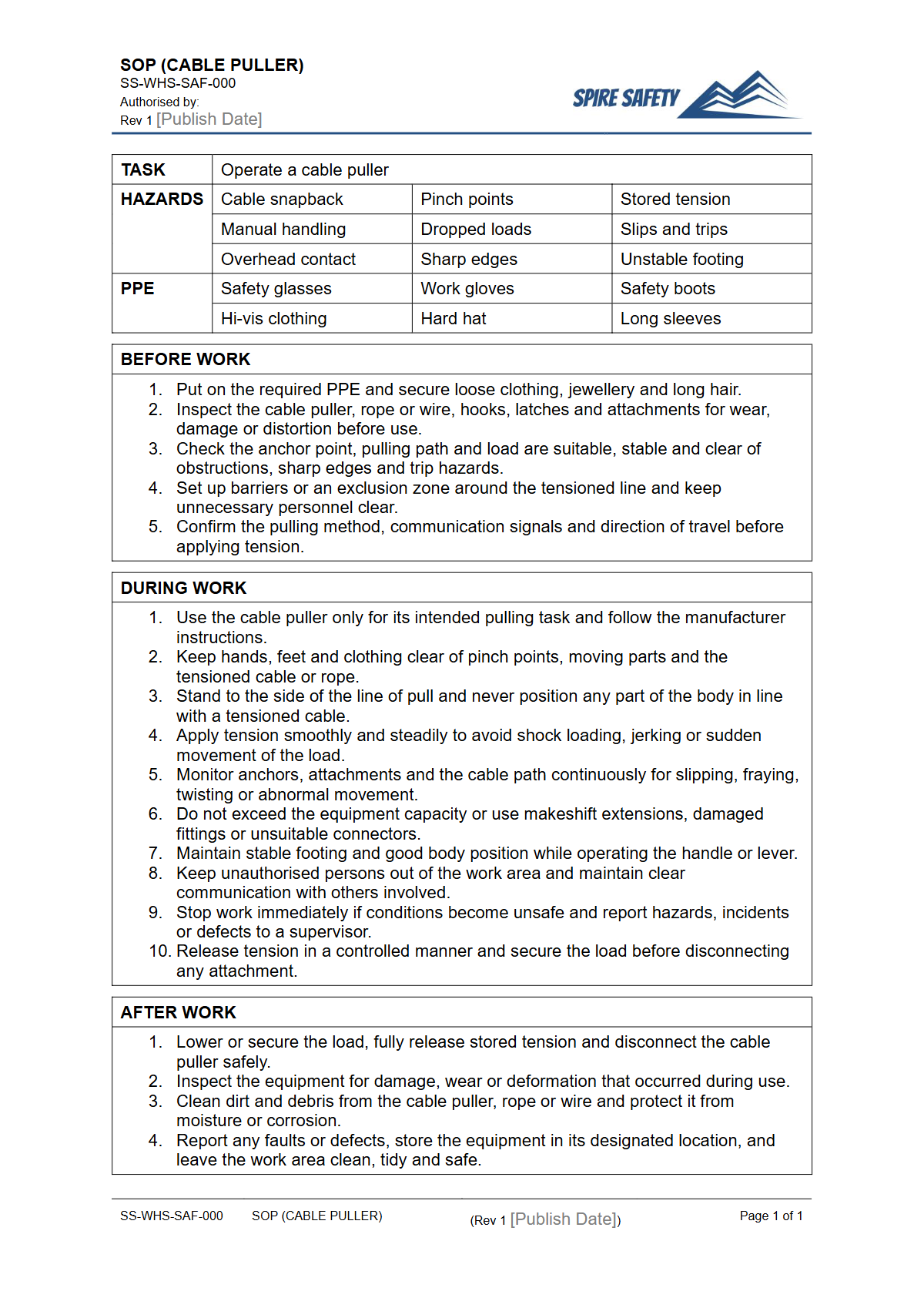
Operating a cable puller, whether manual, hydraulic, or electric, involves significant risks. These include entanglement, high-tension line snapping, electrical hazards, and musculoskeletal injuries.
A formal Safe Operating Procedure (SOP) is a critical administrative control for managing these hazards. This template provides a structured starting point for your organisation to document the step-by-step requirements for safely setting up, operating, and packing up cable pulling equipment.
It helps formalise safe work practices, ensures consistency in training, and demonstrates a commitment to managing workplace risks. Properly developed SOPs are a cornerstone of effective WHS management systems, providing clear instructions to workers and supervisors.
Video walkthrough
How to use the Free Safe Operating Procedure (Cable Puller) Template
This document is a template and is not a completed SOP. You must customise it to reflect the specific equipment, environment, and risks present in your workplace.
To use it, simply download the DOCX file and open it in your preferred word processor.
- Review Each Section: Go through the pre-filled sections, including PPE requirements, pre-start checks, operational steps, and emergency procedures.
- Add Site-Specific Details: Insert information about your specific cable puller model, the types of cables being installed, and unique environmental factors at your site. For instance, if cable pulling is done in conjunction with excavation, you may need to integrate procedures from a free Trencher SOP template.
- Consult with Workers: Involve the operators who will be using the equipment. Their practical experience is invaluable for creating a procedure that is both safe and workable.
- Approve and Train: Once finalised, the SOP should be formally approved by management. All relevant personnel must be trained on its contents before undertaking any cable pulling tasks.
Important Note: We have provided this template as a guide. It is the responsibility of the Person Conducting a Business or Undertaking (PCBU) to ensure the final document is tailored to their specific operations and meets all relevant WHS obligations.
When to use a Cable Puller SOP
A Cable Puller SOP should be an active part of your daily operations, not just a document that sits on a shelf. It should be used:
- During worker induction and training: To ensure new operators understand the correct and safe method for using the equipment.
- For pre-task planning and risk assessments: As a reference during toolbox talks or when planning a specific high-risk pull.
- As a refresher tool: For experienced operators to reinforce safe work habits and stay updated on procedures.
- During incident investigations: To determine if procedures were followed and identify areas for improvement.
The SOP also serves as crucial evidence of your safety processes during WHS compliance auditing, demonstrating that you have systematic approaches to managing plant and equipment risks.
Who should use this Safe Operating Procedure
This SOP is designed for use by various personnel within an organisation to ensure a unified approach to safety. Key users include:
- WHS Managers and Advisors: To develop, implement, and review safety documentation as part of the broader safety management system.
- Supervisors and Foremen: To train their teams, conduct pre-start checks, and oversee the safe execution of cable pulling tasks.
- Equipment Operators: As a direct, step-by-step guide for performing their work safely. Their input is also vital for ensuring the procedure is practical and effective.
- Training Coordinators: To form the basis of competency-based training and assessment programs for plant operation.
Just as you would have procedures for common equipment, like those detailed in our Free Air Compressor SOP, a specific SOP for cable pulling is essential for addressing its unique hazards. This ensures that every person involved in the task, from the planner to the operator, understands their role in maintaining a safe work environment.
Developing task-specific SOPs for all high-risk activities, from complex plant operation to simple tasks like using ladders, is a sign of a mature safety culture. You can find another example with our free Step Ladder SOP template to see how procedures can be adapted for different risk levels.
For a wider range of document templates and safety guides, explore our complete free WHS resources library.
Common mistakes
Common mistakes to avoid
- Using the wrong size or type of puller, rope, or sheave for the cable.
- Failing to thoroughly inspect ropes, winches, and anchor points for wear or damage before use.
- Not establishing clear, confirmed communication signals between the operator and spotters.
- Setting up the pulling equipment or anchor points on unstable or uneven ground.
Legal references
Legal considerations
The following legal requirements may be relevant to this type of work.
- Work Health and Safety Act (Harmonised) — Provides the primary duties for protecting workers and other people from work health and safety risks.
- Work Health and Safety Regulations (Harmonised) — Sets out requirements supporting the management of workplace hazards and risks.
The following codes may be relevant to this type of work.
- Managing WHS Risks Code of Practice — Provides practical guidance on identifying hazards, assessing risks and applying effective controls.
- Work Health and Safety Consultation, Cooperation and Coordination Code of Practice — Provides practical guidance on consulting workers and coordinating with other duty holders.
- Managing the Work Environment and Facilities Code of Practice — Provides practical guidance on safe work environments, workplace facilities and related controls.
Did you know
High-Tension Hazards
Cable pulling can generate immense tension. A snapping rope or cable can recoil with enough force to cause severe injury or death, which is why defined exclusion zones and pre-start equipment checks are critical.
FAQ
Frequently asked questions
01What is a Safe Operating Procedure for a cable puller?
02Why is an SOP important for cable pulling tasks?
03Who is responsible for creating a Cable Puller SOP?
04How often should a Cable Puller SOP be reviewed?
Share this resource
Free Safe Operating Procedure (Cable Puller) Template
Browse Categories
How To Use It
- 1Download and open in Word or PDF.
- 2Replace the placeholders with your business details.
- 3Get it reviewed by a WHS specialist before rollout.
Need it customised?
Our WHS consultants can adapt this template to your site, run a gap analysis, or audit what you already have in place.
Book a Free Consultation WHS consulting servicesor call 1300 156 382
Related templates
- Free Safe Operating Procedure (Cable Reel) Template
- Free Safe Operating Procedure (Cable Stripper) Template
- Free Safe Operating Procedure (Cable Tensioner) Template
- Free Safe Operating Procedure (Cable Termination) Template
- Free Safe Operating Procedure (Cable Winch) Template
- Free Safe Operating Procedure (Cage Cleaning) Template