
Free Safe Operating Procedure (Cable Stripper) Template
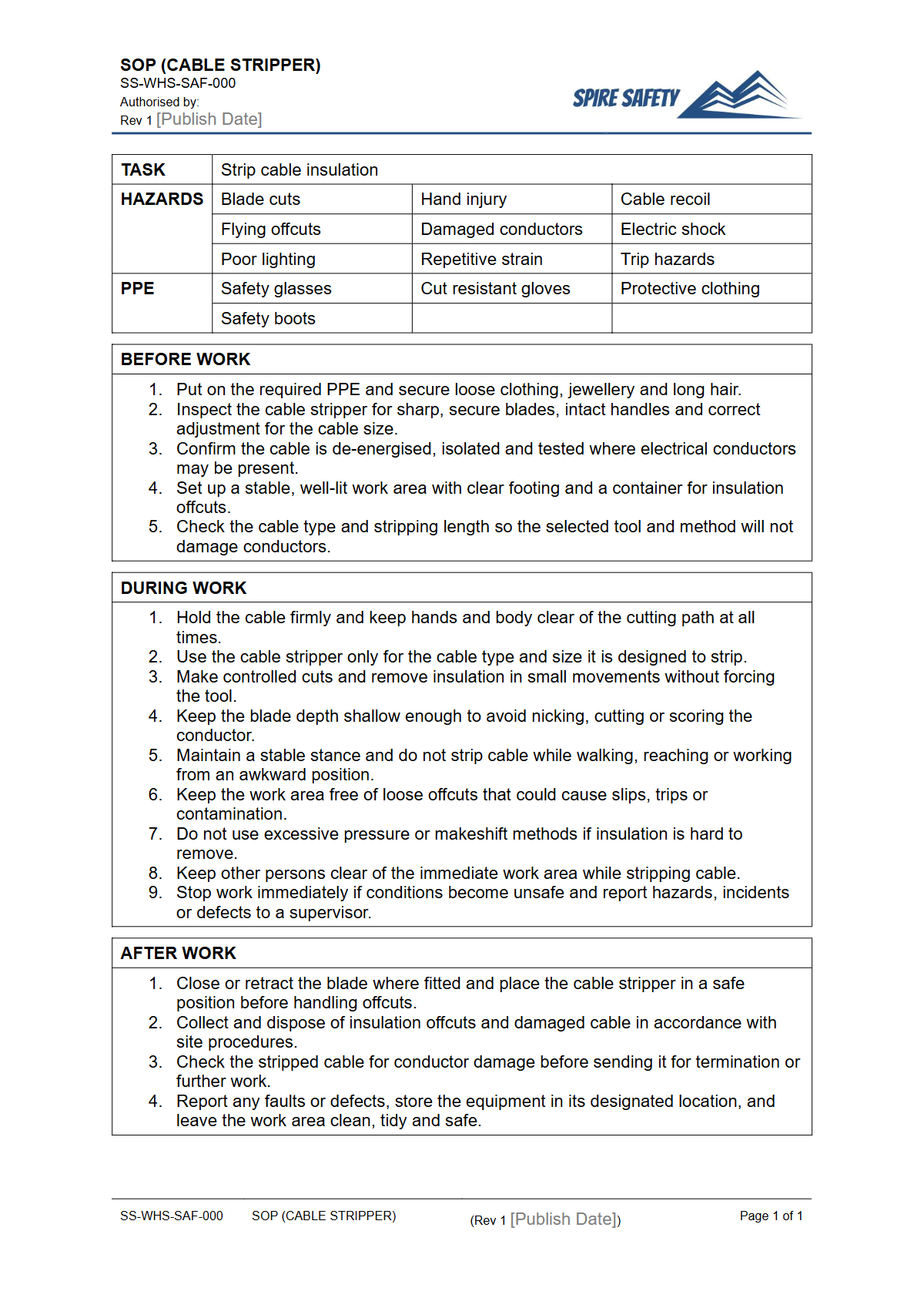
Download our free Safe Operating Procedure (Cable Stripper) Template. This user-friendly DOCX and PDF resource helps you outline safe work steps.
Free Safe Operating Procedure (Cable Stripper) Template
DOCX • 126 KB + PDF
Updated Oct 2026
No signup required
Purpose of the Free Safe Operating Procedure (Cable Stripper) Template
Operating a cable stripper, whether a small handheld tool or a larger bench-mounted machine, presents significant hazards, including cuts, lacerations, and electrical shock. This Free Safe Operating Procedure (Cable Stripper) Template provides a structured framework for documenting the safest way to perform this task.
A well-drafted Safe Operating Procedure (SOP) is a fundamental tool for risk management. It clearly outlines step-by-step instructions, required personal protective equipment (PPE), and emergency procedures, helping to ensure workers understand and follow established safety protocols. Implementing robust SOPs is a critical part of a comprehensive WHS management system.
Video walkthrough
How to use the Free Safe Operating Procedure (Cable Stripper) Template
This template is designed to be a practical starting point. Simply download the DOCX or PDF file and fill in the sections with information specific to your workplace.
This includes the exact model of cable stripper used, the types of cables being processed, and the unique environmental conditions of your site. It is crucial to conduct a site-specific risk assessment to identify all potential hazards and implement effective controls.
Much like using specialised equipment requires specific procedures, such as those detailed in our FREE Plasma Cutter SOP (Safe Operating Procedure) Template, this document must be tailored to be effective.
Customising Your Safe Operating Procedure
A generic document is not sufficient to manage your safety obligations. It is vital that you adapt this template to your specific context.
During customisation, you should consult with the workers who actually operate the equipment. Their direct experience is invaluable for creating a procedure that is both safe and practical.
Please note: This template provides a solid foundation based on Australian WHS principles, but it is not a complete, out-of-the-box solution. We have developed it as a starting point, and you must customise it to reflect the specific cable stripper models, tasks, environment, and control measures unique to your workplace.
When to use a Cable Stripper Safe Operating Procedure
An SOP for cable stripping should be a core part of your operational and training framework. It should be used during the induction and training of new employees to ensure they understand the correct, safe methods from day one.
It also serves as a valuable on-the-job reference for all workers, reinforcing safe behaviour and providing clear instructions. Furthermore, the SOP should be a key document for refresher training, especially if a new type of machine is introduced or after an incident or near miss has occurred. For tasks that may involve working at various heights or locations, it's also important to have procedures for associated equipment, as outlined in our FREE Step Ladder SOP Template.
Who should use this Safe Operating Procedure
This document is intended for a range of personnel within an organisation. Primarily, it is for the operators of cable stripping equipment, providing them with clear guidance to perform their work safely.
Supervisors and managers should use the SOP to oversee work, conduct safety observations, and ensure that procedures are being followed correctly. WHS managers and safety representatives will find the template useful for developing and reviewing risk assessments and safe work systems.
The effectiveness of these implemented procedures can be verified through a systematic process like a WHS compliance auditing program.
What to Include in Your SOP
When customising this template, ensure you include the following key information:
- Hazard Identification: List all potential hazards, such as sharp blades, electrical energy, moving parts, noise, and ergonomic strains.
- Pre-operational Checks: Detail the inspections required before each use, including checking blade condition, guard integrity, and electrical cord safety.
- Personal Protective Equipment (PPE): Specify mandatory PPE, such as cut-resistant gloves, safety glasses or a face shield, and appropriate footwear.
- Step-by-Step Operating Guide: Provide a clear, sequential list of actions for safely setting up, operating, and shutting down the machine.
- Post-operational Tasks: Outline procedures for cleaning the machine, waste disposal, and storing the equipment correctly.
- Emergency Procedures: Describe the immediate actions to take in case of an injury, electrical shock, or machine malfunction.
By tailoring your procedures, you create a document that is relevant and effective. This approach ensures that the controls match the risks present in your workplace, similar to how you would define safe use for other high-risk tools detailed in a FREE Circular Saw SOP (Safe Operating Procedure) Template. This template is just one of many professional documents available in our free WHS resources library, designed to help you build a safer workplace.
Common mistakes
Common mistakes to avoid
- Using the wrong size stripping tool for the cable gauge, damaging the conductor and creating a fire or shock hazard.
- Failing to inspect the tool for worn or damaged blades before use, leading to poor cuts and increased physical effort.
- Not wearing appropriate personal protective equipment (PPE), especially safety glasses and cut-resistant gloves.
- Attempting to strip energised cables without following strict lockout-tagout and isolation procedures.
Legal references
Legal considerations
The following legal requirements may be relevant to this type of work.
- Work Health and Safety Act (Harmonised) — Provides the primary duties for protecting workers and other people from work health and safety risks.
- Work Health and Safety Regulations (Harmonised) — Sets out requirements supporting the management of workplace hazards and risks.
The following codes may be relevant to this type of work.
- Managing WHS Risks Code of Practice — Provides practical guidance on identifying hazards, assessing risks and applying effective controls.
- Work Health and Safety Consultation, Cooperation and Coordination Code of Practice — Provides practical guidance on consulting workers and coordinating with other duty holders.
- Managing the Work Environment and Facilities Code of Practice — Provides practical guidance on safe work environments, workplace facilities and related controls.
Did you know
Electrical Risks
Electrical shock is a primary hazard when stripping live or potentially live cables. Even with insulation, faulty equipment or accidental contact can pose a serious or fatal risk without proper lockout-tagout procedures.
Ergonomic Hazards
Repetitive strain injuries (RSIs) can be a significant risk for workers who manually strip large quantities of cable without proper ergonomic tools, adequate breaks, or correct techniques.
FAQ
Frequently asked questions
01What should be included in a Cable Stripper SOP?
02Is a Safe Operating Procedure a legal requirement in Australia?
03How often should a Cable Stripper SOP be reviewed?
04Can this template be used for all types of cable strippers?
Share this resource
Free Safe Operating Procedure (Cable Stripper) Template
Browse Categories
How To Use It
- 1Download and open in Word or PDF.
- 2Replace the placeholders with your business details.
- 3Get it reviewed by a WHS specialist before rollout.
Need it customised?
Our WHS consultants can adapt this template to your site, run a gap analysis, or audit what you already have in place.
Book a Free Consultation WHS consulting servicesor call 1300 156 382
Related templates
- Free Safe Operating Procedure (Cable Tensioner) Template
- Free Safe Operating Procedure (Cable Termination) Template
- Free Safe Operating Procedure (Cable Winch) Template
- Free Safe Operating Procedure (Cage Cleaning) Template
- Free Safe Operating Procedure (Calendar Machine) Template
- Free Safe Operating Procedure (Call Bell Cord Check) Template