
Free Safe Operating Procedure (Cable Jointing) Template
Download our free Safe Operating Procedure (Cable Jointing) template.
Free Safe Operating Procedure (Cable Jointing) Template
DOCX • 126 KB + PDF
Updated Oct 2026
No signup required
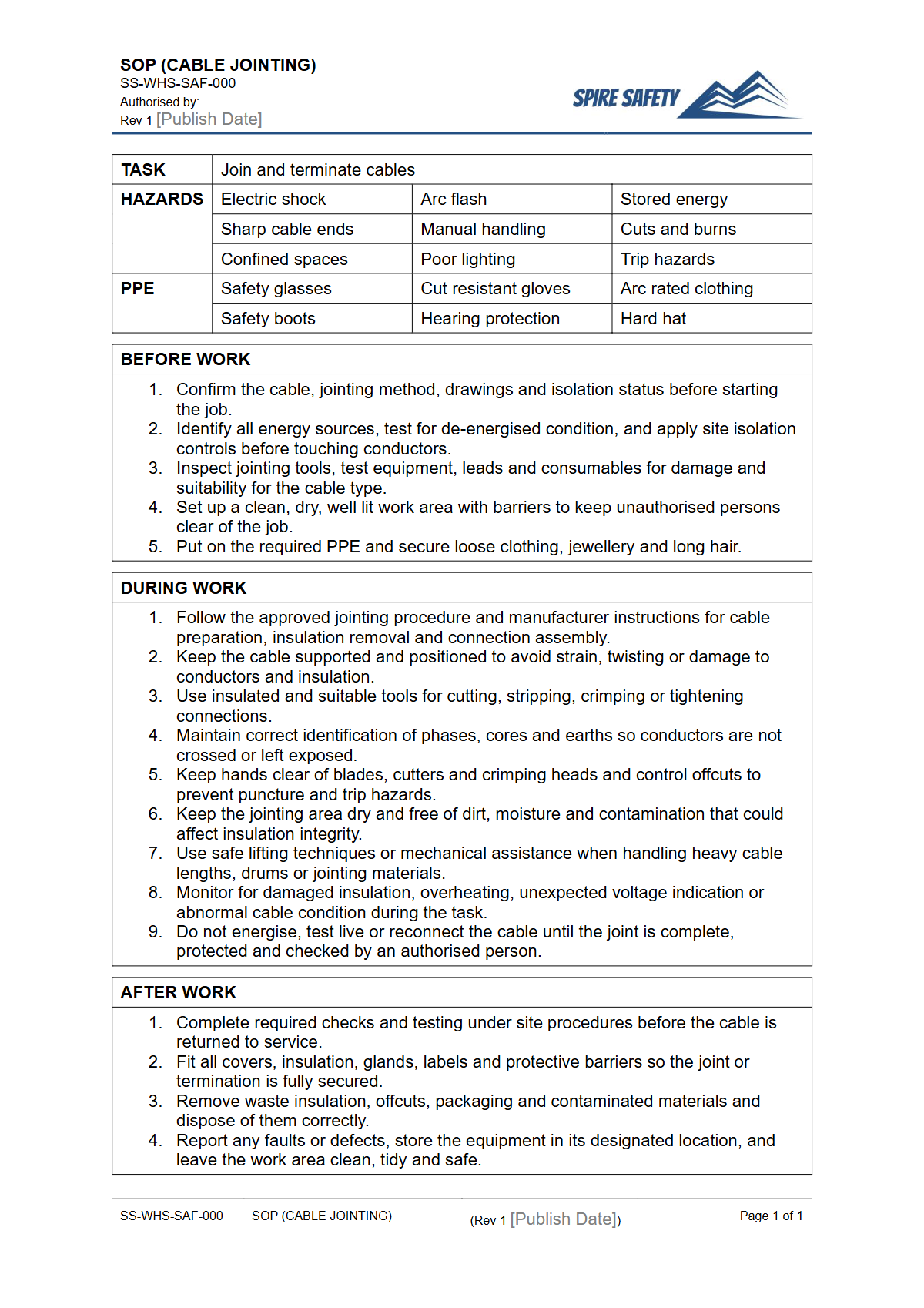
Purpose of the Free Safe Operating Procedure (Cable Jointing) Template
Managing the significant risks associated with electrical work is a critical responsibility for any PCBU. This Free Safe Operating Procedure (Cable Jointing) Template provides a structured starting point for documenting the step-by-step process required to perform cable jointing safely.
A well-drafted SOP is a fundamental tool for ensuring high-risk tasks are performed consistently and safely, every time.
Cable jointing involves inherent dangers, including electric shock, arc flash, burns, and exposure to hazardous substances. This Safe Operating Procedure template is designed to help your organisation formalise controls for these risks.
It prompts you to detail essential steps, from initial risk assessment and site preparation through to the final testing and commissioning, ensuring workers have clear, unambiguous instructions to follow. Using a standardised procedure helps reduce the likelihood of incidents, demonstrates due diligence, and supports worker training and competency management.
Video walkthrough
How to use the Free Safe Operating Procedure (Cable Jointing) Template
This document is a template that must be customised to your specific workplace. After downloading the DOCX or PDF file, you should adapt it to reflect the unique context of your operations.
This involves detailing the specific types of cables (e.g., LV, MV), jointing systems (e.g., heat shrink, cold shrink, resin), tools, and testing equipment used by your team.
You must also incorporate site-specific information, such as emergency procedures, contact personnel, and any particular environmental hazards. An SOP is most effective when developed in consultation with the workers who will be performing the task.
Integrating these procedures is a core part of developing robust WHS management systems that protect your people and your business.
Customisation Note
Important: This document is a template and is not a substitute for professional WHS advice. We strongly recommend that you customise this SOP to reflect the specific equipment, environment, and personnel at your workplace.
The final responsibility for health and safety rests with the PCBU.
When to use a Cable Jointing SOP
A Safe Operating Procedure for cable jointing should be used as a primary reference document for all personnel involved in the task. It should be readily accessible at the work site and integrated into your daily operations. Key times to use the SOP include:
- Worker Training: As a core part of training and competency verification for new or existing electricians.
- Pre-Start Meetings: To review the steps and associated hazards before work commences.
- Task Execution: As a step-by-step guide for workers to follow during the jointing process.
- Audits and Inspections: As evidence of a formalised safety process during internal or external WHS compliance auditing.
- Incident Investigations: To help determine if procedures were followed and identify areas for improvement.
Who should use this SOP
This SOP should be used by several key roles within an organisation to ensure a comprehensive approach to safety:
- Competent Electrical Workers: Licensed electricians and cable jointers performing the task must use the SOP as their primary guide.
- Supervisors and Team Leaders: To oversee work, conduct pre-start briefings, and ensure procedures are followed correctly.
- WHS Managers/Officers: To integrate the SOP into the broader safety management system, use it for risk assessments, and manage document review cycles.
- PCBUs (Persons Conducting a Business or Undertaking): To fulfil their duty of care by providing safe systems of work. For organisations needing assistance in defining roles and responsibilities, engaging specialist WHS consulting can provide valuable clarity.
Before any jointing work begins in an excavated area, the ground and access must be made safe. If trenching is required, you may also need a corresponding FREE Trencher SOP Template to manage associated risks like ground collapse.
We offer a wide range of templates in our free WHS resources library to help you build out your safety documentation.
Common mistakes
Common mistakes to avoid
- Failing to de-energise and follow lock-out/tag-out (LOTO) procedures before starting work.
- Neglecting to test for dead before touching any conductor or component.
- Using incorrect or damaged tools, and failing to use calibrated testing equipment.
- Not wearing the correct personal protective equipment (PPE), especially arc-rated clothing and insulated gloves.
Legal references
Legal considerations
The following legal requirements may be relevant to this type of work.
- Work Health and Safety Act (Harmonised) — Provides the primary duties for protecting workers and other people from work health and safety risks.
- Work Health and Safety Regulations (Harmonised) — Sets out requirements supporting the management of workplace hazards and risks.
The following codes may be relevant to this type of work.
- Managing WHS Risks Code of Practice — Provides practical guidance on identifying hazards, assessing risks and applying effective controls.
- Work Health and Safety Consultation, Cooperation and Coordination Code of Practice — Provides practical guidance on consulting workers and coordinating with other duty holders.
- Managing the Work Environment and Facilities Code of Practice — Provides practical guidance on safe work environments, workplace facilities and related controls.
Did you know
Arc Flash Danger
The temperature of an electrical arc flash can reach up to 20,000°C, which is four times hotter than the surface of the sun. Proper procedures and arc-rated PPE are critical to preventing catastrophic burns.
Consultation is Law
Under Australian model WHS laws, PCBUs have a legal duty to consult with workers on health and safety matters. This includes collaborating on the development and review of Safe Operating Procedures.
FAQ
Frequently asked questions
01What is the difference between a SWMS and an SOP for cable jointing?
02Is this template suitable for high voltage (HV) cable jointing?
03Who is responsible for creating a Safe Operating Procedure?
04How often should a cable jointing SOP be reviewed?
Share this resource
Free Safe Operating Procedure (Cable Jointing) Template
Browse Categories
How To Use It
- 1Download and open in Word or PDF.
- 2Replace the placeholders with your business details.
- 3Get it reviewed by a WHS specialist before rollout.
Need it customised?
Our WHS consultants can adapt this template to your site, run a gap analysis, or audit what you already have in place.
Book a Free Consultation WHS consulting servicesor call 1300 156 382
Related templates
- Free Safe Operating Procedure (Cable Locator) Template
- Free Safe Operating Procedure (Cable Puller) Template
- Free Safe Operating Procedure (Cable Reel) Template
- Free Safe Operating Procedure (Cable Stripper) Template
- Free Safe Operating Procedure (Cable Tensioner) Template
- Free Safe Operating Procedure (Cable Termination) Template