
Free Safe Operating Procedure (Cable Drum Stand) Template
Download our Free Safe Operating Procedure (Cable Drum Stand) Template (DOCX & PDF).
Free Safe Operating Procedure (Cable Drum Stand) Template
DOCX • 126 KB + PDF
Updated Oct 2026
No signup required
Purpose of the Free Safe Operating Procedure (Cable Drum Stand) Template
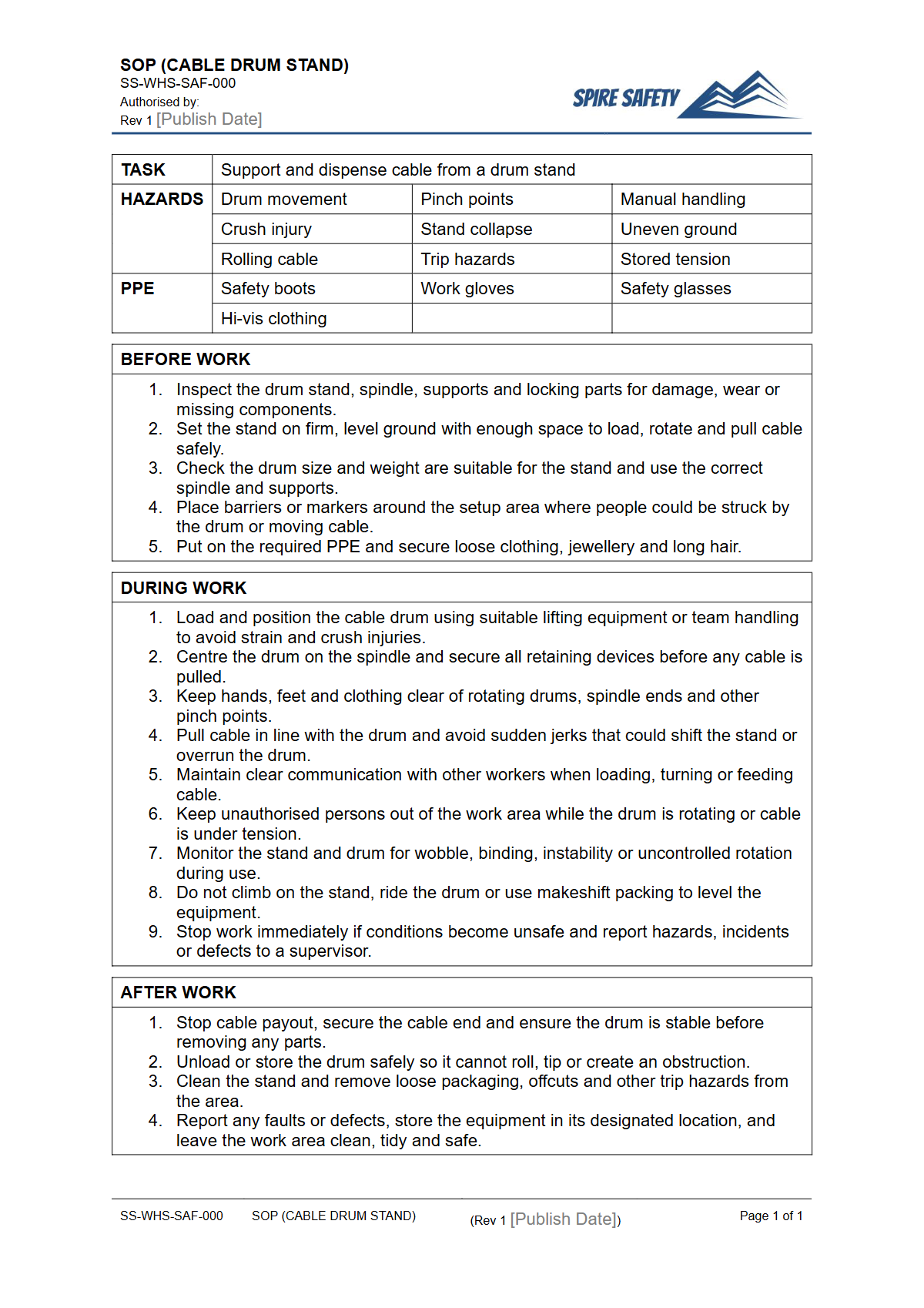
Using cable drum stands introduces significant workplace risks, including crush injuries, strains from manual handling, and instability on uneven ground. This Free Safe Operating Procedure (Cable Drum Stand) Template provides a structured starting point for documenting a safe system of work to manage these hazards.
It is designed to assist your organisation in outlining the necessary steps, control measures, and responsibilities for the safe setup, use, and dismantling of cable drum stands. By formalising your process, you create a consistent, repeatable, and trainable method for performing the task, which is a key component of any effective safety management system.
A well-developed Safe Operating Procedure (SOP) is more than just a document; it's a critical tool for worker training, incident investigation, and continuous improvement. It helps a Person Conducting a Business or Undertaking (PCBU) demonstrate due diligence in managing risks.
The procedure should be reviewed regularly and updated as needed, a process often validated through periodic WHS compliance auditing to ensure its ongoing effectiveness.
Video walkthrough
How to use the Free Safe Operating Procedure (Cable Drum Stand) Template
To implement this resource, download the DOCX or PDF file and adapt it to the specific context of your worksite. A generic document cannot account for all variables, so consultation and customisation are critical.
Follow a process of identifying hazards, assessing risks, and implementing control measures specific to your environment, equipment, and the tasks your workers perform. This process ensures the final SOP is a practical and relevant document that workers will understand and follow.
Important: This document is a template and not a finished Safe Operating Procedure. As we have not assessed your specific workplace, equipment, or operational risks, you are responsible for ensuring the final document is suitable for your needs.
We strongly recommend you consult with your workers and other relevant stakeholders during customisation. A tailored SOP should be integrated into your broader WHS management system to ensure it is properly managed, communicated, and reviewed.
When to use a Cable Drum Stand SOP
A Safe Operating Procedure for cable drum stands should be developed and implemented before any worker is required to use the equipment. It is not just for high-risk construction or electrical sites; any workplace that handles large cable drums should have a documented procedure.
Use this SOP as a central document for worker inductions, pre-start meetings, and toolbox talks to reinforce safe work practices. It is also an essential reference tool during task planning and should be readily accessible to all workers involved in the activity.
If you use other heavy equipment to move drums, such as a telehandler, you will need separate procedures like our FREE Telehandler SOP template to cover its operation.
Who should use this procedure
This Safe Operating Procedure is intended for use by all personnel involved with cable drum stands. This includes:
- Workers: To understand and follow the established safe work method.
- Supervisors and Team Leaders: To induct, train, and monitor workers, ensuring the procedure is being followed correctly.
- WHS/HSE Professionals: To use as a baseline for developing a site-specific procedure as part of the overall safety framework.
- Project Managers: To ensure that tasks involving cable drums are planned with safety as a priority.
If your organisation lacks the internal expertise to adapt and implement this template effectively, seeking external guidance can provide clarity and assurance. Engaging professionals for expert WHS consulting can help bridge knowledge gaps and ensure your safety systems are practical and robust.
The principles of risk assessment apply to all equipment, not just heavy items. For example, even simple equipment requires a documented safe process, which is why we also provide resources like our free Step Ladder SOP. The fundamental process of identifying hazards and outlining safe steps remains the same.
Similarly, while cable drum stands are manually positioned, the risks associated with heavy, powerful machinery are covered in separate documents such as our free Dozer SOP, highlighting the need for equipment-specific procedures.
Common mistakes
Common mistakes to avoid
- Using stands on soft or uneven ground without adequate support plates.
- Exceeding the specified Safe Working Load (SWL) of the stands or the spindle bar.
- Using damaged or non-compatible components (e.g., different stand models, bent spindle).
- Failing to establish an exclusion zone around the setup area during loading and operation.
Legal references
Legal considerations
The following legal requirements may be relevant to this type of work.
- Work Health and Safety Act (Harmonised) — Provides the primary duties for protecting workers and other people from work health and safety risks.
- Work Health and Safety Regulations (Harmonised) — Sets out requirements supporting the management of workplace hazards and risks.
The following codes may be relevant to this type of work.
- Managing WHS Risks Code of Practice — Provides practical guidance on identifying hazards, assessing risks and applying effective controls.
- Work Health and Safety Consultation, Cooperation and Coordination Code of Practice — Provides practical guidance on consulting workers and coordinating with other duty holders.
- Managing the Work Environment and Facilities Code of Practice — Provides practical guidance on safe work environments, workplace facilities and related controls.
Did you know
Unseen Forces
A fully loaded cable drum can weigh several tonnes. Even on a slight incline, the potential energy is immense, and a failure of the stand or braking system can result in an uncontrolled release of the drum.
FAQ
Frequently asked questions
01What is a Safe Operating Procedure for a cable drum stand?
02Why are cable drum stands a WHS risk?
03Who is responsible for writing the Cable Drum Stand SOP?
04Does this template meet Australian WHS standards?
Share this resource
Free Safe Operating Procedure (Cable Drum Stand) Template
Browse Categories
How To Use It
- 1Download and open in Word or PDF.
- 2Replace the placeholders with your business details.
- 3Get it reviewed by a WHS specialist before rollout.
Need it customised?
Our WHS consultants can adapt this template to your site, run a gap analysis, or audit what you already have in place.
Book a Free Consultation WHS consulting servicesor call 1300 156 382
Related templates
- Free Safe Operating Procedure (Cable Jetting) Template
- Free Safe Operating Procedure (Cable Jointing) Template
- Free Safe Operating Procedure (Cable Locator) Template
- Free Safe Operating Procedure (Cable Puller) Template
- Free Safe Operating Procedure (Cable Reel) Template
- Free Safe Operating Procedure (Cable Stripper) Template