
Free Safe Operating Procedure (Cable Jetting) Template
Download our free Safe Operating Procedure (Cable Jetting) template.
Free Safe Operating Procedure (Cable Jetting) Template
DOCX • 126 KB + PDF
Updated Oct 2026
No signup required
Purpose of the Free Safe Operating Procedure (Cable Jetting) Template
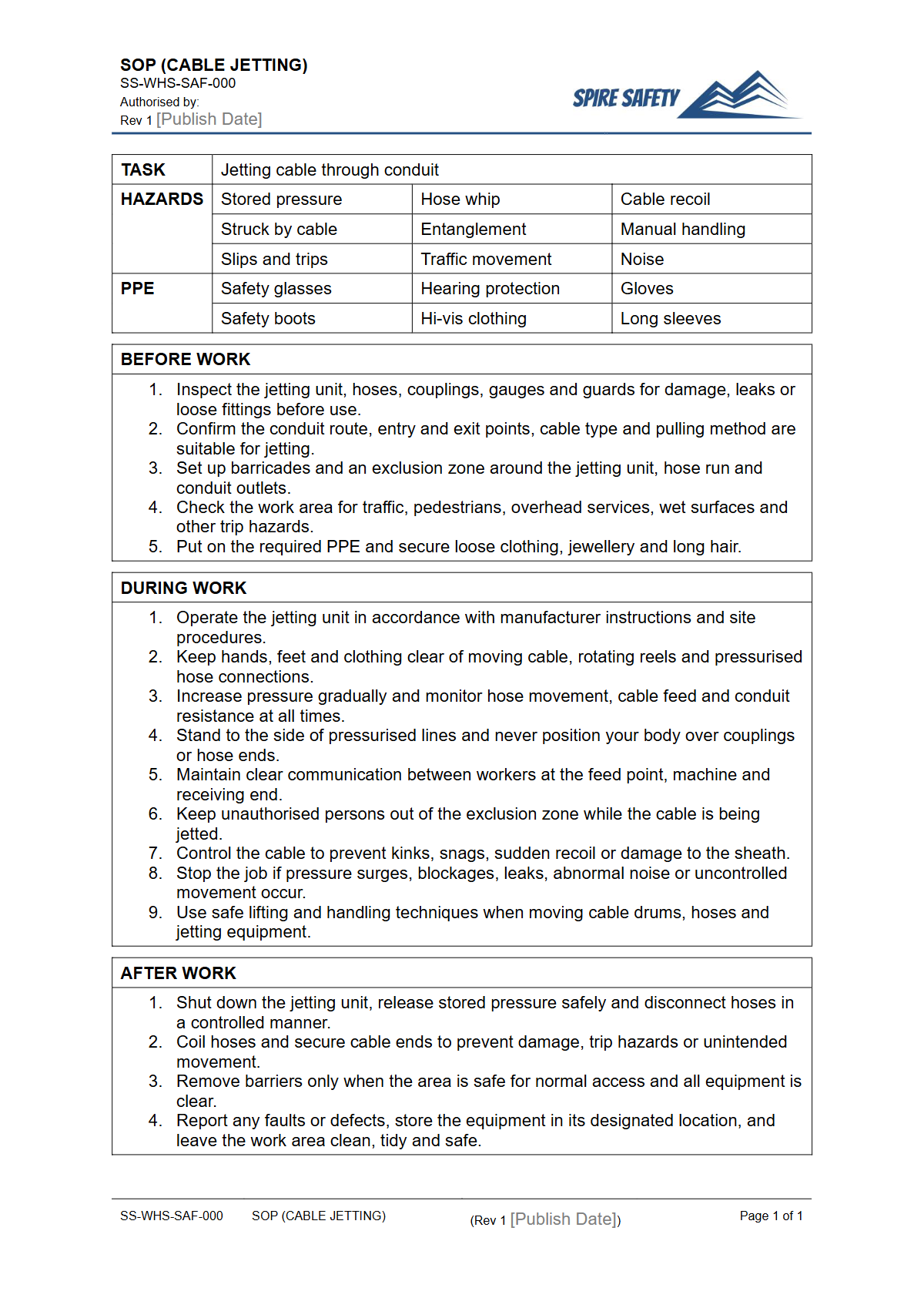
This free Safe Operating Procedure (Cable Jetting) template provides a structured foundation for documenting the safety requirements for installing fibre optic or other cables into underground conduits. Using high-pressure air or water, cable jetting presents significant risks that must be managed through a formal, documented process.
This SOP template is designed to help you outline the step-by-step process for performing the task safely, from pre-start checks through to operation and shutdown.
A well-developed SOP is a critical control measure for managing hazards such as high-pressure fluid injection, entanglement with the cable or drum, noise exposure, and interaction with traffic. It serves as a key component of your overall safety framework, helping you meet your duties under Australian WHS legislation.
Integrating clear procedures like this one is a fundamental part of building robust WHS management systems that protect workers and ensure operational consistency.
Video walkthrough
How to use the Free Safe Operating Procedure (Cable Jetting) Template
This document is a template and must be adapted to your specific operational context. To use this Free Safe Operating Procedure (Cable Jetting) Template effectively, download the DOCX file and begin customising it in consultation with your workers and supervisors.
This collaborative process ensures the procedure is practical, relevant, and reflects the actual work being performed.
Key customisation steps include:
- Identifying the specific make and model of the cable jetting machine and any associated equipment, such as air compressors.
- Conducting a site-specific risk assessment to identify all potential hazards and documenting the agreed-upon control measures.
- Detailing the required Personal Protective Equipment (PPE), such as hearing protection, eye protection, and high-visibility clothing.
- Including site-specific rules, such as traffic management plans, emergency procedures, and communication protocols.
- Securing sign-off from management and ensuring all relevant personnel are trained on the final, approved version.
Please note: this is a template document. We have developed it as a starting point, but you must customise it to reflect the specific hazards, equipment, and environment of your workplace.
When to use a Safe Operating Procedure
An SOP for cable jetting should be used as a primary reference document for several key activities. It is essential for training new operators and for conducting refresher training for experienced staff.
The SOP should be readily available at the worksite for workers to reference before and during the task. It also forms a critical part of pre-start meetings and task planning, ensuring everyone involved understands the risks and safety protocols.
Furthermore, a current SOP is an invaluable tool during incident investigations and safety audits, helping to identify any gaps between documented procedures and actual work practices. For related excavation tasks that often precede cable jetting, using a FREE Trencher SOP Template can provide similar procedural guidance.
Who should use this Safe Operating Procedure
This Safe Operating Procedure template is intended for use by a range of personnel within an organisation. Persons Conducting a Business or Undertaking (PCBUs) can use it to help fulfil their duty of care to provide safe systems of work.
Managers and supervisors should use it to train, monitor, and instruct workers effectively. Health and Safety Representatives (HSRs) can use it as a reference during workplace inspections and consultations.
Most importantly, operators of cable jetting equipment must use the finalised SOP as their guide to performing the work safely and correctly. For work involving the delivery and setup of heavy machinery, a FREE Body Truck SOP Template can help standardise associated vehicle movements.
The effectiveness of these procedures can be verified through a systematic WHS compliance auditing process, ensuring they are being followed correctly in the field.
Common mistakes
Common mistakes to avoid
- Using a generic template without adding site-specific hazards and controls.
- Failing to conduct and document pre-start checks on the jetting machine and compressor.
- Inadequate setup of exclusion zones to protect other workers and the public.
- Neglecting to train workers on the specific procedures outlined in the final SOP.
Legal references
Legal considerations
The following legal requirements may be relevant to this type of work.
- Work Health and Safety Act (Harmonised) — Provides the primary duties for protecting workers and other people from work health and safety risks.
- Work Health and Safety Regulations (Harmonised) — Sets out requirements supporting the management of workplace hazards and risks.
The following codes may be relevant to this type of work.
- Managing WHS Risks Code of Practice — Provides practical guidance on identifying hazards, assessing risks and applying effective controls.
- Work Health and Safety Consultation, Cooperation and Coordination Code of Practice — Provides practical guidance on consulting workers and coordinating with other duty holders.
- Managing the Work Environment and Facilities Code of Practice — Provides practical guidance on safe work environments, workplace facilities and related controls.
Did you know
Powerful Precision
Cable jetting machines can generate air or water pressures exceeding 10 bar (145 psi) to propel cables through conduits over distances of a kilometre or more.
FAQ
Frequently asked questions
01What are the primary hazards associated with cable jetting?
02Does a Safe Operating Procedure replace a risk assessment?
03How often should our Cable Jetting SOP be reviewed?
04Is specific training required in addition to an SOP?
Share this resource
Free Safe Operating Procedure (Cable Jetting) Template
Browse Categories
How To Use It
- 1Download and open in Word or PDF.
- 2Replace the placeholders with your business details.
- 3Get it reviewed by a WHS specialist before rollout.
Need it customised?
Our WHS consultants can adapt this template to your site, run a gap analysis, or audit what you already have in place.
Book a Free Consultation WHS consulting servicesor call 1300 156 382
Related templates
- Free Safe Operating Procedure (Cable Jointing) Template
- Free Safe Operating Procedure (Cable Locator) Template
- Free Safe Operating Procedure (Cable Puller) Template
- Free Safe Operating Procedure (Cable Reel) Template
- Free Safe Operating Procedure (Cable Stripper) Template
- Free Safe Operating Procedure (Cable Tensioner) Template